
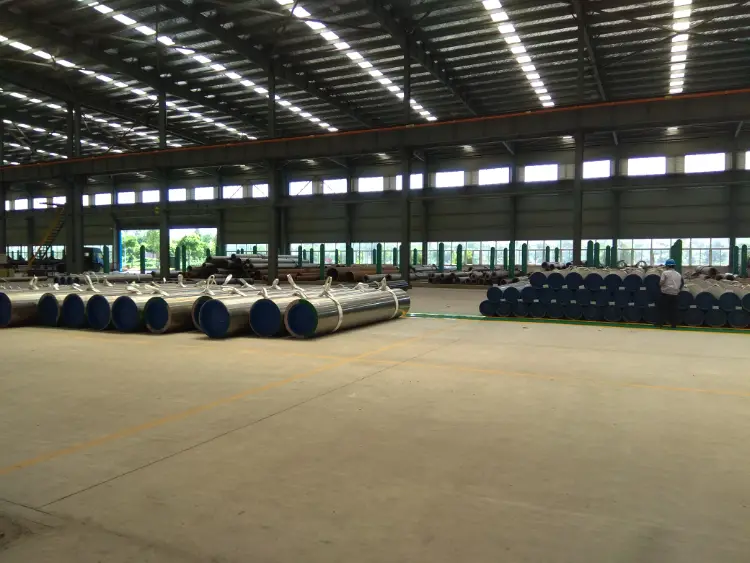
EN 10025-6 S550QL LSAW Pipe
EN 10025-6 S550QL High-Strength Quenched and Tempered Steel for LSAW Pipe
Comprehensive data sheet for S550QL structural steel according to EN 10025-6, including chemical composition, mechanical properties, thermal and electrical properties, equivalent grades, applications in LSAW pipes, and processing guidelines.
Hot rolling, quenching and tempering (Q+T); cold forming with subsequent stress relief; welding with low-hydrogen procedures; cutting (plasma, laser, waterjet); machining in the tempered condition.
- Phone : +8618037372205
- Email : [email protected]
- WhatsApp: Contact via Whtsapp
- WeChat: +8618037372205
EN 10025-6 S550QL LSAW Pipe Introduction
S550QL is a high-strength quenched and tempered fine-grain structural steel specified in EN 10025-6. With a minimum yield strength of 550 MPa for thicknesses up to 50 mm, it offers excellent weldability and low-temperature toughness (L-grade guarantees 27 J impact energy at -50°C). Its high strength-to-weight ratio makes it ideal for demanding welded structures such as LSAW (Longitudinal Submerged Arc Welded) pipes used in offshore platforms, pressure vessels, and heavy machinery.
EN 10025-6 S550QL LSAW Pipe Chemical Composition
The chemical composition of S550QL is strictly controlled to achieve the required mechanical properties and weldability. Maximum limits are specified unless a range is given. The steel is fully killed and fine-grain treated.
- Carbon equivalent (CEV) typically ≤ 0.47-0.52 depending on thickness, ensuring good weldability.
- Microalloying elements such as Nb, V, Ti are used for grain refinement.
- Low sulfur and phosphorus levels guarantee high purity and toughness.
| Element | Standard Value (max %) | Remarks |
|---|---|---|
| Carbon (C) | ≤ 0.20 | Depends on product thickness; for t ≤ 50 mm typical max 0.18% |
| Silicon (Si) | ≤ 0.80 | May be reduced for improved surface quality |
| Manganese (Mn) | ≤ 1.70 | Higher Mn may be used to increase strength |
| Phosphorus (P) | ≤ 0.020 | Low P is essential for toughness |
| Sulfur (S) | ≤ 0.010 | Low S for improved ductility and weldability |
| Aluminum (Al) total | ≥ 0.015 | Fine-grain practice; acid-soluble Al min 0.015% |
| Niobium (Nb) | ≤ 0.06 | Grain refiner and precipitation strengthener |
| Vanadium (V) | ≤ 0.12 | Optional addition |
| Titanium (Ti) | ≤ 0.05 | Optional; also used for grain refinement |
| Chromium (Cr) | ≤ 1.50 | May be added for hardenability |
| Nickel (Ni) | ≤ 2.0 | Can be added for toughness, especially at low temperature |
| Molybdenum (Mo) | ≤ 0.70 | Improves tempering resistance |
| Copper (Cu) | ≤ 0.50 | May be present as residual |
| Nitrogen (N) | ≤ 0.015 | Controlled for aging resistance |
| Boron (B) | ≤ 0.005 | Optional for hardenability |
EN 10025-6 S550QL LSAW Pipe Thermal and Electrical Physical Properties
These physical properties are not specified in EN 10025-6 but are typical for quenched and tempered steel with similar composition. They can vary with temperature and exact heat treatment condition. Density is approximately 7850 kg/m³. Modulus of elasticity decreases with increasing temperature. Thermal conductivity and specific heat capacity are important for welding and service temperature calculations.
| Property | Typical Value | Unit | Test Conditions |
|---|---|---|---|
| Density (ρ) | 7850 | kg/m³ | 20°C |
| Modulus of Elasticity (E) | 210 | GPa | 20°C |
| Shear Modulus (G) | 81 | GPa | 20°C |
| Poisson's Ratio (ν) | 0.3 | - | 20°C |
| Thermal Expansion Coefficient (α) | 11.5 - 12.5 × 10⁻⁶ | /K | 20°C to 100°C |
| Thermal Conductivity (λ) | 35 - 40 | W/(m·K) | 20°C |
| Specific Heat Capacity (c) | 460 - 480 | J/(kg·K) | 20°C |
| Electrical Resistivity (ρ_e) | 0.20 - 0.25 | µΩ·m | 20°C |
EN 10025-6 S550QL LSAW Pipe Mechanical Properties
The mechanical properties depend on the product thickness. Minimum values are according to EN 10025-6. Yield strength (ReH) and tensile strength (Rm) are guaranteed in transverse direction. Elongation (A) is measured on a proportional gauge length (L₀=5.65√S₀). Impact energy (KV) tested on V-notch Charpy specimens at -50°C for L-grade. Bend tests are performed with specified mandrel diameter.
| Property | Standard Requirement | Unit | Test Conditions |
|---|---|---|---|
| Yield Strength (ReH) | ≥ 550 | MPa | Thickness ≤ 50 mm |
| Yield Strength (ReH) | ≥ 530 | MPa | Thickness > 50 mm ≤ 100 mm |
| Yield Strength (ReH) | ≥ 490 | MPa | Thickness > 100 mm ≤ 150 mm |
| Tensile Strength (Rm) | 640 - 820 | MPa | Thickness ≤ 50 mm |
| Tensile Strength (Rm) | 610 - 790 | MPa | Thickness > 50 mm ≤ 100 mm |
| Tensile Strength (Rm) | 590 - 770 | MPa | Thickness > 100 mm ≤ 150 mm |
| Elongation (A) | ≥ 17 | % | Thickness ≤ 50 mm, L₀=5.65√S₀ |
| Elongation (A) | ≥ 16 | % | Thickness > 50 mm ≤ 100 mm |
| Elongation (A) | ≥ 15 | % | Thickness > 100 mm ≤ 150 mm |
| Impact Energy (KV) | ≥ 27 | J | At -50°C, Charpy V-notch, longitudinal |
| Bend Test (Mandrel Diameter) | 3t | - | Thickness ≤ 50 mm, bend angle 180° |
| Bend Test (Mandrel Diameter) | 4t | - | Thickness > 50 mm ≤ 100 mm |
EN 10025-6 S550QL LSAW Pipe Fully Equivalent Material Standards and Replaceable Grades
| Country/Region | Standard | Grade | Remarks |
|---|---|---|---|
| Europe | EN 10025-6 | S550QL | Original designation; L grade with impact at -50°C |
| Europe | EN 10025-6 | S550Q | Same base but impact only at -20°C, if low-temperature toughness not required |
| Europe | EN 10025-6 | S550QL1 | Alternative with impact at -60°C, slightly better toughness |
| International | ISO 4950-2 | E550DD | High yield strength structural steel, quenched and tempered; similar strength level |
| USA | ASTM A514/A514M | Grade B (or others) | Quenched and tempered alloy steel plate with min yield 690 MPa; similar but not identical; S550QL slightly lower strength; requires careful comparison |
EN 10025-6 S550QL LSAW Pipe Application Introduction
S550QL is designed for welded structures where high strength, low weight, and excellent toughness at low temperatures are required. It is particularly suitable for LSAW pipes used in severe environments, including subsea and arctic conditions. The steel can be formed, welded, and machined using standard practices if appropriate precautions are taken due to its strength level. Preheating and post-weld heat treatment may be necessary depending on thickness and hydrogen control.
Product Applications: LSAW pipes for oil & gas transmission (line pipe to API 5L PSL2 or DNV OS-F101), Subsea risers and flowlines, Piling pipes and structural tubulars for offshore wind foundations, Heavy-duty crane booms and mobile crane chassis, Hydraulic cylinder bodies and thick-walled sections, Pressure vessels for LPG and chemical storage
Processed into products: Longitudinally welded pipe sections (LSAW) with diameters up to 64 inch and wall thickness 6-60 mm, Structural nodes and joints in offshore jackets, Brackets, flanges, and stiffeners for heavy machinery, Transition pieces for monopile wind turbine foundations, Welded beams and columns in high-load structures, Pinions, shafts, and gears for extreme service conditions
Application industries: Oil and Gas (offshore/onshore pipelines), Shipbuilding and Marine Engineering, Pressure Vessel and Boiler Manufacturing, Construction and Infrastructure (bridges, high-rise), Mining and Earthmoving Equipment, Wind Energy (tower sections, transition pieces)
EN 10025-6 S550QL LSAW Pipe Similar and Alternative Materials for Comparison
| Country/Region | Standard | Grade | Remarks |
|---|---|---|---|
| Europe | EN 10025-6 | S500Q/QL | Lower yield strength (500 MPa), otherwise similar toughness and processing; may be a cost-effective alternative if lower strength is acceptable |
| Europe | EN 10025-6 | S620QL | Higher yield strength (620 MPa), for more demanding applications; may require stricter welding procedures |
| Europe | EN 10025-6 | S690QL | Even higher strength (690 MPa), premium grade for weight-critical structures; increased hardenability risk during welding |
| USA | ASTM A514/A514M | Grade F | Yield strength ~690 MPa, similar to S620QL; can be considered but note higher strength and different CEV |
| Japan | JIS G 3128 | SHY 685 | High tensile strength steel with min yield 685 MPa; used for pressure vessels; partial overlap in strength |
Notes:
When using S550QL for LSAW pipes, it is essential to follow approved welding procedures (e.g., ISO 15614-1) and consider the carbon equivalent to avoid cold cracking. For sour service, additional HIC/SSC testing per NACE MR0175 may be required. Delivery condition typically includes certificates per EN 10204 Type 3.1. The steel can be supplied with normalised rolled (N), thermomechanically rolled (M), or quenched and tempered (Q+T) options; for S550QL, only Q+T is applicable. Non-destructive examination (NDE) of the plate internal soundness per EN 10160 Class S1/E1 is often specified.
- Share



