
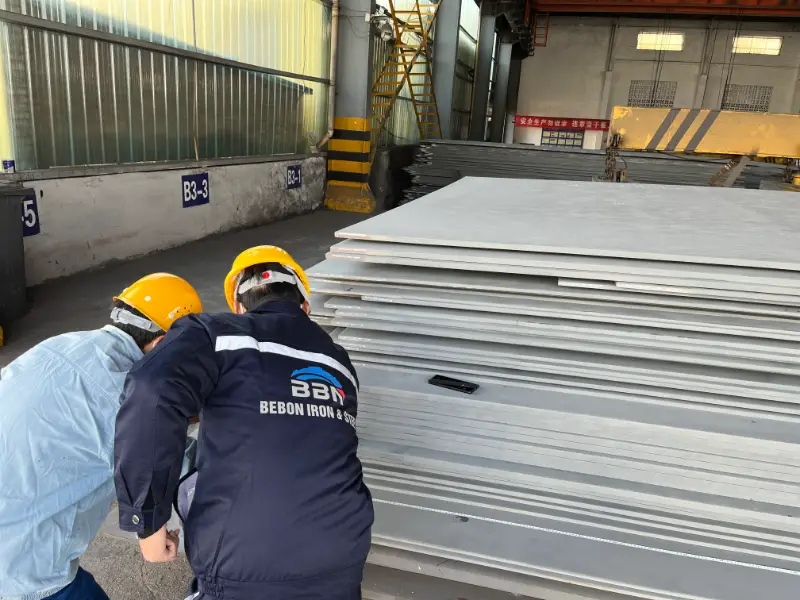
S550Q EN 10025
EN 10025-6 S550Q Steel for LSAW Pipe: High-Strength Quenched & Tempered Fine-Grain Material
Complete material datasheet for S550Q according to EN 10025-6, covering chemical composition, mechanical and thermal properties, international equivalents, and LSAW pipe applications.
Welding, hot forming, cold forming, machining, flame cutting
- Phone : +8618037372205
- Email : [email protected]
- WhatsApp: Contact via Whtsapp
- WeChat: +8618037372205
S550Q EN 10025 Introduction
S550Q is a high-strength, quenched and tempered fine-grain structural steel defined in EN 10025-6. It offers a minimum yield strength of 550 MPa in thicknesses up to 50 mm, combined with good weldability and notch toughness at 0 °C. The fine-grain structure is achieved through microalloying with aluminum and controlled rolling, ensuring consistent through-thickness properties. After quenching and tempering (Q+T), the steel provides an excellent balance of strength, ductility, and resistance to brittle fracture. S550Q is particularly suited for heavy-duty welded constructions and is widely used in the production of LSAW (Longitudinal Submerged Arc Welded) pipes for structural and pressure applications. It can be delivered in plate, strip, or wide flat form, ready for cold or hot forming and welding. The material meets the requirements of the Construction Products Regulation (CPR) and is CE-marked when used in building and civil engineering.
S550Q EN 10025 Chemical Composition
The chemical composition meets the requirements of EN 10025-6:2019 for grade S550Q. Maximum values are given except for aluminium, which has a minimum total content. Alloying elements such as chromium, nickel, and molybdenum may be added to achieve the required strength and hardenability. The carbon equivalent value (CEV) is typically limited to ensure good weldability, with typical CEV ≤ 0.47–0.52 depending on thickness.
| Element | Specified Value (max. or range) | Remarks |
|---|---|---|
| Carbon (C) | ≤ 0.20 % | Max. |
| Silicon (Si) | ≤ 0.80 % | Max. |
| Manganese (Mn) | ≤ 1.70 % | Max. |
| Phosphorus (P) | ≤ 0.025 % | Max. |
| Sulfur (S) | ≤ 0.015 % | Max. |
| Nitrogen (N) | ≤ 0.015 % | Max. |
| Aluminium (Al total) | ≥ 0.015 % | Minimum for fine grain practice |
| Niobium (Nb) | ≤ 0.06 % | Max. |
| Vanadium (V) | ≤ 0.12 % | Max. |
| Titanium (Ti) | ≤ 0.05 % | Max. |
| Chromium (Cr) | ≤ 1.50 % | Max. (optional) |
| Nickel (Ni) | ≤ 2.00 % | Max. (optional) |
| Molybdenum (Mo) | ≤ 0.70 % | Max. (optional) |
| Copper (Cu) | ≤ 0.50 % | Max. (optional) |
| Boron (B) | ≤ 0.005 % | Max. (optional) |
| Zirconium (Zr) | ≤ 0.15 % | Max. (optional) |
S550Q EN 10025 Thermal and Electrical Physical Properties
These physical properties are representative for quenched and tempered structural steels and are not specified in EN 10025-6. Values are provided for engineering calculations and can vary slightly depending on the exact chemical composition and heat treatment condition. The density corresponds to the standard value for carbon and low-alloy steels. All values are given at room temperature unless stated otherwise.
| Property | Typical Value | Unit | Test Condition / Remarks |
|---|---|---|---|
| Density (ρ) | 7.85 | g/cm³ | At 20 °C |
| Elastic modulus (E) | 210 | GPa | At 20 °C |
| Shear modulus (G) | 81 | GPa | At 20 °C, typical |
| Poisson's ratio (ν) | 0.30 | — | At 20 °C, elastic range |
| Thermal expansion coefficient (α) | 11.1 | 10&supminus;&sup6;/K | 20 °C to 100 °C |
| Thermal expansion coefficient (α) | 11.7 | 10&supminus;&sup6;/K | 20 °C to 200 °C |
| Thermal expansion coefficient (α) | 12.3 | 10&supminus;&sup6;/K | 20 °C to 300 °C |
| Thermal conductivity (λ) | 42 | W/(m·K) | At 20 °C |
| Specific heat capacity (cp) | 460 | J/(kg·K) | At 20 °C to 100 °C |
| Electrical resistivity (ρe) | 0.25 | Ω·mm²/m | At 20 °C, typical for low-alloy steel |
S550Q EN 10025 Mechanical Properties
Mechanical properties are determined on transverse test pieces taken from quenched and tempered plates, in accordance with EN 10025-6. Values depend on product thickness. The minimum specified yield strength (ReH) applies to the upper yield stress; for structures without sharp yield point, the 0.2 % proof strength (Rp0.2) may be used. Impact energy values are guaranteed for longitudinal specimens at 0 °C. Bending test requirements refer to a 180° bend with a mandrel diameter as indicated.
| Property | Specified Requirement | Unit | Test Condition / Remarks |
|---|---|---|---|
| Yield Strength (ReH) | ≥ 550 | MPa | Product thickness t ≤ 50 mm |
| Yield Strength (ReH) | ≥ 530 | MPa | 50 mm < t ≤ 100 mm |
| Yield Strength (ReH) | ≥ 510 | MPa | 100 mm < t ≤ 150 mm |
| Tensile Strength (Rm) | 640 – 820 | MPa | t ≤ 50 mm |
| Tensile Strength (Rm) | 600 – 780 | MPa | 50 mm < t ≤ 100 mm |
| Tensile Strength (Rm) | 590 – 770 | MPa | 100 mm < t ≤ 150 mm |
| Elongation after fracture (A) | ≥ 17 | % | Longitudinal, L0=5.65√S0, t ≤ 50 mm |
| Elongation after fracture (A) | ≥ 16 | % | Longitudinal, t > 50 mm |
| Bending test (bend angle 180°) | d = 3t | — | t ≤ 16 mm |
| Bending test (bend angle 180°) | d = 4t | — | 16 mm < t ≤ 50 mm |
| Bending test (bend angle 180°) | d = 5t | — | t > 50 mm |
| Impact energy (KV, longitudinal) | ≥ 27 | J | at 0 °C, standard Charpy-V specimen |
S550Q EN 10025 Full Equivalent Material Standards and Replaceable Grades
| Country / Region | Standard | Grade | Remarks |
|---|---|---|---|
| Europe | EN 10025-6 | S550Q | Original standard, base designation |
| Germany | DIN EN 10025-6 | S550Q | Identical to EN 10025-6 |
| United Kingdom | BS EN 10025-6 | S550Q | Identical to EN 10025-6 |
| France | NF EN 10025-6 | S550Q | Identical to EN 10025-6 |
| Italy | UNI EN 10025-6 | S550Q | Identical to EN 10025-6 |
| Spain | UNE EN 10025-6 | S550Q | Identical to EN 10025-6 |
| Sweden | SS EN 10025-6 | S550Q | Identical, also denoted as SS-EN 10025-6 |
| Poland | PN-EN 10025-6 | S550Q | Identical to EN 10025-6 |
S550Q EN 10025 Application Introduction
S550Q is engineered for demanding structural and pressure-containing applications where high strength, good weldability, and adequate toughness at low temperatures are essential. The material is frequently converted into LSAW pipes due to its homogeneous mechanical properties in both plate and welded conditions. The fine-grain structure and low impurity content ensure reliable performance in fatigue-loaded and fracture-critical components. Common applications include:
Product Applications: LSAW (longitudinal submerged arc welded) pipes for structural and line pipe usage, Welded H-beams, box columns and built-up sections, Pressed and welded pressure vessel shells, Offshore structural modules and jacket legs, Heavy-duty crane booms and mobile equipment frames, Bridge girders and deck plates
Processed into products: LSAW pipe joints and fittings (elbows, tees, reducers), Flanges and end plates for pressure-retaining systems, Piling pipe sections for foundation construction, Crane outriggers and telescopic boom sections, Mining dump body liners and excavator arms, Hydraulic cylinder bodies and piston rods (when welded)
Application industries: Oil and gas (offshore/onshore pipelines, risers, conductor pipes), Civil engineering and building construction (high-rise columns, trusses, arch bridges), Wind energy (tower sections, transition pieces, monopiles), Shipbuilding and marine structures (deck framing, heavy stiffeners), Mining and heavy machinery (booms, chassis, crusher frames), Power generation (penstocks, pressure vessels, turbine supports)
S550Q EN 10025 Similar and Alternative Materials
| Country / Region | Standard | Grade | Remarks |
|---|---|---|---|
| Europe | EN 10025-6 | S550QL | Higher toughness (KV at -50 °C), otherwise same strength; can replace S550Q in cold areas. |
| Europe | EN 10025-6 | S550QL1 | Very high toughness (KV at -60 °C); suitable for arctic applications. |
| Europe | EN 10025-6 | S460Q | Lower yield strength (460 MPa); may be used if design allows reduction. |
| Europe | EN 10025-6 | S500Q | Intermediate yield strength (500 MPa); good alternative for slightly lower demands. |
| USA | ASTM A514 / A517 | Grade F / Grade Q | Quenched & tempered alloy steel plates; comparable strength but different chemical requirements; verify weldability. |
| International | ISO 15614-1 | — | Welding procedure qualification does not define a grade; S550Q can be used under PED/EN standards. |
Notes:
Ordering notes: When specifying S550Q for LSAW pipe, the required plate thickness, diameter, and manufacturing standard (e.g., API 5L, EN 10208, or structural pipe standards) should be agreed. Supplementary requirements such as ultrasonic testing, restricted hardenability, or additional impact testing can be requested. The weldability of S550Q is good when using low-hydrogen processes and appropriate preheat/interpass temperatures as per EN 1011-2. The steel is fully recyclable and complies with environmental directives.
- Share



