
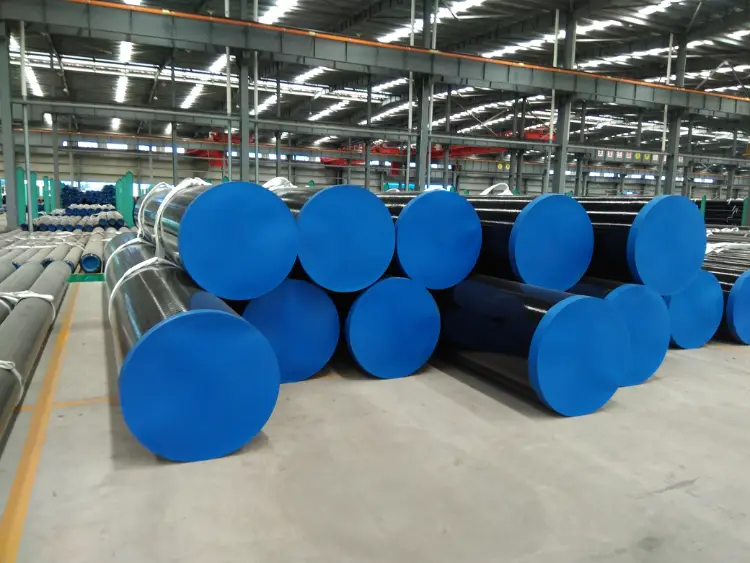
EN10025-6 S500QL1 LSAW Pipe
EN10025-6 S500QL1 LSAW Pipe: High-Strength Quenched & Tempered Steel for Arctic Applications
Detailed material data for S500QL1 steel used in longitudinal submerged arc welded pipes, including chemical composition, mechanical properties, and physical performance per EN 10025-6.
Quenching + Tempering (Q+T); suitable for cold forming, hot forming within permitted temperature ranges, and welding with appropriate procedures
- Phone : +8618037372205
- Email : [email protected]
- WhatsApp: Contact via Whtsapp
- WeChat: +8618037372205
EN10025-6 S500QL1 LSAW Pipe Introduction
S500QL1 is a high-yield-strength structural steel grade defined in EN 10025-6, supplied in the quenched and tempered condition. It belongs to the S500Q series, where "QL1" designates enhanced low-temperature toughness with guaranteed impact energy of 27 J at -40°C. This fine-grain steel offers a minimum yield strength of 500 MPa and excellent weldability, making it ideal for heavy-duty welded structures. When processed into LSAW (Longitudinal Submerged Arc Welded) pipes, S500QL1 delivers reliable performance in demanding environments such as offshore platforms, polar pipeline systems, and high-load structural components. The steel has strict limits on phosphorus and sulfur to improve cleanliness, and controlled additions of microalloying elements like niobium, vanadium, and titanium refine the grain size and enhance mechanical properties.
EN10025-6 S500QL1 LSAW Pipe Chemical Composition
The ladle analysis limits for S500QL1 according to EN 10025-6:2019. For product analysis, the permissible deviations are given in the standard. The maximum carbon equivalent value (CEV) depends on the product thickness; for thickness ≤ 50 mm, CEV ≤ 0.65%. Microalloying elements such as Nb, V, and Ti are added for grain refinement and precipitation hardening.
| Element | Standard Value (max, %) | Remarks |
|---|---|---|
| Carbon (C) | 0.20 | Ladle analysis; CEV limits apply |
| Silicon (Si) | 0.80 | Deoxidation element |
| Manganese (Mn) | 1.70 | Contributes to strength and hardenability |
| Phosphorus (P) | 0.020 | Strict control for low-temperature toughness |
| Sulfur (S) | 0.010 | Strict control for improved cleanliness |
| Chromium (Cr) | 1.50 | Hardenability, optional alloying |
| Nickel (Ni) | 2.0 | Improves low-temperature toughness; optional |
| Molybdenum (Mo) | 0.70 | Hardenability and creep resistance |
| Copper (Cu) | 0.50 | Weathering resistance; optional |
| Niobium (Nb) | 0.06 | Grain refinement; microalloy |
| Titanium (Ti) | 0.05 | Grain refinement; microalloy |
| Vanadium (V) | 0.12 | Precipitation strengthening |
| Boron (B) | 0.005 | Enhances hardenability (if added) |
| Zirconium (Zr) | 0.15 | Grain refinement; optional |
| Nitrogen (N) | 0.015 | Combined with Ti/Al for grain control |
EN10025-6 S500QL1 LSAW Pipe Thermal and Electrical Physical Properties
Representative physical properties for quenched and tempered high-strength low-alloy steels similar to S500QL1. Actual values can vary slightly with chemical composition and heat treatment condition. Data are based on general engineering steel references and are suitable for design calculations.
| Property | Typical Value | Unit | Test Condition / Remarks |
|---|---|---|---|
| Density (ρ) | 7.85 | g/cm³ | At 20°C |
| Young's modulus (E) | 210 | GPa | At 20°C |
| Shear modulus (G) | 81 | GPa | Calculated from E and ν |
| Poisson's ratio (ν) | 0.3 | – | Elastic range |
| Thermal expansion coefficient (α) | 11.1 × 10⁻⁶ | /K | 20–100°C |
| Thermal expansion coefficient (α) | 11.9 × 10⁻⁶ | /K | 20–200°C |
| Thermal expansion coefficient (α) | 12.5 × 10⁻⁶ | /K | 20–300°C |
| Thermal expansion coefficient (α) | 13.0 × 10⁻⁶ | /K | 20–400°C |
| Thermal expansion coefficient (α) | 13.5 × 10⁻⁶ | /K | 20–500°C |
| Thermal conductivity (λ) | 42 | W/(m·K) | At 20°C |
| Thermal conductivity (λ) | 40 | W/(m·K) | At 200°C |
| Thermal conductivity (λ) | 37 | W/(m·K) | At 400°C |
| Specific heat capacity (cp) | 460 | J/(kg·K) | At 20°C |
| Specific heat capacity (cp) | 510 | J/(kg·K) | At 200°C |
| Electrical resistivity (ρ_e) | 0.25 | µΩ·m | At 20°C |
EN10025-6 S500QL1 LSAW Pipe Mechanical Properties
Minimum mechanical properties for S500QL1 flat products in the quenched and tempered condition per EN 10025-6. Properties depend on the product thickness (t) and the test direction (transverse or longitudinal). Impact values apply to thickness ≥ 10 mm. For thicknesses beyond the range, properties shall be agreed upon. The bend test requires no cracks at the specified former diameter.
| Property | Standard Requirement Value | Unit | Test Condition / Remarks |
|---|---|---|---|
| Yield strength (ReH) | 500 min. | MPa | t ≤ 50 mm, transverse |
| Yield strength (ReH) | 480 min. | MPa | 50 < t ≤ 100 mm, transverse |
| Yield strength (ReH) | 440 min. | MPa | 100 < t ≤ 150 mm, transverse |
| Tensile strength (Rm) | 590 – 770 | MPa | t ≤ 100 mm, transverse |
| Tensile strength (Rm) | 540 – 720 | MPa | 100 < t ≤ 150 mm, transverse |
| Elongation (A) | 17 min. | % | t ≤ 50 mm, transverse, gauge length 5.65√S₀ |
| Elongation (A) | 16 min. | % | 50 < t ≤ 100 mm, transverse |
| Elongation (A) | 15 min. | % | 100 < t ≤ 150 mm, transverse |
| Elongation (A) | 17 min. | % | t ≤ 50 mm, longitudinal (if applicable) |
| Impact energy (KV, -40°C) | 27 J min. | J | Transverse, V-notch; average of 3 tests, single min. 19 J; t ≥ 10 mm |
| Bend test (former diameter) | 3t | mm | t ≤ 50 mm, transverse, 180° bend |
EN10025-6 S500QL1 LSAW Pipe Completely Equivalent Material Standards & Replaceable Grades
S500QL1 is specifically defined in the European standard EN 10025-6. There are no exact international equivalents; however, within the same European framework, other S500Q grades differ only in toughness levels. National adoptions are identical because they adopt the EN standard.
| Country/Region | Standard | Grade | Remarks |
|---|---|---|---|
| Germany | DIN EN 10025-6 | S500QL1 | Identical to EN 10025-6 |
| France | NF EN 10025-6 | S500QL1 | Identical adoption |
| United Kingdom | BS EN 10025-6 | S500QL1 | Formerly BS 4360 series, now harmonized |
| Italy | UNI EN 10025-6 | S500QL1 | Harmonized European standard |
| Spain | UNE EN 10025-6 | S500QL1 | Harmonized European standard |
| Sweden | SS EN 10025-6 | S500QL1 | Directly adopted, no separate SS number |
| International (ISO) | ISO 4950-2:1995 (obsolete) | E500D (approximate) | Similar strength level, different toughness designation; ISO standard withdrawn and replaced by EN-based standards |
EN10025-6 S500QL1 LSAW Pipe Application Introduction
S500QL1 LSAW pipes are used where high strength, excellent weldability, and guaranteed toughness at -40°C are critical. The quenched and tempered microstructure provides a fine bainitic/martensitic structure, giving an optimal balance of strength and ductility. Typical sectors include
- Offshore oil and gas (jacket structures, risers, conductor pipes)
- Arctic and subsea pipelines requiring low-temperature toughness
- Heavy-lift crane booms and mobile equipment
- Bridge construction in cold climates
- Pressure vessels and storage tanks designed for low ambient temperatures
Product Applications: Longitudinally welded large-diameter pipes (LSAW), Structural hollow sections for offshore nodes (sometimes called "cans"), Piling and foundation pipes for arctic conditions, High-pressure gas transmission pipelines, Crane boom chords and lattice members, Transition pieces for offshore wind monopiles
Processed into products: Pipe spools and bend segments for subsea flowlines, Jacket legs, braces, and mud mats for offshore platforms, Welded TKY joints and stiffener rings, Reinforcing inserts and flange connectors, Heavy-duty bearing rings and slewing rings, Cold-weather pipeline sections requiring fracture arrest properties
Application industries: Oil & Gas (offshore and onshore), Renewable energy (wind turbine substructures, wave energy), Heavy engineering and lifting equipment, Shipbuilding and marine structures, Bridge and building construction, Pressure vessel manufacturing
EN10025-6 S500QL1 LSAW Pipe Similar / Alternative Material Recommendations
These materials offer comparable strength levels or toughness characteristics. They are not exact matches and require engineering evaluation before substitution, especially regarding weldability, fabrication, and the minimum service temperature.
| Country/Region | Standard | Grade | Remarks |
|---|---|---|---|
| Europe | EN 10025-6 | S500Q | Same strength, impact tested at 0°C (less demanding than QL1) |
| Europe | EN 10025-6 | S500QL | Same strength, impact tested at -20°C |
| Europe | EN 10025-6 | S500QL2 | Same strength, impact tested at -60°C (superior toughness) |
| Europe | EN 10025-6 | S550QL1 | Higher yield strength (550 MPa) with -40°C toughness |
| Europe | EN 10025-3 | S460NL/NL1 | Normalized steel, lower strength but good low-temperature toughness (NL1: -40°C) |
| USA | ASTM A514/A517 | Grade S | Quenched & tempered alloy steel; minimum yield strength 690 MPa, significantly higher strength; requires evaluation of toughness at -40°C |
| Japan | JIS G 3128 | SHY685 | 690 MPa yield class; low-temperature toughness available; different chemical composition |
Notes:
For LSAW pipe production, the starting plate from S500QL1 is formed and welded. The welding procedure must be qualified per EN ISO 15614-1 or project specifications. Post-weld heat treatment (PWHT) is generally not applied because it may reduce the strength of the quenched and tempered microstructure. Simulated heat-affected zone (HAZ) testing is recommended. The CEV limits in EN 10025-6 help ensure cold cracking resistance. For sour service or hydrogen-induced cracking (HIC) resistance, additional testing beyond the standard may be required. The manufacturer should verify through thickness properties for pipes with wall thickness over 25 mm.
- Share



