
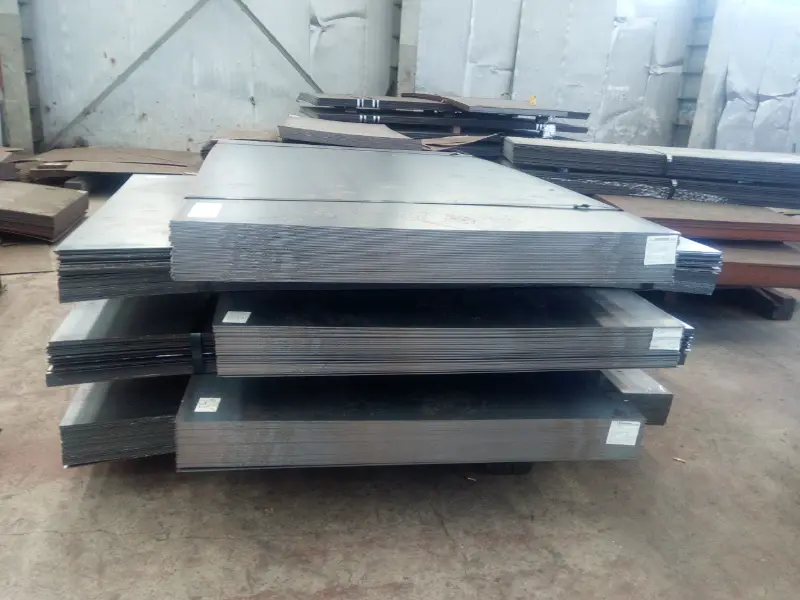
S890QL1 High Yield Strength Structural Steel
S890QL1 High Yield Strength Structural Steel Quenched and Tempered Alloy Plate for Welded Structures
Detailed material data analysis for S890QL1 structural steel according to EN 10025-6, including chemical composition, mechanical properties, and physical characteristics for welded ERW pipe applications.
Hot Rolling, Quenching and Tempering, Electric Resistance Welding (ERW), Cold Forming, Cutting, Machining
- Phone : +8618037372205
- Email : [email protected]
- WhatsApp: Contact via Whtsapp
- WeChat: +8618037372205
S890QL1 High Yield Strength Structural Steel Introduction
S890QL1 is a high yield strength structural steel grade defined in the European standard EN 10025-6 for hot-rolled products made of weldable fine-grain structural steels in the quenched and tempered condition. This grade delivers a minimum yield strength of 890 MPa in thicknesses up to 50 mm. The 'Q' designates quenching and tempering heat treatment, 'L' indicates low temperature impact testing at -50 °C, and '1' specifies the basic quality group for the fine grain steel. Key characteristics:
- Excellent strength-to-weight ratio enabling lightweight construction
- Superior toughness at very low temperatures down to -50 °C
- Good weldability with appropriate precautions due to high carbon equivalent
- Fine grain structure ensuring consistent mechanical properties
S890QL1 High Yield Strength Structural Steel Chemical Composition
The chemical composition of S890QL1 is optimized for high strength and low temperature toughness after quenching and tempering. The steel is fully killed and fine grain treated. Elements like niobium, vanadium, and titanium are added for grain refinement and precipitation strengthening. Key constraints for weldability:
- Carbon content is strictly limited to ensure weldability
- Micro-alloying elements provide hardenability deep into the section
- Phosphorus and Sulfur are kept very low for cleanliness and toughness
| Element | Standard Value (≤ wt%) | Remarks |
|---|---|---|
| Carbon (C) | 0.20 | Maximum content according to ladle analysis |
| Silicon (Si) | 0.80 | Maximum content |
| Manganese (Mn) | 1.70 | Maximum content |
| Phosphorus (P) | 0.020 | Maximum content for enhanced toughness |
| Sulfur (S) | 0.010 | Maximum content for inclusion control |
| Chromium (Cr) | 1.50 | Maximum content for hardenability |
| Nickel (Ni) | 2.0 | Maximum content for toughness |
| Molybdenum (Mo) | 0.70 | Maximum content |
| Copper (Cu) | 0.50 | Maximum content |
| Niobium (Nb) | 0.06 | Maximum content for grain refinement |
| Vanadium (V) | 0.12 | Maximum content for precipitation hardening |
| Titanium (Ti) | 0.05 | Maximum content |
| Boron (B) | 0.005 | Maximum content for hardenability |
| Zirconium (Zr) | 0.15 | Maximum content |
| Nitrogen (N) | 0.015 | Maximum content |
| Aluminum (Al total) | 0.015 | Minimum acid-soluble content required for grain refinement |
S890QL1 High Yield Strength Structural Steel Thermal and Electrical Physical Properties
Physical properties are provided as typical values at room temperature and serve as reference for engineering calculations. These properties are standard for high-strength quenched and tempered steel grades. Precautions for processing:
- Heat treatment, such as stress relieving, must be performed below the tempering temperature to avoid degrading mechanical properties
- Thermal conductivity is essential for calculating heat input during welding
| Property | Typical Reference Value | Unit | Test Condition |
|---|---|---|---|
| Density (ρ) | 7.85 | kg/dm³ | At 20 °C |
| Elastic Modulus (E) | 210 | GPa | At 20 °C |
| Shear Modulus (G) | 81 | GPa | At 20 °C |
| Poisson's Ratio (ν) | 0.3 | - | At 20 °C, elastic range |
| Thermal Expansion Coefficient (α) | 12.5 | 10⁻⁶/K | Between 20 °C and 100 °C |
| Thermal Expansion Coefficient (α) | 13.5 | 10⁻⁶/K | Between 20 °C and 300 °C |
| Thermal Conductivity (λ) | 35 | W/(m·K) | At 20 °C |
| Specific Heat Capacity (cp) | 460 | J/(kg·K) | At 20 °C |
| Electrical Resistivity (ρ_e) | 0.25 | Ω·mm²/m | At 20 °C |
S890QL1 High Yield Strength Structural Steel Mechanical Properties
Mechanical properties are verified in the quenched and tempered condition (+QT) according to EN 10025-6. Properties are valid for transverse test pieces unless otherwise stated. The specified values represent the minimum required performance. Impact testing:
- Charpy-V notch impact energy values are guaranteed at the designated low temperature of -50 °C for quality grade L1
- Strength values are thickness-dependent, decreasing with increasing product thickness
| Property | Standard Requirement Value | Unit | Test Condition |
|---|---|---|---|
| Yield Strength (ReH) | 890 | MPa | Nominal thickness (t) ≤ 50 mm |
| Yield Strength (ReH) | 830 | MPa | Nominal thickness 50 mm < t ≤ 100 mm |
| Yield Strength (ReH) | 780 | MPa | Nominal thickness 100 mm < t ≤ 150 mm |
| Tensile Strength (Rm) | 940 - 1100 | MPa | Nominal thickness (t) ≤ 50 mm |
| Tensile Strength (Rm) | 880 - 1100 | MPa | Nominal thickness 50 mm < t ≤ 100 mm |
| Tensile Strength (Rm) | 840 - 1100 | MPa | Nominal thickness 100 mm < t ≤ 150 mm |
| Elongation after Fracture (A) | 12 | % | Longitudinal, t ≤ 150 mm, gauge length L0 = 5.65√S0 |
| Elongation after Fracture (A) | 10 | % | Transverse, t ≤ 150 mm, gauge length L0 = 5.65√S0 |
| Impact Energy (KV) at -50 °C | 30 | J | Longitudinal, min. value, 10x10 mm test piece |
| Impact Energy (KV) at -50 °C | 27 | J | Transverse, min. value, 10x10 mm test piece |
| Bend Test | D = 4a (t ≤ 50 mm) | - | Mandrel diameter D, bend angle 180°, sample thickness a |
| Bend Test | D = 5a (t > 50 mm) | - | Mandrel diameter D, bend angle 180°, sample thickness a |
S890QL1 High Yield Strength Structural Steel Completely Equivalent Material Standards and Substitutable Grade Recommendations
| Country/Region | Standard | Grade | Remarks |
|---|---|---|---|
| European Union | EN 10025-6:2019 | S890QL1 | Original specification. Covers plates and wide flats up to 150 mm for welded structures with low temperature toughness. |
| European Union | EN 10210-1:2006 | S890QLH | For hot-finished structural hollow sections. Identical chemical and mechanical property base with note on hollow section execution. |
| International | ISO 4951-2:2001 | S890QL1 | Technically identical to the EN standard for bars and sections. ISO designation aligns with EN naming convention. |
| Germany | DIN EN 10025-6 | S890QL1 | DIN adoption of the European standard. Fully interchangeable with EN 10025-6 S890QL1. |
S890QL1 High Yield Strength Structural Steel Application Introduction
S890QL1 is an advanced ultra-high strength structural steel designed for demanding applications where weight reduction, high payload capacity, and safety at low temperatures are critical. Due to its high strength, specific manufacturing and design rules apply:
- The excellent weldability allows for standard processes (MAG/MIG, submerged arc), but preheating and strict heat input control are mandatory to avoid Cold Cracking in the Heat Affected Zone (HAZ)
- Cold forming is possible but requires consideration of the high yield strength and springback effect
- Hot forming is not recommended post-delivery, as it destroys the quenched and tempered microstructure
Product Applications: Telescopic crane booms and lattice boom sections, Jack-up rig legs and offshore platform nodes, Long-span steel bridge girders and box sections, Truck chassis frames and high-capacity tipper bodies, ERW (Electric Resistance Welded) pipes for high-pressure fluid conveyance and structural pilings, Excavator arms, bulldozer blades, and dumper bodies, Structural hollow sections for stadiums and airport terminals, Wind turbine tower sections and transition pieces
Processed into products: Welded main chords and diagonal braces for crane booms, Flanges and webs in welded plate girders for bridges, Longitudinally welded pipes and hollow sections for structural columns, Complex welded box structures in heavy machine frames, Fatigue-critical welded joints in offshore substructures, Formed and welded tubular nodes in space frames, Cut, machined, and welded pin connectors for lifting devices
Application industries: Heavy Mobile Crane Manufacturing, Offshore and Marine Engineering, Bridge Construction, Heavy Transport Vehicles and Trailers, High-Pressure Pipeline Systems (ERW), Mining and Earthmoving Equipment, High-Rise Building Construction, Wind Energy Tower and Foundation Structures
S890QL1 High Yield Strength Structural Steel Closely Related or Similar Substitute Material Recommendations
| Country/Region | Standard | Grade | Remarks |
|---|---|---|---|
| European Union | EN 10025-6:2019 | S890Q | Identical chemical composition and mechanical properties but impact tested at -20 °C instead of -50 °C. Suitable for less demanding low-temperature applications. |
| European Union | EN 10025-6:2019 | S890QL | Same strength class but without the L1 quality suffix. May have slightly different traceability and inspection requirements within the same toughness grade. |
| European Union | EN 10025-6:2019 | S960QL | Higher strength grade with minimum yield strength of 960 MPa. Ni and Cr contents are typically higher. Suitable for weight-optimized designs where S890QL1 strength is insufficient. |
| United States | ASTM A514/A514M | Grade Q | Quenched and tempered alloy steel plate with similar high strength (min 690 MPa yield). Different alloy concept with higher Cr and Mo, requires careful welding procedure comparison. |
Notes:
Welding specific guidance: The carbon equivalent (CEV) typically ranges from 0.65 to 0.72, classifying S890QL1 as a steel with limited weldability requiring specific procedures. Low hydrogen practices are essential. Minimum preheat and interpass temperatures should be determined based on plate thickness and heat input using methods such as those described in EN 1011-2. Post weld heat treatment (PWHT) is generally not recommended as it can significantly reduce strength and toughness in the heat-affected zone, unless specifically qualified. For ERW pipe production, the skelp is formed cold, and the welding parameters must be precisely controlled to match the strength and toughness of the base material in the weld seam zone after the quenching and tempering process.
- Share



