
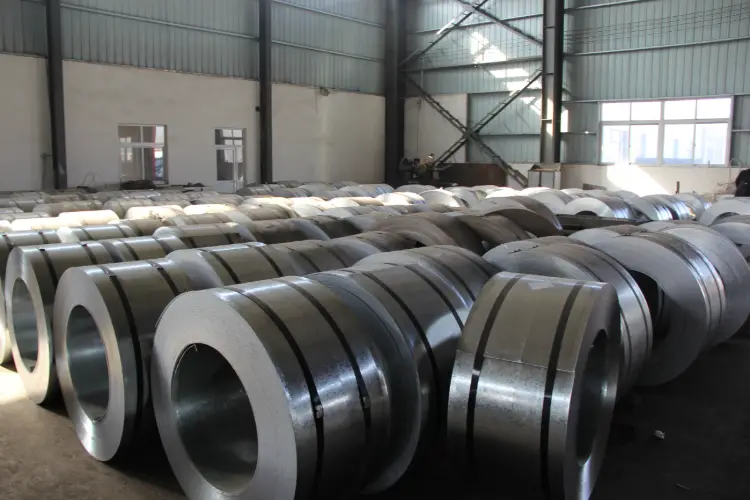
S650MC Hot Rolled Steel Coil
S650MC Hot Rolled Steel Coil: High-Strength Cold-Forming Solution
Detailed material data for S650MC steel according to EN 10149-2, covering chemical composition, mechanical properties, thermal and electrical physical properties, equivalent grades, and application guidance for structural cold-forming uses.
Cold forming, bending, punching, shearing, welding, roll forming, profiling
- Phone : +8618037372205
- Email : [email protected]
- WhatsApp: Contact via Whtsapp
- WeChat: +8618037372205
S650MC Hot Rolled Steel Coil Introduction
S650MC is a hot-rolled, high-strength low-alloy (HSLA) steel produced by thermomechanical rolling according to EN 10149-2. It is specifically designed for cold forming and offers a minimum yield strength of 650 MPa, combined with good ductility and weldability. The fine-grained microstructure, achieved through controlled rolling, enables excellent bending and forming performance without compromising structural integrity.
- Minimum yield strength of 650 MPa ensures lightweight constructions.
- Excellent cold formability allows complex shapes via bending, pressing, and roll forming.
- Good weldability facilitates reliable joining in automotive and engineering applications.
- Compliant with European standard EN 10149-2, suitable for chassis components, structural reinforcements, and crane booms.
S650MC Hot Rolled Steel Coil Chemical Composition
The chemical composition of S650MC steel is controlled to achieve the required mechanical properties through thermomechanical rolling. Microalloying elements such as niobium, vanadium, and titanium are used individually or in combination to refine grain size and provide precipitation strengthening. The sum of Nb+V+Ti shall not exceed 0.22%. The steel is fully killed with a minimum aluminum content of 0.015%. Phosphorus and sulfur are kept low to ensure good ductility and weldability.
| Element | Standard Value (max %) | Remarks |
|---|---|---|
| Carbon (C) | ≤ 0.12 | Ladle analysis |
| Silicon (Si) | ≤ 0.50 | Ladle analysis |
| Manganese (Mn) | ≤ 2.00 | Ladle analysis |
| Phosphorus (P) | ≤ 0.025 | Ladle analysis |
| Sulfur (S) | ≤ 0.015 | Ladle analysis |
| Aluminium (Al) | ≥ 0.015 | Minimum content for fully killed steel |
| Niobium (Nb) | ≤ 0.09 | Microalloying element; combined Nb+V+Ti ≤ 0.22 |
| Vanadium (V) | ≤ 0.20 | Microalloying element; combined Nb+V+Ti ≤ 0.22 |
| Titanium (Ti) | ≤ 0.15 | Microalloying element; combined Nb+V+Ti ≤ 0.22 |
S650MC Hot Rolled Steel Coil Thermal and Electrical Physical Properties
The physical properties are based on typical values for high-strength low-alloy steels with a density of about 7.85 kg/dm³. Thermal expansion, conductivity, and electrical resistivity are comparable to those of general structural steels. Actual values may vary slightly depending on the exact chemical composition and processing. These data are not part of the delivery requirements but serve as design guidance.
| Property | Typical Value | Unit | Test Conditions |
|---|---|---|---|
| Density (ρ) | 7.85 | g/cm³ | Room temperature |
| Modulus of elasticity (E) | 210 | GPa | Room temperature |
| Shear modulus (G) | ~80 | GPa | Room temperature |
| Poisson's ratio (ν) | 0.3 | – | Room temperature |
| Thermal expansion coefficient (α) | 12.0 × 10⁻⁶ | 1/K | 20 – 200 °C |
| Thermal conductivity (λ) | ~50 | W/(m·K) | 20 °C |
| Specific heat capacity | ~460 | J/(kg·K) | Room temperature |
| Electrical resistivity (ρₑ) | ~0.22 | µΩ·m | 20 °C |
S650MC Hot Rolled Steel Coil Mechanical Properties
Mechanical properties are determined on test pieces taken transverse to the rolling direction in accordance with EN 10149-2. Minimum yield strength and tensile strength are guaranteed, while elongation and bendability ensure sufficient cold formability. The values depend on the nominal thickness (t) of the product. No impact test is specified by the standard for this grade; it is typically supplied with as-rolled toughness suitable for ambient applications.
| Property | Required Value | Unit | Test Conditions |
|---|---|---|---|
| Yield strength (ReH) | ≥ 650 | MPa | Transverse, room temperature, all thicknesses |
| Tensile strength (Rm) | 700 – 880 | MPa | Transverse, room temperature, all thicknesses |
| Elongation A80 | ≥ 12 | % | Transverse, room temperature, gauge length 80 mm, t ≤ 3 mm |
| Elongation A5 | ≥ 14 | % | Transverse, room temperature, proportional gauge length, 3 < t ≤ 12 mm |
| Bend test (180°) | 1.5 t | mm (bend core diameter) | Transverse, room temperature, t ≤ 3 mm, crack-free |
| Bend test (180°) | 2.0 t | mm (bend core diameter) | Transverse, room temperature, 3 < t ≤ 6 mm, crack-free |
| Bend test (180°) | 2.5 t | mm (bend core diameter) | Transverse, room temperature, 6 < t ≤ 12 mm, crack-free |
S650MC Hot Rolled Steel Coil Fully Equivalent Material Standards and Replaceable Designations
| Country/Region | Standard | Designation | Remarks |
|---|---|---|---|
| European Union | EN 10149-2 | S650MC | Original European standard, mandatory in CEN member states |
| United Kingdom | BS EN 10149-2 | S650MC | Identical adoption of EN standard |
| Germany | DIN EN 10149-2 | S650MC | Identical adoption of EN standard |
| France | NF EN 10149-2 | S650MC | Identical adoption of EN standard |
| Italy | UNI EN 10149-2 | S650MC | Identical adoption of EN standard |
| Spain | UNE EN 10149-2 | S650MC | Identical adoption of EN standard |
S650MC Hot Rolled Steel Coil Application Introduction
S650MC is primarily used in cold-formed structural and safety components where high static and dynamic strength is required while allowing complex geometries. The steel can be processed by bending, roll forming, punching, and welding without preheating under normal shop conditions. Typical application areas include:
- Automotive lightweight construction: chassis frames, cross members, longitudinal beams, suspension arms, and bumper reinforcements.
- Material handling and lifting: crane booms, telescopic arms, and high-strength structural profiles.
- Agricultural and construction machinery: frames, booms, and wear-resistant parts subjected to moderate forming.
- Storage and logistics: pallet racking, shelving profiles, and containers.
Product Applications: Chassis frames and subframes, Suspension control arms, Crane booms and telescopic arms, Heavy-duty racking systems, Structural hollow sections (after roll forming and welding), Trailer and truck beams
Processed into products: B-pillar reinforcements, Door impact beams, Cross members, Longitudinal beams, Bumper brackets, Hydraulic cylinder brackets, Lift mast profiles
Application industries: Automotive industry, Construction machinery, Agricultural equipment, Material handling and lifting, Steel service centers, General mechanical engineering
S650MC Hot Rolled Steel Coil Similar or Closely Matching Alternative Materials
| Country/Region | Standard | Designation | Remarks |
|---|---|---|---|
| European Union | EN 10149-2 | S600MC | Lower yield strength (≥600 MPa) but better formability; same strengthening mechanism |
| European Union | EN 10149-2 | S700MC | Higher yield strength (≥700 MPa) with slightly reduced elongation; suitable when increased load capacity is needed |
| International | ISO 6930-2 | Fe E650K (approx.) | Similar thermomechanically rolled high-yield steel, closest ISO grade, but exact properties may differ |
| Japan | JIS G3134 | SPFH590 | Hot-rolled high-strength steel for automobile structural uses; minimum tensile strength 590 MPa, lower than S650MC but comparable formability |
| USA | ASTM A1011/A1011M | HSLAS Grade 80 (550) | HSLA steel with minimum yield 550 MPa (Grade 80), weaker than S650MC but widely available |
Notes:
Surface condition: Can be supplied as hot rolled (black), pickled and oiled, or dry pickled depending on subsequent processing requirements.
Weldability: The low carbon equivalent (CEV typically around 0.35–0.45 depending on thickness) ensures good weldability using conventional methods (MAG, resistance spot welding, laser welding) without preheating for moderate thicknesses.
Dimensional tolerances: Conform to EN 10051 for wide strip and plate/ cut lengths.
Additional testing: Upon agreement, Charpy V-notch impact testing can be performed; typical at –20 °C values are ≥ 40 J, but not required by base standard.
RoHS & REACH: The material complies with European directives for hazardous substances (no intentional addition of restricted elements).
- Share



