
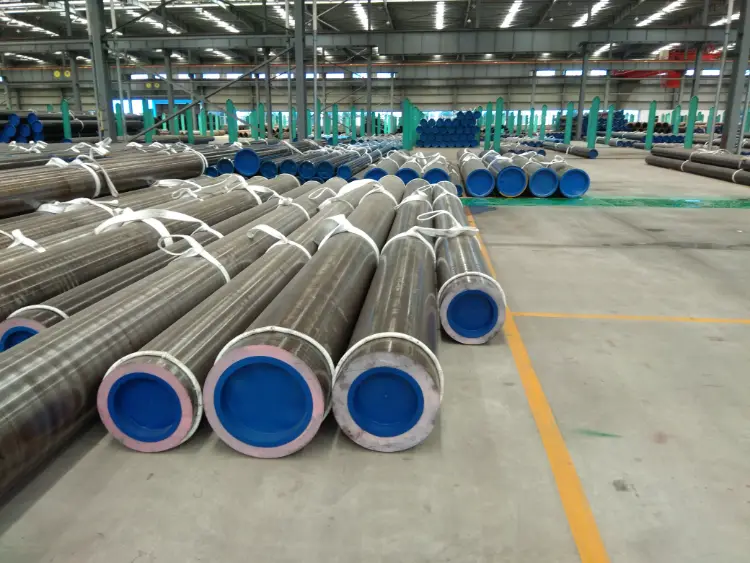
S500Q Quenched & Tempered Steel for LSAW Pipe
S500Q Quenched & Tempered Steel for LSAW Pipe - EN 10025-6 Properties & Applications
Complete material data for S500Q structural steel according to EN 10025-6: chemical composition, mechanical and physical properties, international equivalents, and LSAW pipe applications.
Hot forming, cold forming (bending, rolling), welding (all common methods with appropriate consumables), oxy-fuel and plasma cutting, machining
- Phone : +8618037372205
- Email : [email protected]
- WhatsApp: Contact via Whtsapp
- WeChat: +8618037372205
S500Q Quenched & Tempered Steel for LSAW Pipe Introduction
S500Q is a high-strength quenched and tempered structural steel defined in EN 10025‑6. With a minimum yield strength of 500 MPa for thickness ≤50 mm, it is designed for heavily loaded welded structures. The 'Q' designation indicates delivery in the quenched and tempered condition, providing an excellent combination of strength, toughness, and weldability. Typical applications include longitudinal submerged arc welded (LSAW) pipes, heavy machinery, bridges, and offshore structures. The steel exhibits good low‑temperature toughness (Charpy V‑notch ≥30 J at 0°C) and can be processed by hot forming, cold bending, and welding, subject to established procedures. Main features:
- High yield strength up to 500 MPa (thin gauge)
- Good weldability with controlled carbon equivalent
- Delivered quenched and tempered for uniform mechanical properties
- Suitable for LSAW pipe fabrication and demanding structural applications
S500Q Quenched & Tempered Steel for LSAW Pipe Chemical Composition
Chemical composition limits according to EN 10025-6:2004, Table 1 and Table 2. For S500Q the values apply to product thickness ≤150 mm. The steel is fully killed and contains grain‑refining elements (Al, Nb, V, Ti). The carbon equivalent CEV is limited to ensure weldability (see 'other' notes).
| Element | Standard Value (max unless stated) | Remarks |
|---|---|---|
| Carbon (C) | ≤0.20 | For thickness ≤50 mm; for >50 mm max 0.22 |
| Silicon (Si) | ≤0.80 | |
| Manganese (Mn) | ≤1.70 | |
| Phosphorus (P) | ≤0.020 | |
| Sulfur (S) | ≤0.010 | |
| Aluminium (Al) | ≥0.018 (total) | Minimum for fine grain practice; acid‑soluble Al may be specified |
| Nitrogen (N) | ≤0.015 | |
| Chromium (Cr) | ≤1.50 | |
| Copper (Cu) | ≤0.50 | |
| Molybdenum (Mo) | ≤0.70 | |
| Niobium (Nb) | ≤0.06 | |
| Nickel (Ni) | ≤2.0 | |
| Titanium (Ti) | ≤0.05 | Combined with Nb and V may be limited to 0.12% |
| Vanadium (V) | ≤0.12 | |
| Boron (B) | ≤0.005 | If added, must be fully killed |
| Zirconium (Zr) | ≤0.15 |
S500Q Quenched & Tempered Steel for LSAW Pipe Physical Properties
Physical properties are typical for quenched and tempered fine‑grain structural steel and are not mandatory requirements of EN 10025‑6. Values are valid for a temperature of ~20°C unless otherwise stated. Data compiled from EN 1993‑1‑1 and common steel reference sources.
| Property | Standard Requirement (Typical) | Unit | Test Conditions |
|---|---|---|---|
| Density (ρ) | 7850 | kg/m³ | 20°C |
| Elastic modulus (E) | 210 | GPa | 20°C |
| Shear modulus (G) | ≈81 | GPa | 20°C (calculated using ν=0.3) |
| Poisson's ratio (ν) | 0.3 | – | Elastic range, 20°C |
| Thermal expansion coefficient (α) | 12.0 × 10⁻⁶ | K⁻¹ | 20 – 100°C |
| Thermal conductivity (λ) | 50 – 55 | W/(m·K) | 20°C |
| Specific heat capacity (cp) | ≈460 | J/(kg·K) | 20°C |
| Electric resistivity (ρe) | ≈0.16 | Ω·mm²/m (µΩ·m) | 20°C |
S500Q Quenched & Tempered Steel for LSAW Pipe Mechanical Properties
Tensile properties are based on EN 10025‑6 Table 5 (transverse test pieces). Minimum values for S500Q vary with product thickness. Charpy impact properties are given for longitudinal and transverse specimens at 0°C (Quality Q).
| Property | Standard Requirement | Unit | Test Conditions / Thickness |
|---|---|---|---|
| Yield Strength (ReH) | ≥500 | MPa | t ≤50 mm |
| Yield Strength (ReH) | ≥480 | MPa | 50 mm < t ≤100 mm |
| Yield Strength (ReH) | ≥440 | MPa | 100 mm < t ≤150 mm |
| Tensile Strength (Rm) | 590 – 770 | MPa | t ≤100 mm |
| Tensile Strength (Rm) | 540 – 720 | MPa | 100 mm < t ≤150 mm |
| Elongation (A) | ≥14 | % | Gauge L₀=5.65√S₀, t ≤40 mm, longitudinal |
| Elongation (A) | ≥12 | % | t ≤40 mm, transverse |
| Elongation (A) | ≥14 | % | 40 mm < t ≤100 mm, longitudinal (depending on subgrade) |
| Charpy V‑notch impact energy (KV) | ≥30 (longitudinal) | J | 0°C, 10×10 mm specimen |
| Charpy V‑notch impact energy (KV) | ≥27 (transverse) | J | 0°C, 10×10 mm specimen |
S500Q Quenched & Tempered Steel for LSAW Pipe Fully Equivalent Material Standards and Replaceable Grades
| Country/Region | Standard | Grade | Remarks |
|---|---|---|---|
| International (ISO) | ISO 630‑3:2012 | S500Q | Identical technical delivery conditions; heat treatment, chemistry and mechanics match EN 10025‑6 |
| Europe | EN 10025‑6:2004 | S500QL | Higher toughness at -20°C; same strength and chemistry, but impact requirements differ; may replace S500Q where low‑temperature service is needed |
| Europe | EN 10025‑6:2004 | S500QL1 | Toughness assured at -40°C; same base grade, interchangeable after agreement |
S500Q Quenched & Tempered Steel for LSAW Pipe Application Introduction
S500Q combines high strength with good cold formability and weldability, making it ideal for heavy‑duty welded structures and pipes. The most common product form is LSAW (Longitudinal Submerged Arc Welded) pipe, which exploits the uniform properties of quenched and tempered plate. The following summarises typical uses:
Product Applications: LSAW line pipe (API 5L / EN 10219 / ISO 3183 compliant if processed accordingly), Welded structural hollow sections (circular, rectangular), Heavy‑duty plate girders and box columns, Offshore structural elements (jack‑up legs, tubular joints), Industrial storage tanks and silos
Processed into products: Pipe spools and fittings (elbows, tees, flanges) manufactured from S500Q plates, Crane reach beams and boom sections, Bridge deck panels and orthotropic segments, Transition pieces and monopile connections for offshore wind turbines, Welded T‑nodes, K‑nodes for offshore jacket structures, Pressure vessel cylinders and dished ends (subject to code approvals)
Application industries: Oil and gas transmission (onshore and offshore pipelines), Offshore and marine engineering (platforms, jackets, wind turbine foundations), Civil and structural engineering (bridges, stadiums, high‑rise buildings), Heavy machinery and transport (crane telescopic booms, chassis frames), Pressure vessel and boiler fabrication (shells for high‑pressure service), Shipbuilding (hull structural components)
S500Q Quenched & Tempered Steel for LSAW Pipe Similar / Alternative Materials
| Country/Region | Standard | Grade | Remarks |
|---|---|---|---|
| USA | ASTM A514/A514M | Type Q (or others) | Quenched & tempered alloy plate; minimum yield 690 MPa (100 ksi) > S500Q. Usable where higher strength allows substitution, but welding and fabrication require adjustments. |
| USA | ASTM A709/A709M | HPS 70W (Grade 70W) | High‑performance steel for bridges; minimum yield 485 MPa (~70 ksi). Slightly lower yield than S500Q, but similar toughness and weldability. Suitable alternative after design review. |
| Japan | JIS G3106 | SM570 | Rolled structural steel; minimum yield 460 MPa, tensile 570–720 MPa. Lower strength than S500Q, but used in similar welded applications. Not a direct replacement. |
| China | GB/T 16270‑2009 | Q500D / Q500E | Quenched and tempered high‑strength structural steel; minimum yield 500 MPa (D: -20°C impact, E: -40°C). Very close to S500Q (Q500D corresponds approximately to S500QL). May be substituted after verification. |
Notes:
Carbon equivalent (CEV) is limited according to EN 10025‑6, typically CEV ≤ 0.52 for S500Q (t ≤ 50 mm), ensuring good weldability without excessive preheat. Heat treatment: The steel is delivered in the quenched and tempered (+QT) condition. Hot forming above 580°C may alter mechanical properties; re‑tempering may be required. Weldability: All common arc welding methods are applicable; low‑hydrogen electrodes and moderate preheat (depending on thickness and CEV) are recommended. LSAW pipe manufacturing: Uses S500Q plates formed cold or post‑heated to produce longitudinal welded pipes normally conforming to EN 10219 or API 5L specifications (when applicable). Supplementary requirements: For sour service (HIC/SSC) or elevated temperature, the standard grade needs additional testing and agreements. The user should refer to the full standard and material certificates for actual properties.
- Share



