
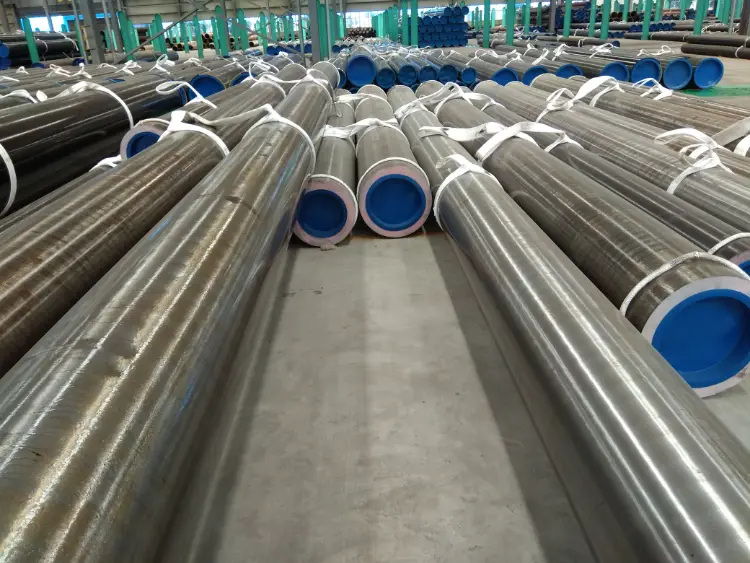
EN 10025-6 S460QL LSAW Pipe Steel
EN 10025-6 S460QL LSAW Pipe Steel: Properties, Equivalents, and Applications
Comprehensive data for EN 10025-6 S460QL steel used in LSAW pipe manufacturing, including chemical composition, mechanical properties, physical properties, international equivalents, and application guidance.
Hot rolling, quenching and tempering, forming, welding (e.g., LSAW pipe manufacturing)
- Phone : +8618037372205
- Email : [email protected]
- WhatsApp: Contact via Whtsapp
- WeChat: +8618037372205
EN 10025-6 S460QL LSAW Pipe Steel Introduction
EN 10025-6 S460QL is a quenched and tempered fine-grain structural steel with a minimum yield strength of 460 MPa. It is widely used in the production of LSAW (Longitudinal Submerged Arc Welded) pipes for demanding applications. The steel offers an excellent combination of high strength, good toughness at low temperatures (-40 °C), and good weldability when proper procedures are followed. Typical applications include offshore structures, pressure vessels, bridges, heavy machinery, and oil & gas pipelines. The QL designation indicates a minimum impact energy of 27 J at -40 °C, making it suitable for low-temperature service.
EN 10025-6 S460QL LSAW Pipe Steel Chemical Composition per EN 10025-6
The following table lists the chemical composition requirements for S460QL according to EN 10025-6:2019. Values are mass percent unless otherwise noted. The limits are based on heat analysis. Note: Additional elements like Al are required for fine grain practice but not individually specified in the basic table.
| Element | Content (%) | Remarks |
|---|---|---|
| C (Carbon) | ≤ 0.20 | |
| Si (Silicon) | ≤ 0.80 | |
| Mn (Manganese) | ≤ 1.70 | |
| P (Phosphorus) | ≤ 0.020 | |
| S (Sulfur) | ≤ 0.010 | |
| N (Nitrogen) | ≤ 0.015 | |
| B (Boron) | ≤ 0.0050 | |
| Cr (Chromium) | ≤ 1.50 | |
| Cu (Copper) | ≤ 0.50 | |
| Mo (Molybdenum) | ≤ 0.70 | |
| Nb (Niobium) | ≤ 0.06 | |
| Ni (Nickel) | ≤ 2.0 | |
| Ti (Titanium) | ≤ 0.05 | |
| V (Vanadium) | ≤ 0.12 | |
| Zr (Zirconium) | ≤ 0.15 |
EN 10025-6 S460QL LSAW Pipe Steel Thermal and Electrical Physical Properties
The following physical properties are typical for S460QL steel at ambient temperature unless otherwise noted. These values are not part of EN 10025-6 but represent common data for low-alloy structural steels. They may vary slightly with specific heat treatment and composition. Note: For LSAW pipe applications, these properties are generally applicable to the base metal.
| Property | Typical Value | Unit | Test Condition / Remarks |
|---|---|---|---|
| Density (ρ) | 7.85 | g/cm³ | at 20 °C |
| Elastic modulus (E) | 210 | GPa | at 20 °C, static |
| Shear modulus (G) | 80 | GPa | at 20 °C |
| Poisson's ratio (ν) | 0.3 | — | at 20 °C |
| Thermal expansion coefficient (α) | 12 | 10⁻⁶/K | 20 – 100 °C |
| Thermal conductivity (λ) | 50 | W/(m·K) | at 20 °C |
| Specific heat capacity (c) | 480 | J/(kg·K) | at 20 °C |
| Electrical resistivity (ρe) | 0.2 | μΩ·m | at 20 °C |
EN 10025-6 S460QL LSAW Pipe Steel Mechanical Properties of S460QL
Mechanical properties according to EN 10025-6:2019 for the quenched and tempered condition. Values are minimum unless a range is given. The QL suffix indicates impact testing at -40 °C. Multi-row entries cover different thickness ranges as per the standard. Note: Properties apply to base material. For LSAW pipes, the weld joint may have different values and requires separate qualification.
| Property | Value | Unit | Test Condition / Thickness Range |
|---|---|---|---|
| Yield strength (ReH) | ≥ 460 | MPa | t ≤ 50 mm |
| Yield strength (ReH) | ≥ 440 | MPa | 50 < t ≤ 100 mm |
| Yield strength (ReH) | ≥ 400 | MPa | 100 < t ≤ 200 mm |
| Tensile strength (Rm) | 550 – 720 | MPa | t ≤ 100 mm |
| Tensile strength (Rm) | 500 – 670 | MPa | 100 < t ≤ 200 mm |
| Elongation (A, L0=5.65√S0) | ≥ 17 | % | t ≤ 40 mm (longitudinal) |
| Elongation (A, L0=5.65√S0) | ≥ 17 | % | 40 < t ≤ 63 mm (longitudinal) |
| Elongation (A, L0=5.65√S0) | ≥ 16 | % | 63 < t ≤ 100 mm (longitudinal) |
| Elongation (A, L0=5.65√S0) | ≥ 15 | % | 100 < t ≤ 200 mm (longitudinal) |
| Impact energy (KV2) | ≥ 27 | J | at -40 °C (longitudinal, for all thicknesses) |
| Bend test (180°) | Mandrel diameter = 3t (no cracking) | — | t ≤ 16 mm |
| Bend test (180°) | Mandrel diameter = 4t (no cracking) | — | 16 < t ≤ 50 mm |
| Bend test (180°) | Mandrel diameter = 5t (no cracking) | — | 50 < t ≤ 100 mm |
| Bend test (180°) | Mandrel diameter = 6t (no cracking) | — | 100 < t ≤ 200 mm |
EN 10025-6 S460QL LSAW Pipe Steel Fully Equivalent Material Standards and Replaceable Grades
| Country/Region | Standard | Grade | Remarks |
|---|---|---|---|
| European Union | EN 10025-6:2019 | S460QL (1.8906) | Original grade |
| United Kingdom | BS EN 10025-6:2019 | S460QL | Identical adoption |
| Germany | DIN EN 10025-6:2019 | S460QL | Identical adoption |
| France | NF EN 10025-6:2019 | S460QL | Identical adoption |
| Italy | UNI EN 10025-6:2019 | S460QL | Identical adoption |
| Spain | UNE EN 10025-6:2019 | S460QL | Identical adoption |
EN 10025-6 S460QL LSAW Pipe Steel Application Introduction
S460QL is extensively used in heavy-duty welded structures where high strength and low-temperature toughness are required. The LSAW pipe produced from this grade is especially suitable for:
- Oil and gas transmission pipelines (onshore and offshore)
- Structural supports for offshore platforms (jacket legs, risers, nodes)
- Pressure vessels and storage tanks
- Bridge construction and civil engineering projects
- Heavy machinery and crane components
Product Applications: LSAW pipe and line pipe, Structural hollow sections, Fittings and flanges, Pressure vessel shells, Bridges and steel structures, Crane booms and heavy-duty frames
Processed into products: Pipeline segments, Offshore jacket legs and braces, Risers and conductors, Wind turbine tower sections, Heavy-wall pressure vessel parts, Welded structural joints
Application industries: Oil & Gas, Offshore & Marine, Heavy Engineering, Civil Construction & Infrastructure, Renewable Energy (wind turbine towers), Pressure Vessel Manufacturing
EN 10025-6 S460QL LSAW Pipe Steel Similar / Alternative Material Grades
| Country/Region | Standard | Grade | Remarks |
|---|---|---|---|
| EU | EN 10025-6 | S460Q | Same strength and chemistry; impact test at 0 °C or -20 °C instead of -40 °C |
| EU | EN 10025-6 | S500QL | Higher yield strength (500 MPa), similar toughness, potential substitute for higher loads |
| EU | EN 10025-4 | S460M | Thermomechanically rolled (not Q+T), lower carbon equivalent, may not match toughness |
| USA | ASTM A514/A514M | Grade B | Quenched and tempered, 690 MPa yield, requires careful welding, not a direct replacement |
| China | GB/T 1591 | Q460D | High strength low alloy structural steel, -20 °C impact, different delivery condition |
| China | GB/T 16270 | Q460E | High strength quenched and tempered steel, -40 °C, may be closer but still requires comparison |
Notes:
For LSAW pipe fabrication, preheating and Post Weld Heat Treatment (PWHT) are often required depending on thickness and service conditions. Welding consumables should be matched to achieve similar mechanical properties. Post-weld inspection (UT, RT) is recommended for critical applications. Note: Always refer to the latest edition of EN 10025-6 and project specifications for detailed requirements.
- Share



