
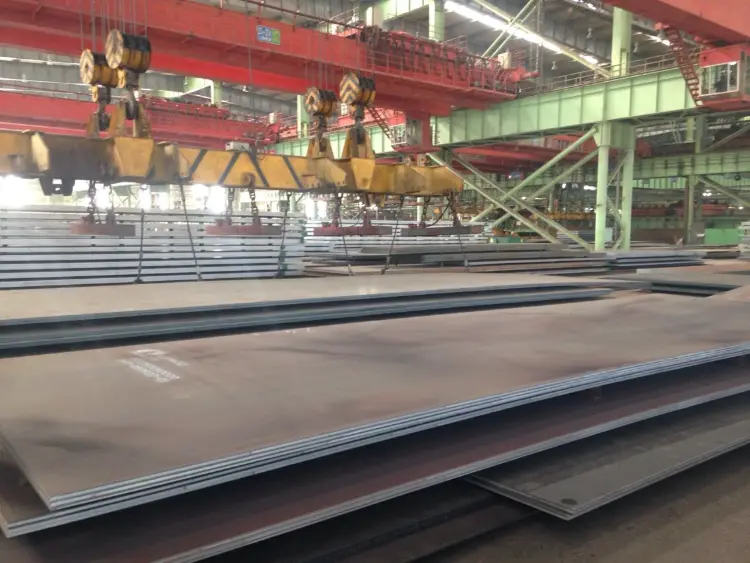
S460Q EN 10025-6
S460Q EN 10025-6 Quenched & Tempered Structural Steel for LSAW Pipe Applications
Comprehensive material data for S460Q high-strength structural steel per EN 10025-6:2019, widely used in longitudinal submerged arc welded (LSAW) pipe manufacturing. Includes chemical composition, mechanical properties, physical data, and equivalent grades.
Quenching & tempering (Q+T); welding (submerged arc, LSAW); cold forming; hot forming (controlled)
- Phone : +8618037372205
- Email : [email protected]
- WhatsApp: Contact via Whtsapp
- WeChat: +8618037372205
S460Q EN 10025-6 Introduction
S460Q is a high‑yield quenched and tempered weldable fine‑grain structural steel specified in EN 10025‑6. It delivers a minimum yield strength of 460 MPa in thicknesses up to 50 mm, combined with excellent toughness down to ‑20 °C (Q‑quality). The quenched and tempered (Q + T) condition provides a favourable strength‑toughness balance, good formability and reliable weldability. Typical applications include heavily loaded welded structures, such as long‑span bridges, offshore platforms, cranes, earthmoving equipment, and pressure vessels. In the form of LSAW (longitudinal submerged arc welded) pipes, S460Q is employed for high‑pressure oil and gas transmission lines, structural piling and subsea pipelines where high strength and resistance to brittle fracture are essential.
S460Q EN 10025-6 Chemical Composition
Indicative ladle analysis limits according to EN 10025-6:2019 Table 1 for grade S460Q. All values are maximum except where ranges are given. Elements not included in the table shall not be intentionally added without agreement between manufacturer and purchaser. Aluminium acts as a grain‑refiner but the minimum total Al content may be waived if other nitrogen‑binding elements are present.
| Element | Value (wt.%) | Remarks |
|---|---|---|
| Carbon (C) | ≤ 0.20 | Ladle analysis |
| Silicon (Si) | ≤ 0.80 | Ladle analysis |
| Manganese (Mn) | ≤ 1.70 | Ladle analysis |
| Phosphorus (P) | ≤ 0.025 | Ladle analysis |
| Sulfur (S) | ≤ 0.015 | Ladle analysis |
| Chromium (Cr) | ≤ 1.50 | Ladle analysis |
| Nickel (Ni) | ≤ 2.00 | Ladle analysis |
| Molybdenum (Mo) | ≤ 0.70 | Ladle analysis |
| Copper (Cu) | ≤ 0.50 | Ladle analysis |
| Vanadium (V) | ≤ 0.12 | Ladle analysis |
| Niobium (Nb) | ≤ 0.06 | Ladle analysis |
| Titanium (Ti) | ≤ 0.05 | Ladle analysis |
| Nitrogen (N) | ≤ 0.015 | Ladle analysis |
| Boron (B) | ≤ 0.005 | Ladle analysis |
| Aluminium (Al) total | ≥ 0.020 (if required for fine‑grain practice) | Optional; may be omitted if alternative grain‑refinement is verified |
S460Q EN 10025-6 Typical Physical Properties
Approximate reference data for quenched and tempered low‑alloy structural steel. These values are not specified in EN 10025-6 but characterise the typical behaviour of S460Q‑type steels for engineering calculations.
| Property | Value | Unit | Test Condition / Temperature |
|---|---|---|---|
| Density (ρ) | 7850 | kg/m³ | 20 °C |
| Elastic modulus (E) | 210 | GPa | 20 °C |
| Shear modulus (G) | 81 | GPa | 20 °C |
| Poisson's ratio (ν) | 0.3 | – | 20 °C |
| Thermal expansion coefficient (α) | 12.0 | 10⁻⁶/K | 20 – 100 °C |
| Thermal expansion coefficient (α) | 13.0 | 10⁻⁶/K | 20 – 200 °C |
| Thermal expansion coefficient (α) | 13.5 | 10⁻⁶/K | 20 – 300 °C |
| Thermal conductivity (λ) | 45 | W/(m·K) | 20 °C |
| Specific heat capacity (cp) | 460 | J/(kg·K) | 20 °C |
| Electrical resistivity (ρe) | 0.20 | μΩ·m | 20 °C |
S460Q EN 10025-6 Mechanical Properties – Minimum Requirements
Mechanical properties for flat products (plates) in quenched and tempered condition per EN 10025-6:2019 Table 2. Tensile test is transverse; impact test is longitudinal (L) and transverse (T). The impact energy applies to the specified quality Q (‑20 °C). The values are valid for product thicknesses up to 150 mm.
| Property | Value | Unit | Test Condition / Thickness |
|---|---|---|---|
| Yield strength (ReH min.) | 460 | MPa | Thickness ≤ 50 mm |
| Yield strength (ReH min.) | 440 | MPa | 50 < thickness ≤ 100 mm |
| Yield strength (ReH min.) | 400 | MPa | 100 < thickness ≤ 150 mm |
| Tensile strength (Rm) | 550 – 720 | MPa | Thickness ≤ 50 mm |
| Tensile strength (Rm) | 550 – 720 | MPa | 50 < thickness ≤ 100 mm |
| Tensile strength (Rm) | 500 – 670 | MPa | 100 < thickness ≤ 150 mm |
| Elongation after fracture (A min.) | 17 | % | Thickness ≤ 150 mm (Lo = 5.65√So) |
| Impact energy (KV min.) longitudinal | 40 | J | At -20 °C, 10×10 mm specimen |
| Impact energy (KV min.) transverse | 27 | J | At -20 °C, 10×10 mm specimen |
S460Q EN 10025-6 Direct Equivalents and International Substitutes
| Country/Region | Standard | Grade | Remarks |
|---|---|---|---|
| Germany | DIN EN 10025-6 | S460Q | Identical to EN 10025-6 |
| France | NF EN 10025-6 | S460Q | Identical to EN 10025-6 |
| United Kingdom | BS EN 10025-6 | S460Q | Identical to EN 10025-6 |
| Italy | UNI EN 10025-6 | S460Q | Identical to EN 10025-6 |
| Spain | UNE EN 10025-6 | S460Q | Identical to EN 10025-6 |
| International | ISO 4950-2:1995 | E460DD | Comparable high‑yield QT steel; verify tensile‑yield ratio and impact requirements |
| China | GB/T 16270-2009 | Q460D | Similar min. yield 460 MPa and ‑20 °C impact; check QT delivery condition availability |
S460Q EN 10025-6 Application Introduction
S460Q steel offers an optimum combination of high strength, good weldability and sufficient ductility, making it an excellent choice for welded fabrications subjected to static and dynamic loads. Its quenched and tempered microstructure ensures reliable performance in safety‑critical structures. In the LSAW pipe sector, it allows for reduced wall thickness while maintaining pressure‑retaining capacity, thus lowering material cost and welding volume.
Product Applications: Longitudinal submerged‑arc welded (LSAW) pipes for oil, gas and water transport, Spiral welded pipes (SSAW) from S460Q coil, Welded plate girders and box columns for bridges, Heavy‑duty crane booms and lattice masts, Hydraulic cylinder bodies and piston rods, Structural hollow sections for offshore and architectural applications
Processed into products: Pipe segments, bends and tees for pipeline systems, Flanges, stiffeners and end plates for welded assemblies, Welded joints and transition pieces in subsea risers, Load‑bearing brackets, pins and bushings in machinery, Cut‑to‑size parts for fabricators of heavy equipment
Application industries: Oil & gas (onshore and offshore pipelines, transmission lines), Offshore engineering (jackets, topsides, subsea structures), Civil engineering / bridge building (plate girders, box girders), Heavy‑lift and cargo handling (mobile cranes, spreader bars, lifting beams), Mining and earthmoving equipment (dump bodies, excavator booms), Pressure vessel and storage tank construction (high‑pressure shells)
S460Q EN 10025-6 Materials with Similar Mechanical Performance
| Country/Region | Standard | Grade | Remarks |
|---|---|---|---|
| Europe | EN 10025-3 | S460N | Normalised/normalised rolled; same min. yield but lower minimum toughness temperature (‑20 °C) depending on quality; different processing route |
| Europe | EN 10025-4 | S460M | Thermomechanically rolled; similar strength, toughness class M (‑20 °C) or ML (‑50 °C); often used for heavy plates without QT |
| Europe | EN 10025-6 | S460QL | QT condition with improved toughness at ‑40 °C (QL) or ‑60 °C (QL1); suitable for even more demanding low‑temperature applications |
| USA | ASTM A709 / A709M | 50W [345 MPa] | Lower strength class (345 MPa); not a direct substitute but used in bridges with corrosion resistance requirements; consider higher grade HPS 70W for similar strength |
Notes:
Welding considerations: S460Q steel requires low‑hydrogen welding processes and preheat/interpass temperature control depending on thickness and carbon equivalent. Post‑weld heat treatment (PWHT) may be applied, but the material's QT condition should not be unintentionally altered.
Through‑thickness properties: For demanding applications with high restraint, Z‑quality grades (Z15, Z25, Z35) to EN 10164 can be supplied upon agreement.
Surface condition: The steel is normally delivered in the as‑tempered surface; scale removal (shot blasting, primer) is possible by arrangement.
LSAW pipe specifics: In pipe production, the plate is formed and welded; the weld seam properties shall meet the same requirements as the parent metal. Verify that the pipe manufacturer performs appropriate weld procedure qualification and NDT inspection.
- Share



