
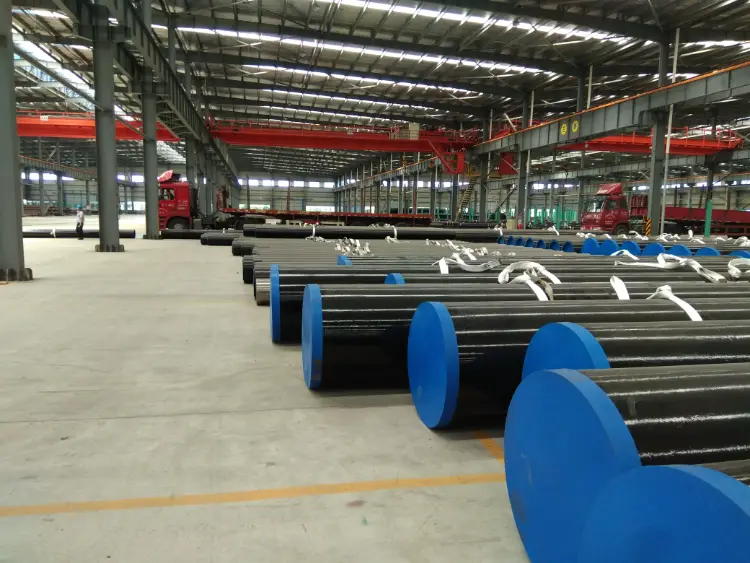
ASTM A252 Grade C LSAW Pipe
ASTM A252 Grade C LSAW Pipe: High-Strength Steel Pile for Foundation and Marine Applications
Comprehensive material data for ASTM A252 Grade C LSAW pipe, including chemical composition, mechanical properties, thermal and electrical physical properties, international equivalents, and application guidance for piling and structural engineering.
Welding (submerged arc welding), forming, optional expansion, heat treatment by manufacturer's option
- Phone : +8618037372205
- Email : [email protected]
- WhatsApp: Contact via Whtsapp
- WeChat: +8618037372205
ASTM A252 Grade C LSAW Pipe Introduction
ASTM A252 Grade C is a carbon steel grade specified for welded and seamless steel pipe piles used in deep foundations, marine structures, and heavy civil construction. It is the highest strength grade in the A252 standard, offering a minimum yield strength of 345 MPa (50 ksi) and minimum tensile strength of 485 MPa (70 ksi). This LSAW (Longitudinal Submerged Arc Welded) pipe is characterized by good weldability, high load-bearing capacity, and suitability for driving into challenging ground conditions. The standard does not prescribe full chemical composition, leaving alloy design to the manufacturer while mandating limits on phosphorus and sulfur to ensure ductility and weldability. Typical applications include bridge piers, offshore platforms, retaining walls, and building foundations. The pipe is supplied in the as-welded condition, often with optional coating for corrosion protection.
ASTM A252 Grade C LSAW Pipe Chemical Composition
According to ASTM A252, the steel composition is not fully defined; only phosphorus and sulfur have mandated maximum limits to ensure ductility and weldability in the pipe pile. The manufacturer selects other elements (C, Mn, Si, etc.) to achieve the required mechanical properties. Typical carbon-manganese structural steel compositions are used.
| Chemical Element | Specified Value (max) | Remarks |
|---|---|---|
| Phosphorus (P) | 0.050% | Maximum allowed for all grades |
| Sulfur (S) | 0.045% | Maximum allowed for all grades |
| Carbon (C) | Not specified | Controlled by manufacturer to meet mechanical properties |
| Manganese (Mn) | Not specified | Controlled by manufacturer |
| Silicon (Si) | Not specified | Added for deoxidation as needed |
| Other elements | Not specified | Residual elements within normal limits for structural steel |
ASTM A252 Grade C LSAW Pipe Thermal and Electrical Physical Properties
The following values are typical for carbon structural steel similar to that used in ASTM A252 Grade C. They are not mandated by the product standard but are useful for design calculations such as heat transfer, welding preheat, and electrical conductivity. Actual values may vary slightly depending on exact chemical composition.
| Property | Typical Value | Unit | Test Condition |
|---|---|---|---|
| Density (ρ) | 7.85 | g/cm³ | At room temperature |
| Elastic Modulus (E) | 200–210 | GPa | Tension/compression; room temperature |
| Shear Modulus (G) | 80 | GPa | Calculated from E and ν |
| Poisson's Ratio (ν) | 0.30 | – | Room temperature |
| Thermal Expansion Coefficient (α) | 11.7 × 10⁻⁶ | /K | Between 20°C and 100°C |
| Thermal Conductivity (λ) | 51.9 | W/(m·K) | At 20°C |
| Specific Heat Capacity (c) | 486 | J/(kg·K) | At 20°C |
| Electrical Resistivity (ρ_e) | 0.143 | Ω·mm²/m | At 20°C |
ASTM A252 Grade C LSAW Pipe Mechanical Properties
Mechanical properties for ASTM A252 Grade C pipe are defined for the finished product. The values are minimum unless noted. Elongation is measured on a gauge length of 50 mm (2 in) or 200 mm (8 in) depending on wall thickness. Bend test is required for welded pipe of NPS 14 and smaller, unless otherwise specified. No impact toughness is required by the standard.
| Property | Specified Value | Unit | Test Condition |
|---|---|---|---|
| Yield Strength (ReH) | ≥ 345 | MPa | 0.5% extension under load or 0.2% offset method |
| Tensile Strength (Rm) | ≥ 485 | MPa | Transverse or longitudinal specimen per specification |
| Elongation (A) | ≥ 18 | % | Gauge length 50 mm (2 in); for wall thickness ≤ 8 mm |
| Elongation (A) | ≥ 15 | % | Gauge length 200 mm (8 in); for wall thickness > 8 mm |
| Bend Test | No cracks or ruptures | – | Bend diameter = 4 × wall thickness; 180°; only for welded pipe NPS ≤ 14 |
ASTM A252 Grade C LSAW Pipe Completely Equivalent Material Standards and Substitutable Grades
While no other standard is an exact copy of ASTM A252 Grade C (as A252 is specific to pipe piles), the following standards define steel pipes with comparable strength and application suitability. Direct substitution should be confirmed with design codes and service conditions.
| Country/Region | Standard | Grade/Designation | Remarks |
|---|---|---|---|
| Europe | EN 10219-1 | S355J2H | Cold-formed welded structural hollow section; similar yield and tensile strength; impact properties at -20°C; often interchangeable for piling if approved |
| Europe | EN 10219-1 | S355MH | Thermomechanical rolled hollow section; lower residual stress; suitable for piling |
| Japan | JIS A5525 | SPS490 | Steel pipe pile; minimum yield 315 MPa; slightly lower strength than Grade C but used in similar applications |
| International | ISO 630-2 | S355J0H | Structural steel hollow section; comparable strength |
ASTM A252 Grade C LSAW Pipe Application Introduction
ASTM A252 Grade C LSAW pipe is designed for heavy-load bearing applications in deep foundations and marine environments. Its high strength allows for reduced wall thickness compared to lower grades, saving weight and cost. The LSAW process ensures consistent weld quality and dimensional accuracy. The pipe can be supplied with protective coatings (e.g., coal tar epoxy, fusion-bonded epoxy) to resist soil and seawater corrosion. It is suitable for splicing by welding or mechanical connectors and driving with impact hammers. Typical industries and products include:
Product Applications: Pipe piles for foundation support, Caisson shells, Mooring dolphins, Retaining wall piles (soldier piles), Trestle piles
Processed into products: Driven open-end or closed-end pipe piles, Spliced pile segments, Pile caps and connectors, Anchoring systems for retaining walls, Structural columns in submerged conditions
Application industries: Civil infrastructure (bridges, highways, high-rise buildings), Marine and offshore engineering (docks, jetties, breakwaters), Coastal protection and seawalls, Oil & gas (offshore platform substructures), Waterfront development, Foundation engineering (bored piles, driven piles)
ASTM A252 Grade C LSAW Pipe Closely Related / Similar Alternative Materials
These materials are not direct substitutes for ASTM A252 Grade C based on standard scope, but share similar mechanical ranges and may be considered with engineering evaluation for structural pipe applications.
| Country/Region | Standard | Grade/Designation | Remarks |
|---|---|---|---|
| USA | ASTM A53 | Grade B | Pipe for pressure and mechanical applications; min yield 240 MPa, lower strength; may need thicker wall |
| USA / International | API 5L | Grade B or X42 | Line pipe; Grade B yields 241 MPa; X42 yields 289 MPa; lower than Grade C; used in pipelines, not piles |
| USA | ASTM A500 | Grade C | Cold-formed welded structural tubing; yield 345 MPa same as Grade C, but different dimension range and intended for structures |
| China | GB/T 9711 | L360 (X52) | Pipeline steel; yield 360 MPa; higher strength but not designed as pipe pile; may be acceptable with qualification |
Notes:
- ASTM A252 does not require hydrostatic testing unless specified; pipe is primarily a structural element.
- Welds are not normally post-weld heat treated for Grade C.
- Dimensional tolerances (diameter, wall thickness, straightness) are per the standard.
- For aggressive environments, additional corrosion allowance (3–5 mm) may be added beyond the structural wall thickness.
- When driven into hard strata, driving shoes can be welded to the pipe tip.
- Share



