
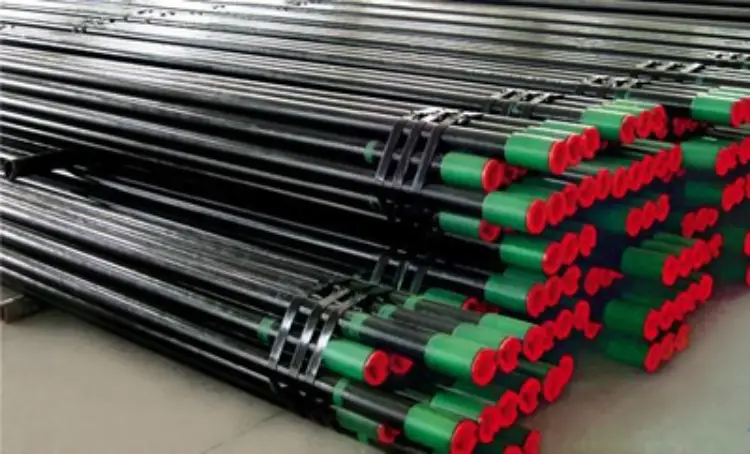
EN 10025-6 S460QL1 Quenched & Tempered Steel for LSAW Pipes
EN 10025-6 S460QL1 Quenched & Tempered Steel for LSAW Pipes - Full Data & Equivalents
Complete material data for S460QL1 as per EN 10025-6, covering chemical composition, mechanical and physical properties, international equivalents, similar grades, and application guide for LSAW pipe usage.
LSAW welding, hot bending, cold forming, cutting, machining, preheating and post‑weld heat treatment may be required for thick sections
- Phone : +8618037372205
- Email : [email protected]
- WhatsApp: Contact via Whtsapp
- WeChat: +8618037372205
EN 10025-6 S460QL1 Quenched & Tempered Steel for LSAW Pipes Introduction
EN 10025-6 S460QL1 is a European quenched and tempered fine‑grain structural steel with a minimum yield strength of 460 MPa. The designation "Q" indicates quenching and tempering, "L" stands for low‑temperature toughness at -20 °C, and "L1" guarantees impact energy at -40 °C. This grade combines high strength with excellent weldability and good notch ductility, making it particularly suitable for LSAW (Longitudinal Submerged Arc Welded) pipes in demanding applications. The base material is supplied as hot‑rolled plate or strip, then formed and welded into large‑diameter pipes. Chemical composition is strictly controlled with low carbon equivalent values to ensure reliable weldability without the need for excessive preheat. Micro‑alloying with niobium, vanadium, and titanium refines the grain structure, enhancing both strength and toughness. S460QL1 is widely used in offshore structures, pressure vessels, bridges, heavy‑duty cranes, and pipeline systems where a combination of high load‑bearing capacity, low‑temperature service, and good fabricability is required. The quenched and tempered condition provides uniform mechanical properties through the thickness, making it reliable even in thick‑walled sections.
EN 10025-6 S460QL1 Quenched & Tempered Steel for LSAW Pipes Chemical Composition
Typical limits as per EN 10025‑6 for the S460QL1 grade. All values are maximum unless stated otherwise. The low carbon equivalent and controlled micro‑alloying ensure excellent weldability and consistent mechanical properties.
| Element | Standard Value | Remarks |
|---|---|---|
| Carbon (C) | ≤ 0.20 | For thickness ≤ 100 mm |
| Silicon (Si) | ≤ 0.60 | Typical for deoxidation |
| Manganese (Mn) | ≤ 1.70 | Improves strength and hardenability |
| Phosphorus (P) | ≤ 0.020 | Strict control for toughness |
| Sulfur (S) | ≤ 0.010 | Low to avoid hot cracking |
| Nitrogen (N) | ≤ 0.015 | Limits ageing effects |
| Aluminium (Al total) | ≥ 0.015 | Minimum for grain refinement |
| Niobium (Nb) | ≤ 0.06 | Grain refiner and precipitation strengthener |
| Vanadium (V) | ≤ 0.12 | Similar role as Nb |
| Titanium (Ti) | ≤ 0.05 | Grain size control and nitrogen fixation |
| Chromium (Cr) | ≤ 1.0 | Hardenability element |
| Nickel (Ni) | ≤ 0.80 | Enhances low‑temperature toughness |
| Molybdenum (Mo) | ≤ 0.70 | Improves strength after tempering |
| Copper (Cu) | ≤ 0.50 | Residual element; may be used for weather resistance |
| Boron (B) | ≤ 0.005 | Very small amounts for hardenability |
| Carbon Equivalent (CEV) | ≤ 0.47 | For thickness ≤ 50 mm; ≤ 0.48 for 50–100 mm |
EN 10025-6 S460QL1 Quenched & Tempered Steel for LSAW Pipes Physical Properties
Physical constants are indicative for this steel type and may vary slightly with composition and heat treatment. Values provided at room temperature unless otherwise noted.
| Property | Standard Value | Unit | Test Condition / Remarks |
|---|---|---|---|
| Density (ρ) | 7.85 | g/cm³ | Room temperature |
| Elastic Modulus (E) | 205 | GPa | Tensile modulus |
| Shear Modulus (G) | ≈ 80 | GPa | Calculated |
| Poisson's Ratio (ν) | 0.3 | – | Elastic range |
| Thermal Expansion (α) | 12.0×10⁻⁶ | K⁻¹ | 20–100 °C |
| Thermal Conductivity (λ) | ≈ 45 | W/(m·K) | At 20 °C |
| Specific Heat Capacity (cₚ) | ≈ 460 | J/(kg·K) | At 20 °C |
| Electrical Resistivity (ρ_e) | 0.20–0.25 | µΩ·m | At 20 °C |
EN 10025-6 S460QL1 Quenched & Tempered Steel for LSAW Pipes Mechanical Properties
Properties according to EN 10025‑6 for quenched and tempered condition. Impact energy values are for Charpy V‑notch specimens. The L1 grade guarantees sufficient toughness at -40 °C.
| Property | Standard Requirement | Unit | Test Condition |
|---|---|---|---|
| Yield Strength (ReH) | ≥ 460 | MPa | Thickness ≤ 50 mm, transverse |
| Yield Strength (ReH) | ≥ 430 | MPa | Thickness 50–100 mm, transverse |
| Tensile Strength (Rm) | 550–720 | MPa | Thickness ≤ 50 mm |
| Tensile Strength (Rm) | 530–700 | MPa | Thickness 50–100 mm |
| Elongation (A) | ≥ 17 | % | Gauge length 5.65√S₀, thickness ≤ 50 mm |
| Elongation (A) | ≥ 16 | % | Thickness 50–100 mm |
| Charpy Impact Energy (KV₂) | ≥ 27 (long.) / ≥ 20 (trans.) | J | At -40 °C |
| Bend Test (mandrel diameter) | No cracks allowed, 3×thickness | – | 180° bend, thk. ≤ 50 mm |
EN 10025-6 S460QL1 Quenched & Tempered Steel for LSAW Pipes Completely Equivalent Standards and Replaceable Grades
| Region / Standard | Designation | Grade | Remarks |
|---|---|---|---|
| International (ISO) | ISO 4950-2:1995 | S460QL1 | Identical chemical and mechanical requirements |
| European (EN) | EN 10025-6:2019 | S460QL1 | Original standard, latest revision |
| British (BS) | BS EN 10025-6 | S460QL1 | UK national adoption |
| German (DIN) | DIN EN 10025-6 | S460QL1 | German national adoption |
| French (NF) | NF EN 10025-6 | S460QL1 | French national adoption |
EN 10025-6 S460QL1 Quenched & Tempered Steel for LSAW Pipes Application Introduction
S460QL1 is engineered for load‑bearing structures exposed to low temperatures. In the form of LSAW pipe, it serves the oil & gas, offshore, and heavy engineering sectors. The fine‑grain quenched and tempered microstructure ensures reliable performance under static and dynamic loads.
Product Applications: Longitudinal submerged arc welded (LSAW) pipes for long‑distance oil and gas transmission, Heavy‑wall pressure vessels and reactors, Structural tubular sections and pile pipes, Offshore structural hollow sections, Bridge and crane main beams
Processed into products: Pipeline bends and induction bends, Flanges, connectors, and reducers, Welded T‑junctions and Y‑pieces, Crane boom and lattice sections, Pile sleeves and transition pieces for offshore wind foundations
Application industries: Oil & Gas (pipeline and riser systems), Offshore and marine engineering (platforms, jackets, wind turbine substructures), Construction and civil engineering (bridges, stadiums, high‑rise buildings), Heavy machinery and mining (cranes, excavator booms, pressure vessels), Power generation (penstocks, structural steel for power plants)
EN 10025-6 S460QL1 Quenched & Tempered Steel for LSAW Pipes Similar or Closely Matching Materials
| Region / Standard | Designation | Grade | Remarks |
|---|---|---|---|
| Europe (EN) | EN 10025-6 | S460QL | Same yield strength; impact test at -20 °C instead of -40 °C |
| Europe (EN) | EN 10025-6 | S460Q | Basic quenched & tempered grade, ambient impact test |
| Europe (EN) | EN 10025-3 | S460NL | Normalised fine‑grain steel, similar strength, good low‑temperature toughness |
| Europe (EN) | EN 10025-4 | S460ML | Thermomechanically rolled, similar strength and low‑temperature behaviour |
| USA (ASTM) | ASTM A572/A572M | Grade 65 | Yield 450 MPa, not quenched & tempered, used for structural plates |
| USA (ASTM) | ASTM A537/A537M | Class 2 | Quenched & tempered pressure vessel steel, yield min. 448 MPa, good toughness |
| API | API 5L | X65 (L450) | Line pipe grade with approximately 450 MPa minimum yield, comparable strength level |
Notes:
Welding considerations: Preheating is normally not required for thinner sections due to the low carbon equivalent, but may be necessary for thick plates and at low ambient temperatures. Post‑weld heat treatment (PWHT) may be applied to relieve stresses in thick welds or after severe cold forming. Always follow a qualified welding procedure. The steel can be cold‑formed up to a certain ratio; for severe bending, hot forming above the tempering temperature may be needed. Consult the material supplier for specific forming and processing recommendations.
- Share



