
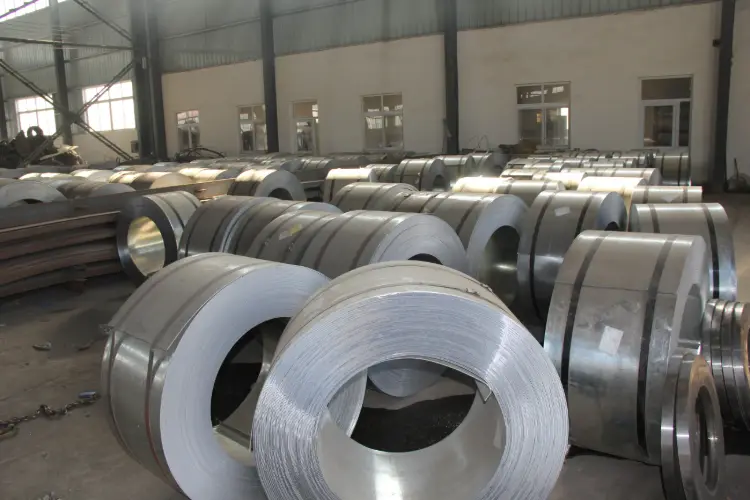
S500MC High-Strength Hot-Rolled Steel Coil per BS EN 10149-2
BS EN 10149-2 S500MC Hot Rolled Steel Coil - High-Strength Low-Alloy Structural Steel with Excellent Cold Formability
Comprehensive material data for S500MC hot rolled steel coil to EN 10149-2: chemical composition, mechanical properties, physical and thermal data, international equivalents and application recommendations.
Thermomechanical rolling, cold forming (bending, punching, roll forming), arc welding (MIG/MAG, laser, resistance welding), suitable for hot-dip coating.
- Phone : +8618037372205
- Email : [email protected]
- WhatsApp: Contact via Whtsapp
- WeChat: +8618037372205
S500MC High-Strength Hot-Rolled Steel Coil per BS EN 10149-2 Introduction
S500MC is a hot-rolled, high-strength low-alloy (HSLA) structural steel for cold forming, standardised under EN 10149-2. It is produced by thermomechanical rolling, delivering a minimum yield strength of 500 MPa while maintaining good ductility, weldability and toughness. The "MC" designation indicates thermomechanically rolled and suitable for cold forming. Its fine-grain microstructure is achieved through controlled rolling and microalloying with elements such as niobium, vanadium and titanium. Typical thicknesses range up to 16 mm in coil, sheet or strip form. S500MC is used where weight reduction together with high load-bearing capacity is required, notably in automotive frames, crane booms and agricultural machinery. The steel exhibits a balanced combination of strength, elongation and bending ability, enabling complex cold-formed components without cracking. It can be readily welded using conventional methods, provided proper procedures are followed.
S500MC High-Strength Hot-Rolled Steel Coil per BS EN 10149-2 Chemical Composition
The chemical composition of S500MC is carefully controlled to achieve a fine-grained microstructure and the required strength-ductility balance. The table below shows the maximum limits according to EN 10149-2, except for aluminium which has a minimum value for full deoxidation. Microalloying with Nb, V and Ti (individually or in combination) is essential. The carbon equivalent (CEV) is typically ≤ 0.39% based on the maximum composition, ensuring good weldability.
| Chemical Element | Standard Value (%) | Remarks |
|---|---|---|
| Carbon (C) | ≤ 0.12 | Ladle analysis maximum |
| Silicon (Si) | ≤ 0.50 | Ladle analysis maximum |
| Manganese (Mn) | ≤ 1.70 | Ladle analysis maximum |
| Phosphorus (P) | ≤ 0.025 | Ladle analysis maximum |
| Sulfur (S) | ≤ 0.015 | Ladle analysis maximum |
| Aluminium (Al,total) | ≥ 0.015 | Minimum for grain refinement and deoxidation |
| Niobium (Nb) | ≤ 0.09 | Typical microalloying range: 0.015–0.080 |
| Vanadium (V) | ≤ 0.20 | Optional microalloying element |
| Titanium (Ti) | ≤ 0.15 | Optional microalloying for weldability and strength |
| Molybdenum (Mo) | ≤ 0.50 | Optional; not mandatory in standard |
| Boron (B) | ≤ 0.005 | Optional for hardenability control |
S500MC High-Strength Hot-Rolled Steel Coil per BS EN 10149-2 Physical, Thermal and Electrical Properties
The data below represent typical physical properties of a thermomechanically rolled HSLA steel similar to S500MC at room temperature. These values are suitable for design calculations and finite element modelling, but they may vary slightly depending on the exact chemical composition and processing route. Thermal properties are averaged over the indicated temperature ranges and are taken from standard engineering tables for low-carbon microalloyed steels.
| Property | Typical Value | Unit | Condition / Temperature |
|---|---|---|---|
| Density (ρ) | 7.85 | g/cm³ | Room temperature |
| Modulus of elasticity (E) | 210 | GPa | Room temperature, quasi-static loading |
| Shear modulus (G) | 81 | GPa | Calculated from E and ν: G = E / [2(1+ν)] |
| Poisson's ratio (ν) | 0.3 | – | Room temperature, elastic range |
| Thermal expansion coefficient (α) | 12.0 × 10⁻⁶ | 1/K | Between 20 °C and 100 °C |
| Thermal expansion coefficient (α) | 13.0 × 10⁻⁶ | 1/K | Between 20 °C and 300 °C |
| Thermal conductivity (λ) | 52 | W/m·K | At 20 °C |
| Thermal conductivity (λ) | 47 | W/m·K | At 200 °C |
| Specific heat capacity (c) | 470 | J/kg·K | Between 20 °C and 100 °C |
| Specific heat capacity (c) | 510 | J/kg·K | Between 20 °C and 300 °C |
| Electrical resistivity (ρ_e) | 0.17 | μΩ·m | At 20 °C |
S500MC High-Strength Hot-Rolled Steel Coil per BS EN 10149-2 Mechanical Properties
The following table lists the required mechanical properties of S500MC hot-rolled steel. The standard defines minimum yield strength, tensile strength range and minimum elongation depending on product thickness. The bending test is mandatory and must show no cracks. Impact toughness is not a normative requirement unless agreed at the time of order, therefore it is given as typical guidance for fine-grain HSLA steels. All tests are performed at room temperature except where noted.
| Property | Standard Requirement / Typical Value | Unit | Test Condition |
|---|---|---|---|
| Yield strength (ReH) | ≥ 500 | MPa | Thickness ≤ 16 mm; transverse specimen |
| Tensile strength (Rm) | 550 – 700 | MPa | Thickness ≤ 16 mm; transverse specimen |
| Elongation (A80) | ≥ 12 | % | t < 3 mm; longitudinal specimen, gauge length 80 mm |
| Elongation (A5) | ≥ 14 | % | 3 mm ≤ t ≤ 16 mm; longitudinal specimen, gauge length 5.65√S₀ |
| Bend test (180°) | Mandrel diameter 0.5t (t ≤ 8 mm) nMandrel diameter 1.0t (8 < t ≤ 16 mm) | – | Bending angle 180°, no cracks on the outside of the bend |
| Impact energy (KV, typical) | ≥ 40 (longitudinal) n≥ 27 (transverse) | J | Charpy-V specimen 10×10 mm², −20 °C (when agreed); not mandatory per standard |
S500MC High-Strength Hot-Rolled Steel Coil per BS EN 10149-2 Fully Equivalent Material Standards & Replaceable Grades
| Country / Region | Standard | Grade | Remarks |
|---|---|---|---|
| Europe (EU) | EN 10149-2 | S500MC | Original designation, thermomechanically rolled |
| Germany | DIN EN 10149-2 | S500MC | Identical to EN standard |
| United Kingdom | BS EN 10149-2 | S500MC | Identical to EN standard |
| France | NF EN 10149-2 | S500MC | Identical to EN standard |
| Italy | UNI EN 10149-2 | S500MC | Identical to EN standard |
| Spain | UNE EN 10149-2 | S500MC | Identical to EN standard |
| Sweden | SS EN 10149-2 | S500MC | Identical to EN standard |
| International | ISO 6930-2 | S500MC | Equivalent, same concept and requirements |
S500MC High-Strength Hot-Rolled Steel Coil per BS EN 10149-2 Application Introduction
S500MC is designed for lightweight structural components that require a combination of high strength, good cold formability and reliable weldability. Its thermomechanical rolling process guarantees a fine-grained microstructure, enabling the production of thin-walled yet highly loaded parts. Typical processing includes uncoiling, blanking, cold bending, stretch forming, roll forming and welding (MIG/MAG, laser, resistance spot welding). The material can also be hot-dip galvanised for corrosion protection.
Product Applications: Chassis frames and subframes, Bumper reinforcement beams, Suspension control arms, Longitudinal beams for trucks, Crane boom sections and telescopic arms, Agricultural implement frames, Wheel rims and disc wheels, Safety cage structures (ROPS/FOPS)
Processed into products: Cold-formed profiles (U-channels, hat sections), Laser-welded tailored blanks, Stamped and deep-drawn brackets, Cross members and engine cradles, Axle mounting brackets, Hydraulic cylinder mounting plates, Roll-formed sill reinforcements
Application industries: Automotive (passenger cars, commercial vehicles), Construction and earth-moving machinery, Agricultural machinery and equipment, Crane and lifting equipment, Railway vehicles (structural frames), Trailer and container manufacturing, General mechanical engineering
S500MC High-Strength Hot-Rolled Steel Coil per BS EN 10149-2 Similar / Alternative High-Strength Low-Alloy Grades for Cold Forming
| Country / Region | Standard | Grade | Remarks |
|---|---|---|---|
| Europe | EN 10149-2 | S460MC | Lower strength (min. ReH 460 MPa), slightly higher ductility; same production route |
| Europe | EN 10149-2 | S550MC | Higher strength (min. ReH 550 MPa), reduced elongation (A5 ≥ 12% for 3–6 mm); same family |
| Europe | EN 10149-2 | S600MC | Further increased strength (min. ReH 600 MPa), more limited cold formability |
| Europe | SEW 092 (historical) | QStE500TM | Predecessor designation, identical chemical and mechanical concept |
| USA | ASTM A1011/A1011M | HSLAS Grade 70 [480] (Class 2) | Tensile-based classification; typical min. YS 485 MPa (70 ksi), similar strength but different production standard |
| Japan | JIS G3113 | SAPH440 | Automotive structural steel; lower strength (min. TS 440 MPa), used for chassis components |
Notes:
The CEV (carbon equivalent value) of S500MC, calculated as CEV = C + Mn/6 + (Cr+Mo+V)/5 + (Ni+Cu)/15, typically remains ≤ 0.39 % under the maximum composition, which ensures good weldability without preheating for moderate thicknesses (t ≤ 20 mm) under normal conditions. For thicker sections or highly restrained joints, a procedure qualification is recommended. The material is not intended for post-weld heat treatment; its properties are guaranteed in the as-rolled condition. Surface protection by painting, powder coating or hot-dip galvanizing (Zn temperature approx. 450 °C) is feasible without significant loss of strength, provided excessive liquid metal embrittlement mitigation is observed. Manufacturing tolerances on thickness, width and flatness follow EN 10051 for continuously hot-rolled strip. Coils can be supplied in dry (non-pickled) or pickled and oiled condition as agreed.
- Share



