
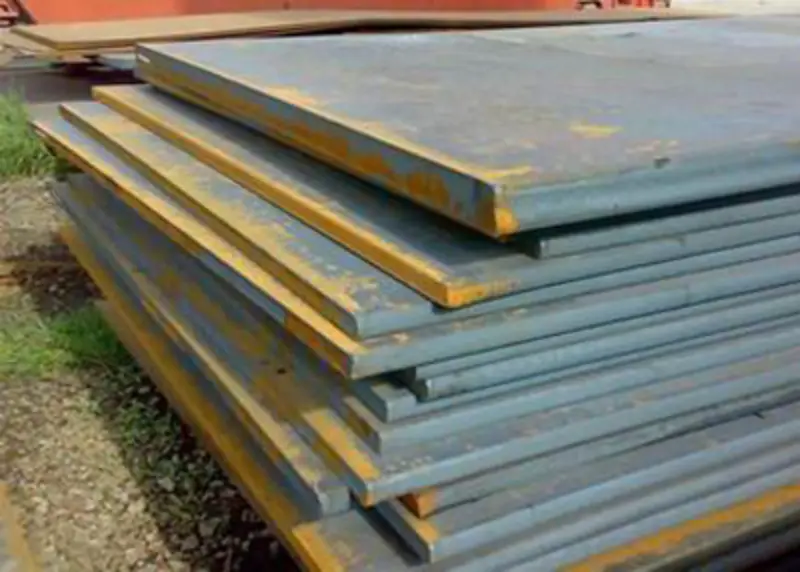
S355JR+304L Clad Steel Plate
S355JR+304L Clad Steel Plate: High-Strength, Corrosion-Resistant Composite for Demanding Environments
Explore the comprehensive material data for S355JR+304L clad steel plate, a composite combining structural carbon steel S355JR with austenitic stainless steel 304L. Get chemical composition, mechanical and physical properties, applications, and equivalent materials.
Bonding methods: hot roll bonding, explosive cladding, weld overlay. Subsequent processing: plasma/laser/waterjet cutting, welding (with appropriate filler metal sequence), cold/warm forming, rolling, machining (requires careful tool selection due to dissimilar layers).
- Phone : +8618037372205
- Email : [email protected]
- WhatsApp: Contact via Whtsapp
- WeChat: +8618037372205
S355JR+304L Clad Steel Plate Introduction
The S355JR+304L clad steel plate is a laminated composite that bonds a structural carbon steel base (S355JR, per EN 10025-2) with a corrosion-resistant austenitic stainless steel cladding (304L, per EN 10088-2). This bimetal delivers the high strength and weldability of S355JR combined with the excellent corrosion and pitting resistance of 304L, offering a cost-efficient alternative to solid stainless steel construction. The clad plate is produced by hot roll bonding, explosive cladding, or weld overlay, ensuring a robust metallurgical bond with typical cladding ratios of 5–15% of total thickness.
Key characteristics:
- Base metal: S355JR – min. yield 355 MPa, good toughness at ambient temperatures.
- Cladding: 304L – low carbon for improved intergranular corrosion resistance, excellent in oxidizing acids, food processing, and architectural environments.
- Cost savings: Substantial reduction in stainless steel usage while maintaining surface integrity.
- Applicable standards: ASTM A264, JIS G3601, or manufacturer's specifications.
Typical applications include pressure vessels, heat exchangers, chemical tanks, and structural parts in corrosive atmospheres.
S355JR+304L Clad Steel Plate Chemical Composition
The clad plate has a heterogeneous structure. The following tables list the chemical requirements for the base metal S355JR (EN 10025-2) and the cladding layer 304L (EN 10088-2). The overall composition is not uniform; each layer complies with its respective standard.
| Chemical Element | Standard Value (Base S355JR) | Standard Value (Cladding 304L) | Remarks |
|---|---|---|---|
| C (Carbon) | ≤0.24% | ≤0.030% | Base: for product thickness ≤40 mm. Clad: low carbon for intergranular corrosion resistance. |
| Si (Silicon) | ≤0.55% | ≤1.00% | Base & Clad |
| Mn (Manganese) | ≤1.60% | ≤2.00% | Base & Clad |
| P (Phosphorus) | ≤0.035% | ≤0.045% | Base & Clad |
| S (Sulfur) | ≤0.035% | ≤0.015% | Base & Clad |
| Cu (Copper) | ≤0.55% (if specified) | - | Optional in S355JR |
| N (Nitrogen) | ≤0.012% (if applicable) | ≤0.11% | 304L nitrogen limit; S355JR nitrogen is not explicitly limited but governed by Al/N ratio |
| Cr (Chromium) | - | 18.0–20.0% | Cladding only |
| Ni (Nickel) | - | 8.0–12.0% | Cladding only |
| nb (Niobium) & V (Vanadium) | S355JR may contain Nb+V ≤0.22% (optional) | - | For fine-grain strengthening if applicable |
S355JR+304L Clad Steel Plate Thermal and Electrical Physical Properties
Due to the composite nature, effective physical properties depend on layer thicknesses. The table provides typical values for the base metal S355JR and the cladding 304L separately. For engineering calculations of the clad plate as a whole, the base metal properties are usually dominant (e.g., stiffness, CTE). Thermal conductivity through thickness is limited by the lower conductivity of the stainless layer.
| Property | Typical Value | Unit | Test Condition / Material |
|---|---|---|---|
| Density (ρ) | 7.85 | g/cm³ | S355JR base (20°C) |
| Density (ρ) | 7.93 | g/cm³ | 304L cladding (20°C) |
| Elastic modulus (E) | 210 | GPa | S355JR (ambient) |
| Elastic modulus (E) | 200 | GPa | 304L (ambient) |
| Shear modulus (G) | ~81 | GPa | S355JR (calculated from E and ν) |
| Poisson's ratio (ν) | 0.3 | - | S355JR & 304L (typical) |
| Coefficient of thermal expansion (α) | 12.0 × 10⁻⁶ | /K | S355JR (20–100°C); effective for clad plate |
| Coefficient of thermal expansion (α) | 16.0 × 10⁻⁶ | /K | 304L (20–100°C); local cladding surface |
| Thermal conductivity (λ) | ~50 | W/m·K | S355JR (20°C) |
| Thermal conductivity (λ) | ~15 | W/m·K | 304L (20°C) |
| Specific heat capacity (cp) | ~460 | J/kg·K | Carbon steel base (typical) |
| Specific heat capacity (cp) | ~500 | J/kg·K | 304L (typical) |
| Electrical resistivity (ρ_e) | ~0.22 | µΩ·m | S355JR (20°C) |
| Electrical resistivity (ρ_e) | ~0.72 | µΩ·m | 304L (20°C) |
S355JR+304L Clad Steel Plate Mechanical Properties
The mechanical behavior of the clad plate is largely governed by the base metal S355JR. Tensile and impact tests are performed on full-thickness specimens including both layers. Bond shear strength is verified to ensure cladding integrity. The properties below comply with EN 10025-2 for the base metal and typical clad plate standards (e.g., ASTM A264).
| Property | Standard Requirement Value | Unit | Test Condition |
|---|---|---|---|
| Yield Strength (ReH) | ≥355 | MPa | Nominal thickness ≤16 mm, transverse |
| Yield Strength (ReH) | ≥345 | MPa | Nominal thickness >16 mm and ≤40 mm |
| Yield Strength (ReH) | ≥335 | MPa | Nominal thickness >40 mm and ≤63 mm (for reference) |
| Tensile Strength (Rm) | 470–630 | MPa | For thickness ≤100 mm, longitudinal or transverse |
| Elongation after fracture (A) | ≥22 | % | L0 = 5.65√S0, thickness ≤40 mm |
| Elongation after fracture (A) | ≥21 | % | Thickness >40 mm and ≤63 mm |
| Impact energy (KV) at 20°C | ≥27 | J | Longitudinal, V-notch, S355JR (JR quality), single value minimum |
| Bond shear strength | ≥200 (typical minimum, often 250–350) | MPa | Shear test per ASTM A264, average of two specimens |
| Bend test (180°) | No cracks, no separation | - | Bend diameter d = 2 × plate thickness (base metal requirement); cladding must not detach |
S355JR+304L Clad Steel Plate Fully Equivalent Material Standards & Substitutable Grades
The combination S355JR+304L is typically produced to the steelmaker's specification. The following clad combinations from international standards are functionally equivalent in terms of base metal strength level and stainless cladding type. Differences in precise chemistry or test requirements may exist; please verify with the respective standard.
| Country/Region | Standard | Grade Designation | Remarks |
|---|---|---|---|
| Europe | EN 10025-2 / EN 10088-2 / manufacturer | S355JR+304L (1.4307 clad) | Original specification; most widely used. |
| USA | ASTM A264 | Type 304L clad with A572 Gr 50 or A516 Gr 70 base | A572 Gr 50 yield ≈345 MPa, comparable to S355JR; A516 Gr 70 is also common for pressure vessels. |
| Japan | JIS G3601 | SM490A+SUS304L | SM490A min. yield 325–365 MPa (thickness dependent), similar to S355JR. |
| China | GB/T 8165-2008 | Q345B+S30408 (06Cr19Ni10) | Q345B yield ≥345 MPa; S30408 equivalent to 304L. Often used in petrochemical and infrastructure. |
| International | ISO 19902 (offshore) / ISO 3834 (welding) | Substitute combinations with equivalent base/clad pairs | For structural applications, engineer may specify a clad plate with base steel meeting ISO 630 Grade E355 and clad ISO 9328-2 X2CrNi19-11. |
S355JR+304L Clad Steel Plate Application Introduction
The S355JR+304L clad steel plate excels in environments where a robust, weldable structural base must be combined with a corrosion-resistant surface. It enables designers to reduce material cost and weight versus solid stainless while maintaining service life. Typical usage scenarios and suggested product forms are listed below.
Product Applications: Pressure vessels (reactors, separators, accumulators), Storage tanks (chemical, potable water, wine, dairy), Shell and tube heat exchangers, tube sheets, and baffles, Flue gas desulfurization scrubbers, ducts, and stacks, Cryogenic vessel linings, Bridges and structural elements with corrosion protection on one face, Architectural cladding panels where the stainless side faces the weather
Processed into products: Vessel shells (rolled and welded cylinders), Tank bottoms and walls (welded plate construction), Tube sheets for heat exchangers (drilled to accept tubes), Heat exchanger plate packs (if thinned and pressed), Flanges and nozzles (clad overlay on carbon steel forgings), Structural beams with welded stainless cover for corrosion resistance, Manhole covers and access doors in corrosive environments, Expansion joints and ductwork segments
Application industries: Chemical and petrochemical processing, Oil and gas (onshore/offshore), Pulp and paper manufacturing, Water treatment and desalination, Food and beverage processing, Power generation (FGD, condensers), Shipbuilding and marine structures, Architectural and civil engineering (exposed steelwork)
S355JR+304L Clad Steel Plate Similar / Alternative Material Recommendations
If an exact S355JR+304L clad plate is not available, the following alternatives offer comparable performance. The choice depends on allowable strength, corrosion resistance, or cost targets.
| Country/Region | Standard | Grade Designation | Remarks |
|---|---|---|---|
| Europe | EN | S275JR+304L | Lower strength base (min. yield 275 MPa) – adequate for less demanding structural loads. |
| Europe | EN | S355JR+316L (1.4404) | Superior pitting corrosion resistance with Mo, suitable for chloride environments. |
| USA | ASTM A264 | A36+304L | A36 base with lower strength (250 MPa yield) – more economical, widely available. |
| USA | ASTM A264 | A516 Gr 70+316L | Higher temperature pressure vessel steel with improved corrosion cladding. |
| Japan | JIS G3601 | SM400B+SUS304L | SM400B yield ≥235–245 MPa; lower strength but acceptable for many tank applications. |
| Solid stainless alternative | EN 10088-2 (or ASTM A240) | 304L solid plate | No base metal; full corrosion resistance but higher cost and lower strength (tensile ≥485 MPa, yield ≥170 MPa). |
| Other clad combination | Manufacturer specific | S355J2+N+304L | Base metal with improved impact toughness (-20°C) if needed. |
Notes:
Welding considerations: Joining clad plates requires a specific sequence: (1) weld the base metal from the carbon steel side using matching carbon steel electrodes; (2) back-gouge to sound metal, then apply a transition layer with Ni-based filler (e.g., E/ERNiCr-3) to avoid dilution; (3) fill the cladding cap with 304L compatible filler (E/ER308L). Post-weld heat treatment, if required for the base metal, may sensitize the 304L cladding; stress-relief heat treatment must be carefully evaluated.
Forming: Cold forming is possible, but the difference in yield strength and work hardening between the layers must be accounted for; springback will be dominated by the base metal. Hot forming above 300°C may affect the cladding's intergranular corrosion resistance if held too long in the sensitization range.
Inspection: Ultrasonic testing of the bond is standard, typically per ASTM A578 or EN 10160, to ensure no unbonded areas. Shear strength is tested per batch. Surface of cladding is usually liquid penetrant examined for cracks.
- Share



