
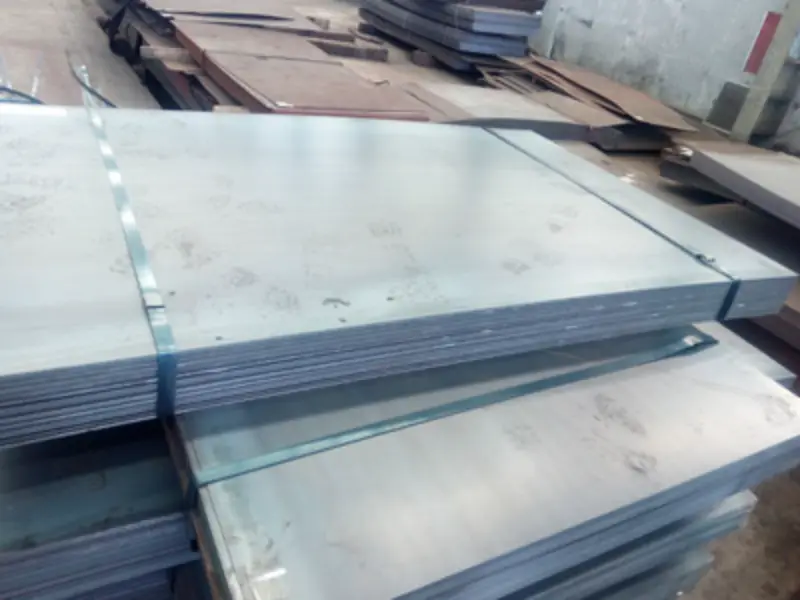
S355G2+N Offshore Structural Steel
S355G2+N Offshore Structural Steel - EN 10225 Grade Analysis
Comprehensive data sheet for S355G2+N steel according to EN 10225, including chemical, mechanical, and physical properties for fixed offshore structures.
Welding, thermal cutting, cold forming, machining, normalizing
- Phone : +8618037372205
- Email : [email protected]
- WhatsApp: Contact via Whtsapp
- WeChat: +8618037372205
S355G2+N Offshore Structural Steel Introduction
S355G2+N is a normalized or normalized-rolled weldable fine-grain structural steel designed primarily for fixed offshore structures. It offers a minimum yield strength of 355 MPa for thicknesses up to 16 mm, with good tensile strength and excellent toughness at low temperatures (down to -20 °C). The steel exhibits superior weldability due to controlled carbon equivalent (CEV ≤ 0.43%) and low impurity levels.
- Key attributes: high strength-to-weight ratio, reliable ductility, and consistent through-thickness properties.
- Typical shapes: plates, coils, sections, and bars.
- Suitability for harsh marine environments is enhanced by strictly limited sulfur and phosphorus contents.
S355G2+N Offshore Structural Steel Chemical Composition
Chemical composition according to EN 10225:2009 for grade S355G2. All values are ladle analysis maximums unless a range is given. The steel is fully killed with a minimum aluminum content. The carbon equivalent CEV = C + Mn/6 + (Cr+Mo+V)/5 + (Ni+Cu)/15 is controlled to ensure weldability.
| Chemical Element | Standard Value (max %) | Remarks |
|---|---|---|
| C | 0.18 | Max for thickness ≤ 40 mm |
| Si | 0.50 | |
| Mn | 1.00 – 1.65 | |
| P | 0.025 | |
| S | 0.015 | |
| Cu | 0.30 | |
| Cr | 0.30 | |
| Ni | 0.50 | |
| Mo | 0.10 | |
| Al (total) | 0.015 min | Fully killed; acid soluble Al ≥ 0.015% |
| V | 0.08 | |
| Nb | 0.05 | |
| Ti | 0.03 | |
| N | 0.012 | Max for products without nitrogen binding elements |
| CEV | 0.43 (typical) | Max for thickness ≤ 40 mm |
S355G2+N Offshore Structural Steel Thermal and Electrical Physical Properties
Room-temperature physical properties are representative for normalized S355G2+N steel. Values are typical for structural carbon‑manganese steels and may vary slightly with actual composition and heat treatment. Thermal conductivity and specific heat are given at around 20 °C; expansion coefficients apply to common offshore operating temperature ranges.
| Property | Typical Value | Unit | Test Condition / Remarks |
|---|---|---|---|
| Density (ρ) | 7.85 | g/cm³ | At 20 °C |
| Elastic modulus (E) | 210 | GPa | At 20 °C; longitudinal |
| Shear modulus (G) | 81 | GPa | At 20 °C; calculated from E and ν |
| Poisson's ratio (ν) | 0.3 | – | At 20 °C |
| Thermal expansion (α) – 20–100 °C | 11.1 × 10⁻⁶ | 1/K | Mean coefficient |
| Thermal expansion – 20–200 °C | 11.9 × 10⁻⁶ | 1/K | |
| Thermal expansion – 20–300 °C | 12.5 × 10⁻⁶ | 1/K | |
| Thermal expansion – 20–400 °C | 13.0 × 10⁻⁶ | 1/K | |
| Thermal expansion – 20–500 °C | 13.5 × 10⁻⁶ | 1/K | |
| Thermal conductivity (λ) | 52 | W/(m·K) | At 20 °C |
| Specific heat capacity (cp) | 500 | J/(kg·K) | At 20 °C |
| Electrical resistivity (ρe) | 0.23 | μΩ·m | At 20 °C |
S355G2+N Offshore Structural Steel Mechanical Properties
Tensile and toughness properties as per EN 10225:2009, measured on test pieces taken in the transverse or longitudinal direction as specified.
All values are for the normalized (+N) condition. The yield strength minimum decreases with increasing product thickness, while tensile strength is given as a range. Impact energy (Charpy V-notch) at -20 °C ensures adequate brittle fracture resistance for offshore service.
| Property | Standard Required Value | Unit | Test Condition / Remarks |
|---|---|---|---|
| Upper yield strength (ReH) – t ≤ 16 mm | 355 min | MPa | Transverse; room temperature |
| ReH – 16 < t ≤ 25 mm | 345 min | MPa | Transverse |
| ReH – 25 < t ≤ 40 mm | 335 min | MPa | Transverse |
| ReH – 40 < t ≤ 63 mm | 325 min | MPa | Transverse |
| ReH – 63 < t ≤ 80 mm | 315 min | MPa | Transverse |
| ReH – 80 < t ≤ 100 mm | 295 min | MPa | Transverse |
| ReH – 100 < t ≤ 150 mm | 285 min | MPa | Transverse |
| Tensile strength (Rm) – t ≤ 100 mm | 470 – 630 | MPa | Transverse |
| Tensile strength (Rm) – 100 < t ≤ 150 mm | 450 – 600 | MPa | Transverse |
| Elongation (A) – t ≤ 40 mm | 22 min | % | Longitudinal; gauge length 5.65√S0 |
| Elongation (A) – 40 < t ≤ 63 mm | 21 min | % | Longitudinal |
| Elongation (A) – 63 < t ≤ 100 mm | 20 min | % | Longitudinal |
| Charpy impact energy (KV) – T = -20 °C, t ≤ 150 mm | 40 (average) / 27 (single) | J | Longitudinal; V-notch; standard specimen |
| Bend test (mandrel diameter) | No cracks; 180° bend | – | Only for welding procedure qualification; D = 3a (a = thickness) optional |
S355G2+N Offshore Structural Steel Completely Equivalent Material Standards and Replaceable Grades
Direct equivalents are rarely identical due to differing delivery conditions and test requirements. The table below lists standards and grades that can be considered fully equivalent or officially recognized as substitutes for S355G2+N in offshore projects, subject to project specification approval.
| Country/Region | Standard | Grade | Remarks |
|---|---|---|---|
| International | ISO 630-3 | S355G2+N | Identical technical delivery conditions |
| Germany | DIN EN 10225 | S355G2+N | Adopted European standard |
| UK | BS EN 10225 | S355G2+N | BS implementation of EN 10225 |
| France | NF EN 10225 | S355G2+N | AFNOR standard |
| Italy | UNI EN 10225 | S355G2+N | Italian adoption |
| Spain | UNE EN 10225 | S355G2+N | Spanish adoption |
| Netherlands | NEN EN 10225 | S355G2+N | Dutch adoption |
| USA | – | – | No direct equivalent; use ASTM A572 Gr. 50 with supplementary impact requirements |
S355G2+N Offshore Structural Steel Application Introduction
S355G2+N is engineered for load-bearing members in fixed offshore platforms and renewable energy structures. Its balanced combination of strength, toughness, and weldability makes it suitable for demanding marine environments. Typical fabrication includes cutting, cold forming, and multi-pass welding without post-weld heat treatment for thicknesses up to 40 mm. Pre-heating and interpass temperature control are advised when thickness exceeds 30 mm.
Product Applications: Fixed platform jackets and topsides, Wind turbine monopile and transition piece, Deck plates and stiffening girders, Helideck structures, Subsea structural templates, Mooring system components (non-fatigue critical)
Processed into products: Main legs and braces of jacket structures, Can joints and tubular nodes, Stiffeners, bulkhead plates, Padeyes and lifting lugs, Fender systems on offshore structures, Transition piece flanges and connection plates, Access platform walkways and grating supports
Application industries: Offshore oil & gas, Offshore wind energy, Shipbuilding (limited to offshore support vessels), Civil marine structures (piers, quay walls), Renewable energy foundations (monopiles, transition pieces)
S355G2+N Offshore Structural Steel Similar / Substitute Material Recommendations
These grades exhibit comparable strength and toughness but may differ in chemistry, delivery condition, or certification scope. They can serve as alternatives for S355G2+N when approved by the design specification.
| Country/Region | Standard | Grade | Remarks |
|---|---|---|---|
| Europe | EN 10025-3 | S355N | Normalized structural steel for general use; similar strength at ≤ 40 mm, impact -20 °C |
| USA | ASTM A572 | Grade 50 [345] | 355 MPa yield; require supplemental Charpy test at -20 °C |
| USA | API 2H | Grade 50 | Offshore structural steel plates; normalized; 345–355 MPa yield |
| Japan | JIS G 3106 | SM490A / SM490B | Normalized; 325–365 MPa yield; impact energy matched if B grade selected |
| China | GB/T 712 | DH36 | Offshore structural steel; normalized; 355 MPa yield; impact -20 °C |
| Russia | GOST R 52927 | D36 | Similar offshore grade; 355 MPa; normalized option |
Notes:
Important: All data is based on EN 10225:2009 for thickness ranges typical of offshore structural steel. For precise project use, refer to the certified material test certificate according to EN 10204 type 3.1 or 3.2.
Weldability: The CEV ≤ 0.43 ensures good weldability with low hydrogen processes. Preheating is recommended when ambient temperature is below 5 °C.
Through-thickness properties: If specified, Z-quality (e.g., Z15, Z25) can be ordered according to EN 10164 to guarantee ductility in the thickness direction.
Cold forming: A minimum internal bend radius of 2t is recommended for cold bending perpendicular to the rolling direction; hot forming or stress relieving may be required for tight radii.
Values are nominal and for general informational purposes only. Actual values may vary based on specific product form and manufacturer.
- Share



