
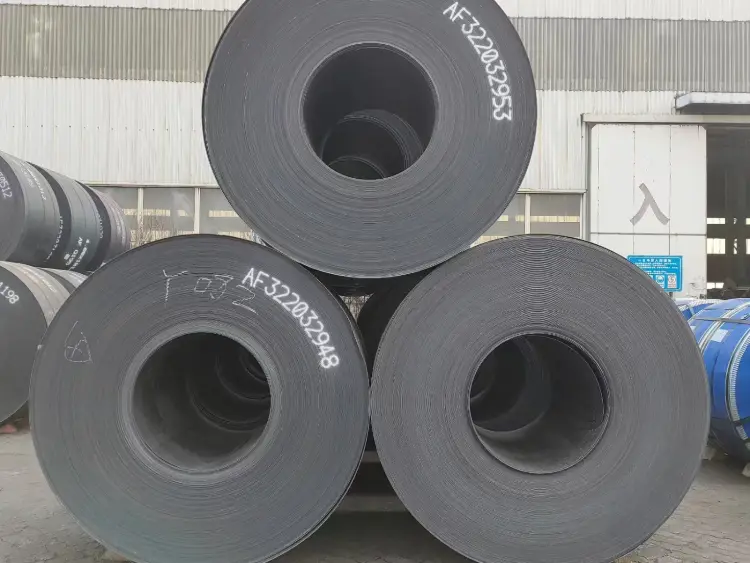
EN10225 S355G3+N Shipbuilding Steel Coil
EN10225 S355G3+N Shipbuilding Steel Coil: Offshore Structural Steel Properties and Data
Comprehensive material data for EN10225 S355G3+N steel coil used in offshore structures, including chemical composition, mechanical & thermal properties, international equivalents and applications.
Normalizing (+N), cutting, welding, bending, forming, machining
- Phone : +8618037372205
- Email : [email protected]
- WhatsApp: Contact via Whtsapp
- WeChat: +8618037372205
EN10225 S355G3+N Shipbuilding Steel Coil Introduction
EN10225 S355G3+N is a normalized weldable structural steel specifically designed for offshore and marine applications. Supplied in coil form, it offers a minimum yield strength of 355 MPa and excellent low-temperature impact toughness at -20°C (G3 quality). The +N condition ensures refined grain structure and uniform properties through normalizing heat treatment. This grade is widely used in the fabrication of fixed offshore platforms, structural members, and shipbuilding components where high strength, good weldability, and resistance to brittle fracture are essential. Its balanced chemistry with controlled carbon equivalent (CEV) supports reliable welding under workshop and site conditions.
EN10225 S355G3+N Shipbuilding Steel Coil Chemical Composition
Typical ladle analysis for EN10225 S355G3+N according to the standard. Values are maximum unless a range is indicated. Elements such as niobium, vanadium, and titanium may be added for grain refinement. The carbon equivalent (CEV) is controlled for weldability.
| Element | Standard Value | Remarks |
|---|---|---|
| Carbon (C) | ≤0.18% | Typical max |
| Silicon (Si) | 0.10 – 0.55% | Range for deoxidation |
| Manganese (Mn) | 0.90 – 1.65% | Range |
| Phosphorus (P) | ≤0.035% | Max |
| Sulfur (S) | ≤0.035% | Max |
| Chromium (Cr) | ≤0.30% | Max |
| Nickel (Ni) | ≤0.50% | Max |
| Molybdenum (Mo) | ≤0.08% | Max |
| Copper (Cu) | ≤0.35% | Max |
| Aluminum (Al) total | ≥0.020% | Min for fine grain |
| Nitrogen (N) | ≤0.012% | Max |
| Titanium (Ti) | ≤0.05% | If added |
| Niobium (Nb) | ≤0.05% | If added |
| Vanadium (V) | ≤0.10% | If added |
EN10225 S355G3+N Shipbuilding Steel Coil Thermal and Electrical Physical Properties
Typical physical properties for S355G3+N grade carbon-manganese steel at room temperature (20°C) unless otherwise indicated. These values are representative for normalized offshore structural steel and may be used for engineering calculations.
| Property | Typical Value | Unit | Test Condition |
|---|---|---|---|
| Density (ρ) | 7850 | kg/m³ | At 20°C |
| Modulus of Elasticity (E) | 210 | GPa | At 20°C |
| Shear Modulus (G) | 81 | GPa | Calculated from E, ν |
| Poisson's Ratio (ν) | 0.3 | – | Elastic range |
| Thermal Expansion Coefficient (α) | 12 × 10⁻⁶ | /K | 20 – 100°C |
| Thermal Expansion Coefficient (α) | 13 × 10⁻⁶ | /K | 20 – 200°C |
| Thermal Conductivity (λ) | 45 | W/(m·K) | At 20°C |
| Specific Heat Capacity (c) | 460 | J/(kg·K) | At 20°C |
| Electrical Resistivity (ρ_e) | 0.25 × 10⁻⁶ | Ω·m | At 20°C |
EN10225 S355G3+N Shipbuilding Steel Coil Mechanical Properties
Mechanical property requirements for EN10225 S355G3+N at ambient temperature. Values depend on product thickness. Impact test temperature is -20°C for longitudinal specimens (G3 quality). Minimum energy of 50 J is required. Transverse values are specified on agreement.
| Property | Standard Requirement | Unit | Test Condition |
|---|---|---|---|
| Yield Strength (ReH) | ≥355 | MPa | t ≤ 25 mm |
| Yield Strength (ReH) | ≥345 | MPa | 25 < t ≤ 40 mm |
| Yield Strength (ReH) | ≥335 | MPa | 40 < t ≤ 63 mm |
| Yield Strength (ReH) | ≥325 | MPa | 63 < t ≤ 100 mm |
| Tensile Strength (Rm) | 470 – 630 | MPa | t ≤ 100 mm |
| Elongation (A) | ≥22 | % | t ≤ 25 mm; 5.65√S₀ gauge |
| Elongation (A) | ≥21 | % | 25 < t ≤ 63 mm |
| Elongation (A) | ≥21 | % | 63 < t ≤ 100 mm |
| Impact Energy (KV) | ≥50 | J | Longitudinal, -20°C |
| Bend Test (Mandrel Diameter d) | d = 3a | – | t ≤ 16 mm; 180° bend |
EN10225 S355G3+N Shipbuilding Steel Coil Identical/Equivalent Material Standards and Replaceable Grades
| Country/Region | Standard | Grade | Remarks |
|---|---|---|---|
| Europe | EN 10225 | S355G3+N | Original designation |
| United Kingdom | BS EN 10225 | S355G3+N | Direct adoption of EN standard |
| Germany | DIN EN 10225 | S355G3+N | Identical to EN |
| France | NF EN 10225 | S355G3+N | Identical to EN |
| International | ISO 630-3 (with similarity) | S355G3+N | Not identical but recognized for offshore structural steels |
EN10225 S355G3+N Shipbuilding Steel Coil Application Introduction
S355G3+N steel coil is extensively used in the offshore and marine engineering sectors. It is suitable for primary structural members that demand high toughness and reliable weldability. Typical applications include:
Product Applications: Jacket structures for offshore platforms, Deck plates and stiffeners, Subsea structural supports, Ship hulls and bulkheads, Offshore crane booms and pedestals
Processed into products: Welded I-beams and box girders, Tubular joints and braces, Tension and compression bars, Flare booms and helidecks, Mooring components and padeyes
Application industries: Offshore oil & gas platforms, Shipbuilding and marine engineering, Offshore wind energy foundations, Structural steel fabrication for marine environments
EN10225 S355G3+N Shipbuilding Steel Coil Similar/Comparable Alternative Materials
| Country/Region | Standard | Grade | Remarks |
|---|---|---|---|
| Europe | EN 10025-3 | S355N | Similar normalized structural steel, not specifically offshore; requires project agreement |
| USA | API 2H | Grade 50 | Offshore structural steel; slightly different chemistry |
| USA | ASTM A572 / A572M | Grade 50 | Structural steel with 345 MPa min yield; may need additional testing for offshore use |
| Japan | JIS G 3106 | SM490A/B/C | Weldable structural steel; requires property verification for submarine applications |
Notes:
- The +N condition guarantees normalizing heat treatment; coil material may slightly vary in thickness tolerances. Contact the supplier for exact thickness capabilities.
- For improved corrosion resistance, coatings or cathodic protection are commonly applied in offshore service.
- Data provided is for guidance and based on EN 10225 standard; always verify with the latest mill certificate and project specifications.
- Share



