
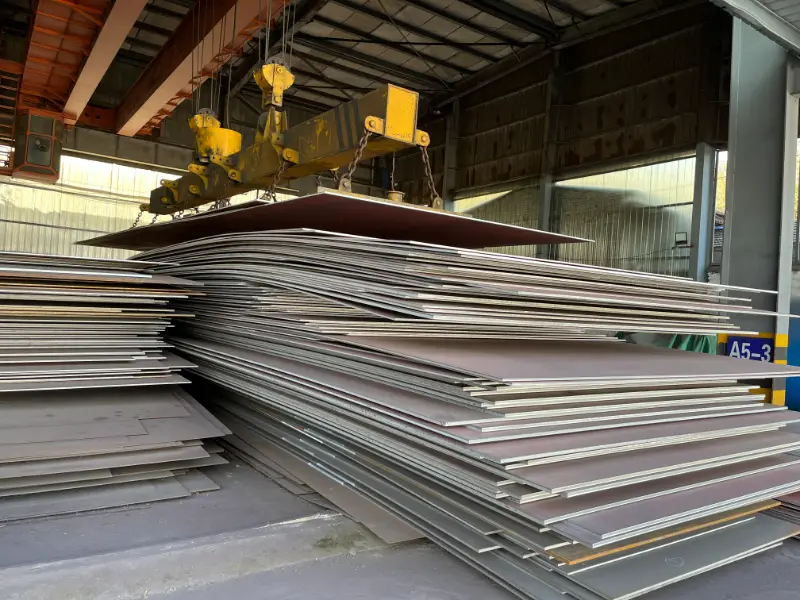
EN10225 S355G7+N Shipbuilding & Offshore Structural Steel Plate/Coil
EN10225 S355G7+N Shipbuilding & Offshore Structural Steel Plate/Coil
Comprehensive material data for EN10225 S355G7+N normalized weldable fine-grain structural steel used in fixed offshore structures and shipbuilding. Includes chemical composition, mechanical properties, and physical data.
Hot rolling followed by normalizing (+N), suitable for cutting, cold forming, hot forming, welding, and machining
- Phone : +8618037372205
- Email : [email protected]
- WhatsApp: Contact via Whtsapp
- WeChat: +8618037372205
EN10225 S355G7+N Shipbuilding & Offshore Structural Steel Plate/Coil Introduction
EN10225 S355G7+N is a normalized, weldable fine-grain structural steel intended for fixed offshore structures. It belongs to the S355 strength class with a minimum yield strength of 355 MPa for thicknesses up to 16 mm. The grade G7 guarantees impact toughness down to -40°C (longitudinal, average 50 J minimum). The +N condition signifies a normalizing heat treatment that refines the grain structure, providing superior toughness and uniformity. Key features include:
- High strength combined with excellent low-temperature toughness for harsh marine environments.
- Good through-thickness properties making it suitable for critical welded joints.
- Strict control of alloying elements (V, Nb, Ti) to ensure fine-grain size and weldability.
- Complies with EN 10225:2009 + A1:2019, widely specified for platforms, jackets, decks, and support structures in the offshore oil & gas and wind energy sectors.
EN10225 S355G7+N Shipbuilding & Offshore Structural Steel Plate/Coil Chemical Composition
The composition limits are according to EN 10225, providing a fine-grain structural steel with controlled micro-alloying (V, Nb, Ti) to ensure a minimum yield of 355 MPa and -40°C impact toughness. Nitrogen-fixing elements and low sulfur guarantee good through-thickness ductility. Note: Al total ≥ 0.015% is required for fine-grain practice; CEV (carbon equivalent) is controlled for weldability.
| Element | Specified Value (%) | Remarks |
|---|---|---|
| C | ≤0.16 | |
| Si | 0.15 – 0.50 | |
| Mn | 1.00 – 1.65 | |
| P | ≤0.020 | |
| S | ≤0.007 | For improved Z-quality, ≤0.005 |
| Al (total) | ≥0.015 | Fine-grain element |
| Nb | ≤0.05 | |
| V | ≤0.08 | |
| Ti | ≤0.03 | |
| Cr | ≤0.25 | |
| Ni | ≤0.30 | |
| Mo | ≤0.08 | |
| Cu | ≤0.30 | |
| N | ≤0.012 | Adequate binding by Al, V, Ti |
| Nb+V+Ti | ≤0.12 | Sum of micro-alloying |
| CEV | ≤0.43 | Typical, depending on thickness |
EN10225 S355G7+N Shipbuilding & Offshore Structural Steel Plate/Coil Physical and Thermal Properties
These values are typical for low-alloy structural steel at room temperature and are provided for design calculations. They are not part of the EN 10225 mandatory requirements but are widely accepted in engineering practice. Note: Properties such as thermal conductivity decrease with increasing temperature.
| Property | Typical Value | Unit | Test Condition / Remarks |
|---|---|---|---|
| Density (ρ) | ~7850 | kg/m³ | at 20°C |
| Modulus of elasticity (E) | ~210 | GPa | at 20°C |
| Shear modulus (G) | ~80 | GPa | at 20°C |
| Poisson's ratio (ν) | ~0.3 | Elastic region | |
| Coefficient of thermal expansion (α) | ~12 × 10⁻⁶ | K⁻¹ | 20°C to 100°C |
| Thermal conductivity (λ) | ~50 | W/(m·K) | at 20°C |
| Specific heat capacity | ~460 | J/(kg·K) | at 20°C |
| Electrical resistivity (ρₑ) | ~0.20 | µΩ·m | at 20°C |
EN10225 S355G7+N Shipbuilding & Offshore Structural Steel Plate/Coil Mechanical Properties
Mechanical properties depend on product thickness. The table lists minimum requirements for transverse or longitudinal test pieces as defined in EN 10225. Impact tests are at -40°C for G7 grade. Bend tests are carried out on mandrel diameters dependent on thickness. Elongation is measured on a gauge length L0=5.65√So (proportional test piece).
| Property | Specified Value | Unit | Testing Condition |
|---|---|---|---|
| Yield strength (ReH) | ≥355 | MPa | Thickness ≤16 mm |
| Yield strength (ReH) | ≥345 | MPa | 16 < t ≤ 40 mm |
| Yield strength (ReH) | ≥335 | MPa | 40 < t ≤ 63 mm |
| Yield strength (ReH) | ≥325 | MPa | 63 < t ≤ 80 mm |
| Yield strength (ReH) | ≥315 | MPa | 80 < t ≤ 100 mm |
| Tensile strength (Rm) | 470 – 630 | MPa | t ≤ 100 mm |
| Elongation (A) | ≥22 | % | t ≤ 40 mm (L0=5.65√So) |
| Elongation (A) | ≥21 | % | 40 < t ≤ 63 mm |
| Elongation (A) | ≥20 | % | 63 < t ≤ 100 mm |
| Impact energy (KV₂) at -40°C, longitudinal | ≥50 (avg.) / ≥35 (single) | J | V-notch, 3 specimens |
| Bend test (transverse) | No cracks | 180° bend; mandrel d=3a for t≤16 mm, d=4a for t>16 mm |
EN10225 S355G7+N Shipbuilding & Offshore Structural Steel Plate/Coil Fully Equivalent Material Standards & Replaceable Grades
| Country/Region | Standard | Grade | Remarks |
|---|---|---|---|
| Europe | EN 10225 | S355G7+N | The base standard; also available as +M (thermomechanical rolled) with identical chemistry but different mechanical values. |
| International (ISO) | ISO 19902 | S355G7 | ISO 19902 Table B.1 directly references EN 10225 S355G7 for fixed steel offshore structures. |
EN10225 S355G7+N Shipbuilding & Offshore Structural Steel Plate/Coil Application Introduction
S355G7+N is engineered for demanding marine and offshore environments where high strength, excellent weldability, and guaranteed -40°C impact toughness are mandatory. It is delivered in normalized condition, ensuring a fine homogeneous microstructure that performs reliably in thick plate applications. Common usage areas:
Product Applications: Fixed offshore platform topside modules and jackets, Deck plates and stiffened panels, Monopile and transition piece foundations for wind turbines, Ship hulls and superstructures for ice-class vessels, Marine crane booms and lifting appliances, Subsea structural components
Processed into products: Flanges and webs in built-up girders, Tubular joints and node cans, Stiffeners, brackets, and bulkheads, Heavy-duty padeyes and lifting lugs, Bearing plates and base columns, Shear keys and structural connectors
Application industries: Offshore Oil & Gas, Shipbuilding and Marine Construction, Wind Energy (offshore turbine foundations), Civil Engineering for harsh environments, Port and Harbor Equipment
EN10225 S355G7+N Shipbuilding & Offshore Structural Steel Plate/Coil Near/Similar Substitute Materials
| Country/Region | Standard | Grade | Remarks |
|---|---|---|---|
| Europe | EN 10025-3 | S355N, S355NL | Normalized structural steel; S355NL provides -50°C impact, comparable to G7 toughness but not specifically for offshore structures. |
| Europe | EN 10025-4 | S355M, S355ML | Thermomechanical rolled; S355ML has -50°C impact, often used as an alternative when +M delivery condition is accepted. |
| USA | ASTM A572/A572M | Grade 50 [345] | Similar strength but does not guarantee -40°C impact; supplementary testing needed. |
| USA | API 2H | Grade 50 | For offshore structural plates, but chemistry and toughness requirements differ. |
| Japan | JIS G3106 | SM490B | 490 MPa tensile class, requires evaluation for -40°C toughness. |
| International | ISO 630-3 | S355NL | Normalized rolled weldable fine-grain steel with -50°C impact, closely matches mechanical properties. |
Notes:
Special considerations:
- The +N (normalized) condition improves toughness homogeneity, especially in thick products. For thicknesses above 80 mm, step cooling or additional HIC (hydrogen-induced cracking) testing may be specified.
- Z-quality (through-thickness tensile) can be ordered with suffixes such as Z25 or Z35 for critical joints.
- Welding procedures must account for a typical CEV ≤0.43 and preheat may be required depending on thickness and hydrogen levels.
- For substructures exposed to very low air temperatures, the -40°C requirement of G7 ensures ductile behavior; consider G8 or G10 for even lower service temperatures.
- Share



