
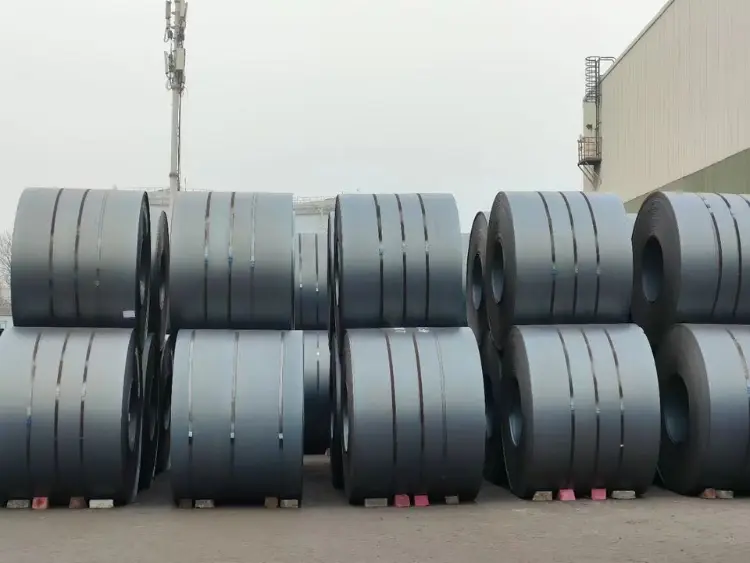
EN10225 S355G8+N Shipbuilding Steel Coil
EN10225 S355G8+N Shipbuilding Steel Coil: Premium Normalized Offshore Structural Steel
Comprehensive data sheet for EN10225 S355G8+N shipbuilding steel coil: chemical composition, mechanical properties, thermal and electrical characteristics, equivalent grades, and detailed application guidance for offshore and marine engineering.
Hot rolling followed by normalizing (+N); cold forming, welding, cutting, and machining are typical downstream processes.
- Phone : +8618037372205
- Email : [email protected]
- WhatsApp: Contact via Whtsapp
- WeChat: +8618037372205
EN10225 S355G8+N Shipbuilding Steel Coil Introduction
EN10225 S355G8+N is a high-strength normalized structural steel specifically developed for fixed offshore structures. It belongs to the EN 10225 family of weldable fine-grain steels designed to meet the stringent requirements of the offshore industry, including excellent weldability, low-temperature toughness, and enhanced resistance to brittle fracture. The '+N' designation indicates that the steel is delivered in the normalized condition, ensuring uniform mechanical properties and fine grain structure. With a minimum yield strength of 355 MPa and impact energy guaranteed at -40 °C (G8 quality), this steel is ideally suited for critical structural components operating in harsh marine environments. Typical applications include legs of jack-up rigs, hulls of offshore vessels, deck structures, and other primary load-bearing members. Its balanced chemical composition, controlled phosphorous and sulfur levels, and carefully selected microalloying elements provide superior through-thickness properties and fatigue resistance, making it a reliable choice for safety-critical offshore projects worldwide.
EN10225 S355G8+N Shipbuilding Steel Coil Chemical Composition
The chemical composition is tightly controlled to ensure weldability, toughness, and resistance to atmospheric corrosion in marine environments. Microalloying with niobium, vanadium, and titanium refines the grain structure and enhances strength without compromising ductility. Phosphorus and sulfur are kept low to improve through-thickness properties and avoid lamellar tearing. The carbon equivalent value (CEV) is limited to guarantee good field weldability.
| Chemical Element | Standard Value (wt%) | Remarks |
|---|---|---|
| Carbon (C) | ≤0.18 | Max, for t ≤ 40 mm |
| Silicon (Si) | ≤0.50 | Max |
| Manganese (Mn) | 0.90 – 1.65 | Range, depending on thickness |
| Phosphorus (P) | ≤0.020 | Max, for enhanced toughness |
| Sulfur (S) | ≤0.010 | Max, for improved through-thickness properties |
| Chromium (Cr) | ≤0.25 | Max |
| Nickel (Ni) | ≤0.30 | Max |
| Molybdenum (Mo) | ≤0.08 | Max |
| Copper (Cu) | ≤0.30 | Max |
| Nitrogen (N) | ≤0.012 | Max, if sufficient Al is present |
| Niobium (Nb) | ≤0.05 | Max |
| Vanadium (V) | ≤0.08 | Max |
| Titanium (Ti) | ≤0.03 | Max |
| Aluminum (Al total) | ≥0.020 | Minimum for grain refinement |
| Niobium+Vanadium+Titanium | ≤0.12 | Max sum of microalloying elements |
| Carbon Equivalent (CEV) | ≤0.43 | Typical max for t ≤ 40 mm, ensures weldability |
EN10225 S355G8+N Shipbuilding Steel Coil Thermal and Electrical Physical Properties
The following physical constants are not mandatory in EN 10225 but represent typical data for low-alloy carbon‑manganese structural steels like S355G8+N. These values are essential for design calculations involving heat transfer, thermal expansion, and corrosion protection (e.g., impressed current systems).
| Property | Typical Value | Unit | Test Condition |
|---|---|---|---|
| Density (ρ) | ≈7850 | kg/m³ | At 20 °C |
| Young's modulus (E) | ≈210 | GPa | At room temperature, tension |
| Shear modulus (G) | ≈81 | GPa | Calculated, room temperature |
| Poisson's ratio (ν) | ≈0.3 | - | Elastic range |
| Coefficient of thermal expansion (α) | ≈11.5 | 10⁻⁶/K | 20 – 100 °C |
| Coefficient of thermal expansion (α) | ≈12.0 | 10⁻⁶/K | 20 – 200 °C |
| Thermal conductivity (λ) | ≈50 | W/(m·K) | At 20 °C |
| Specific heat capacity | ≈460 | J/(kg·K) | At 20 °C |
| Electrical resistivity (ρₑ) | ≈0.22 | μΩ·m | At 20 °C |
EN10225 S355G8+N Shipbuilding Steel Coil Mechanical Properties
These values are applicable to normalized coil material tested in the longitudinal direction according to EN 10225-2. Properties for transverse specimens may be slightly lower. Impact energy is guaranteed at -40 °C, characteristic of the G8 quality. Bending tests are required to demonstrate cold formability.
| Property | Standard Requirement | Unit | Test Condition |
|---|---|---|---|
| Yield strength (ReH) | ≥355 | MPa | t ≤ 40 mm; transverse values available upon agreement |
| Tensile strength (Rm) | 470 – 630 | MPa | t ≤ 100 mm; all thicknesses |
| Elongation (A%) | ≥22 | % | Gauge length 5.65√S₀, t ≤ 40 mm, longitudinal |
| Impact energy (KV) | ≥42 | J | -40 °C, Charpy V-notch, longitudinal, t ≤ 40 mm |
| Bend test | No cracks | - | 180° bending, mandrel diameter 2t for t ≤ 16 mm; 3t for 16 < t ≤ 40 mm |
EN10225 S355G8+N Shipbuilding Steel Coil Completely Equivalent Material Standards and Replaceable Grades
| Country / Region | Standard | Grade | Remarks |
|---|---|---|---|
| European Union | EN 10225-2:2009 | S355G8+N | Original standard grade (normalized) |
| International (IACS) | UR W (Classification Rules) | EH36 (normalized) | Equivalent when ordered with offshore supplement and normalized condition |
| USA | ASTM A131/A131M | EH36 (normalized) | Comparable chemistry and mechanical properties; verify CEV and impact temperature |
| USA | ABS (American Bureau of Shipping) | EH36 | Normalized delivery; used for offshore structures |
| Norway / International | DNV GL (now DNV) | NV E36 / D36 E36 | Toughness at -40 °C; normalized available |
| UK | BS 7191 | 355EMZ | Withdrawn but historically equivalent; modern projects refer to EN 10225 |
| China | GB/T 712 | EH36 | Normalized EH36 may be accepted under class rules |
EN10225 S355G8+N Shipbuilding Steel Coil Application Introduction
EN10225 S355G8+N steel coil is tailored for heavy-duty offshore and marine constructions, where reliability at low temperatures and superior fatigue performance are paramount. Its consistent mechanical properties and weldability reduce fabrication costs and improve structural integrity. The normalized condition ensures homogeneous properties throughout the coil, even after post-weld heat treatment.
Product Applications: Jack-up rig leg chords and rack plates, Topside module structural framing, Deck panels and bulkheads for FPSO (Floating Production Storage and Offloading) units, Transition pieces (TPs) and monopiles for offshore wind turbines, Hull plates for Arctic supply ships, Storage tank shells for LNG or LPG plants
Processed into products: Cut-to-length strips for stiffener production, Welded beams and columns (built-up H-sections), Tubular nodes and bracings, Cold-formed angles and channels, Flanges and gussets for connections, Repair pads and doubler plates
Application industries: Offshore oil & gas platform fabrication, Shipbuilding (specialized vessels, ice-class ships), Renewable energy (offshore wind turbine foundations), Port and harbor infrastructure (quay walls, breakwaters), Pressure vessel and storage tank manufacturing for cold climates
EN10225 S355G8+N Shipbuilding Steel Coil Similar or Substitute Materials with Comparable Performance
| Country / Region | Standard | Grade | Remarks |
|---|---|---|---|
| EU | EN 10025-3 | S355N/NL | Normalized fine-grain structural steel; NL offers -50 °C impact, but not specifically for offshore; check through-thickness properties |
| EU | EN 10225 | S355G10+N | Higher toughness at -50 °C (G10); similar offshore steel |
| EU | EN 10225 | S355G8+M | Thermomechanically rolled variant, may have tighter chemistry and higher strength consistency |
| USA | ASTM A572/A572M | Grade 50 Type 1 | Similar yield strength but without guaranteed low-temperature notch toughness; not for critical offshore use unless supplemented |
| Japan | JIS G 3106 | SM490B/C | Slightly lower yield (325 MPa) unless upgraded; toughness levels vary; not direct substitute without class approval |
Notes:
When ordering, the purchaser should specify the required through-thickness property class (e.g., Z25 or Z35 according to EN 10164) if required. Full product certification per EN 10204 type 3.1 is typically supplied. Coils may be ordered with optional ultrasonic testing per EN 10160 or EN 10307. The steel exhibits good resistance to hydrogen-induced cracking (HIC) when processed to low sulfur levels. For welding, preheat is generally not required for thicknesses up to 30 mm; low-hydrogen consumables are recommended. Consult the steel manufacturer for the latest CEV and PCM limits, especially for thicker gauges.
- Share



