
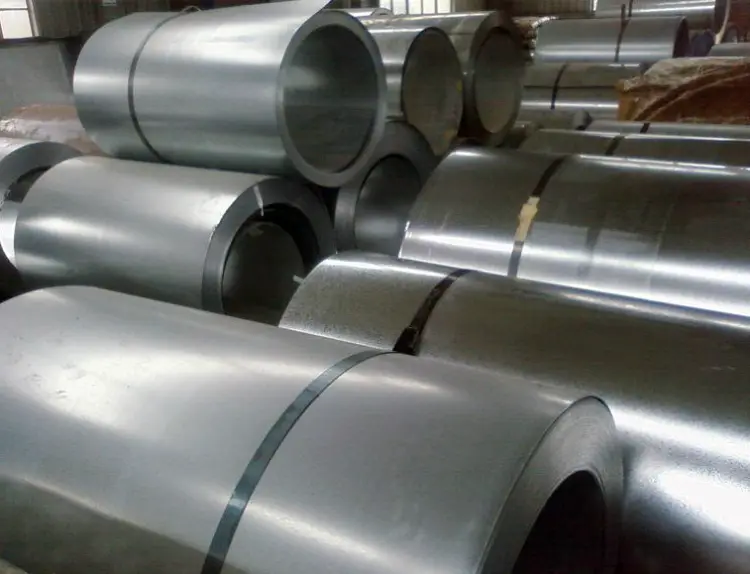
NK F70 Shipbuilding Steel Coil
NK F70 Shipbuilding Steel Coil: High-Strength Marine Grade with Exceptional Weldability
NK F70 is a high-strength structural steel grade certified by ClassNK for shipbuilding, offering minimum yield strength of 685 MPa. It is supplied as coils and plates for critical marine structures requiring excellent toughness and weldability.
Hot rolling, cold rolling, controlled cooling, quenching and tempering, welding, bending, cutting
- Phone : +8618037372205
- Email : [email protected]
- WhatsApp: Contact via Whtsapp
- WeChat: +8618037372205
NK F70 Shipbuilding Steel Coil Introduction
NK F70 is a high-strength shipbuilding steel classified under the Nippon Kaiji Kyokai (ClassNK) rules. It is designed for critical structural components in marine environments where superior strength, toughness, and weldability are essential. With a minimum yield strength of 685 MPa and tensile strength ranging from 785 to 940 MPa, F70 enables weight reduction without compromising safety. This grade is supplied as coils, plates, or sheets in quenched and tempered condition, ensuring uniform mechanical properties. It exhibits excellent low-temperature impact toughness, making it suitable for arctic and severe marine applications. The steel is produced through controlled rolling and heat treatment processes, leading to a fine-grained bainitic/martensitic microstructure. F70 finds extensive use in offshore platforms, hull structures, and heavy-lift crane booms where high load-bearing capacity is required.
NK F70 Shipbuilding Steel Coil Chemical Composition
The chemical composition of NK F70 is carefully controlled to achieve high strength and good weldability. Typical ladle analysis limits are provided. Carbon is kept ≤0.20% to maintain weldability, while manganese, chromium, nickel, and molybdenum are added for hardenability and toughness. Microalloying elements such as niobium, vanadium, and titanium refine the grain size. Phosphorus and sulfur are minimized to ensure cleanliness and low-temperature toughness. The carbon equivalent (CEV) is normally ≤0.52% to avoid cold cracking.
| Chemical Element | Standard Value (Typical) | Remarks |
|---|---|---|
| Carbon (C) | 0.10 – 0.20% | Max. increased with agreement |
| Silicon (Si) | 0.10 – 0.60% | Deoxidation control |
| Manganese (Mn) | 0.60 – 1.60% | Hardenability element |
| Phosphorus (P) | ≤0.020% | Max. for improved toughness |
| Sulfur (S) | ≤0.010% | Max.; low sulfur for cleanliness |
| Chromium (Cr) | 0.20 – 0.80% | Optional; improves strength |
| Nickel (Ni) | 0.20 – 1.50% | Optional; enhances low-temperature toughness |
| Molybdenum (Mo) | 0.10 – 0.60% | Optional; resist temper embrittlement |
| Copper (Cu) | ≤0.30% | Residual |
| Niobium (Nb) | 0.01 – 0.06% | Grain refinement |
| Vanadium (V) | 0.02 – 0.10% | Precipitation strengthening |
| Titanium (Ti) | 0.01 – 0.03% | Grain refinement and deoxidation |
| Aluminum (Al) | 0.015 – 0.060% | Deoxidation; fine grain practice |
| Boron (B) | ≤0.0008% | Optional; trace element |
| Nitrogen (N) | ≤0.012% | Residual |
| Carbon Equivalent (CEV) | ≤0.52% | Based on ladle analysis; CEV = C+Mn/6+(Cr+Mo+V)/5+(Ni+Cu)/15 |
NK F70 Shipbuilding Steel Coil Thermal and Electrical Physical Properties
The physical properties of NK F70 are comparable to other quenched and tempered low-alloy steels. Density is standard for steels. Elastic modulus and shear modulus are typical. Poisson's ratio is around 0.3. Thermal expansion is measured between 20°C and 200-600°C. Thermal conductivity and specific heat capacity vary with temperature. Electrical resistivity is provided for reference. These properties are important for structural design, welding distortion analysis, and thermal management.
| Property | Typical Value | Unit | Test Condition / Temperature |
|---|---|---|---|
| Density (ρ) | 7850 | kg/m³ | At 20°C |
| Elastic modulus (E) | 210 | GPa | At 20°C |
| Shear modulus (G) | 81 | GPa | At 20°C |
| Poisson's ratio (ν) | 0.3 | - | At 20°C |
| Coefficient of thermal expansion (α) | 12.5 | x10⁻⁶/°C | 20-200°C |
| Coefficient of thermal expansion (α) | 13.3 | x10⁻⁶/°C | 20-400°C |
| Coefficient of thermal expansion (α) | 13.8 | x10⁻⁶/°C | 20-600°C |
| Thermal conductivity (λ) | 42 | W/(m·K) | At 20°C |
| Thermal conductivity (λ) | 39 | W/(m·K) | At 200°C |
| Thermal conductivity (λ) | 36 | W/(m·K) | At 400°C |
| Specific heat capacity (cp) | 460 | J/(kg·K) | At 20°C |
| Specific heat capacity (cp) | 520 | J/(kg·K) | At 200°C |
| Specific heat capacity (cp) | 580 | J/(kg·K) | At 400°C |
| Electrical resistivity (ρe) | 0.25 | μΩ·m | At 20°C |
NK F70 Shipbuilding Steel Coil Mechanical Properties
The tensile and impact properties are specified according to ClassNK rules for quenched and tempered plates. Yield strength is minimum 685 MPa for thickness up to 50 mm and slightly reduced for thicker plates (e.g., 670 MPa for 50-100 mm). Tensile strength range is 785-940 MPa. Elongation is guaranteed as per gauge length 5.65√So. Impact energy at -40°C (or lower as agreed) for transverse specimens is typically 46 J minimum for grade F. Bend test requirements (180° bending over a specified mandrel diameter) are included in the standard.
| Property | Standard Required Value | Unit | Test Condition |
|---|---|---|---|
| Yield strength (ReH) | ≥685 | MPa | t ≤ 50 mm, transverse |
| Yield strength (ReH) | ≥670 | MPa | 50 < t ≤ 100 mm, transverse |
| Yield strength (ReH) | ≥620 | MPa | 100 < t ≤ 150 mm, transverse (if applicable) |
| Tensile strength (Rm) | 785 – 940 | MPa | t ≤ 100 mm, transverse |
| Tensile strength (Rm) | 770 – 940 | MPa | 100 < t ≤ 150 mm (if applicable) |
| Elongation (A) (L0 = 5.65√So) | ≥14 | % | Transverse, t ≤ 50 mm |
| Elongation (A) | ≥14 | % | Transverse, 50 < t ≤ 100 mm |
| Elongation (A) | ≥14 | % | Transverse, 100 < t ≤ 150 mm |
| Charpy V-notch impact energy (KV) at -40°C | ≥46 (average) | J | Transverse, 10x10 mm specimen |
| Charpy V-notch impact energy (KV) at -40°C | ≥31 (single) | J | Transverse, 10x10 mm specimen |
| Bend test (180°) | Crack-free | - | Mandrel diameter = 3t for t ≤ 50 mm; 4t for t > 50 mm (bend axis transverse) |
NK F70 Shipbuilding Steel Coil Exact Equivalent Material Standards and Substitutable Grades
| Country/Region | Standard | Grade/Designation | Remarks |
|---|---|---|---|
| Japan / International | ClassNK Part K | NK F70 | Original specification; high-strength shipbuilding steel |
| European Union | EN 10025-6:2019 | S690Q / S690QL / S690QL1 | Quenched and tempered structural steel with equivalent strength; may require additional certification for marine use |
| USA | ASTM A514/A514M | Grade S (or Grade F for similar strength) | High-yield-strength quenched and tempered alloy steel plate; 690 MPa min yield; limited thickness range |
| USA | ASTM A709/A709M | Grade 100 Type Q (690 MPa) | Structural steel for bridges; comparable strength but not specifically for marine |
| Norway / Germany | DNV GL (now DNV) | VL D690 / VL E690 / VL F690 | DNV high-strength steel for shipbuilding; direct equivalent |
| UK | Lloyd's Register | LR F70 | Equivalent grade under LR rules |
| France | Bureau Veritas | BV F70 | Equivalent under BV rules |
| China | China Classification Society | CCS F70 | Equivalent under CCS rules |
| South Korea | Korean Register | KR RF70 | Equivalent under KR rules |
| International | American Bureau of Shipping | ABS EQ70 / FQ70 | ABS equivalent high-strength steel for marine applications |
NK F70 Shipbuilding Steel Coil Application Introduction
NK F70 steel is primarily employed in the shipbuilding and offshore engineering sectors where high strength-to-weight ratio and excellent toughness are paramount. It is suitable for heavy plate structures subjected to dynamic loading and low temperatures. The grade is often delivery as quenched and tempered coils that are later flattened and cut for fabrication. Typical applications include ships' hulls, decks, and bottom structures; legs and spudcans of jack-up rigs; lifting appliances such as crane booms and heavy-lift hooks; and pressure hulls for submersibles. Its superior weldability allows automated welding processes (SAW, GMAW, FCAW) with appropriate preheat and consumables.
Product Applications: Container ships, bulk carriers, tankers, Jack-up rigs and semi-submersible platforms, Icebreakers and arctic vessels, Heavy-duty crane booms and mobile cranes, Hydraulic excavator arms and booms, Ship loader/unloader structures
Processed into products: Hull skin plates and stiffeners, Deck plating and hatch coamings, Legs, chords, and braces of jack-up rigs, Crane main chords and boom boxes, Submarine pressure hull sections, Bolted/riveted structural connections (e.g., A-brackets)
Application industries: Shipbuilding and marine engineering, Offshore oil & gas platforms, Port and harbor construction, Heavy lifting and transport equipment, Bridge and structural engineering (with approval), Defense and naval vessels
NK F70 Shipbuilding Steel Coil Similar / Alternative Materials with Comparable Performance
| Country/Region | Standard | Grade/Designation | Remarks |
|---|---|---|---|
| Sweden | SSAB | Weldox 700 E/F | High-strength structural steel with min. yield 700 MPa; excellent weldability; used in cranes and offshore |
| Germany | DIN EN 10025-6 | S690Q / S690QL | Structural steel with identical strength; may need qualification for marine approval |
| Japan | JIS G 3106 | SM570 (limited strength ~570 MPa) | Lower strength but similar concept; suitable for less demanding structural parts |
| USA | ASTM A517/A517M | Grade A/B/S/P/F (690 MPa quenched & tempered) | Boiler and pressure vessel quality; high strength; not specifically for marine but can be adapted |
| Global | API 2W | Grade 60 / 70 | Offshore structural steel for platforms; similar strength (70 ksi ≈ 485 MPa for Grade 70, lower than F70); for comparison |
| China | GB/T 1591-2018 | Q690D / Q690E | High-strength low-alloy structural steel; comparable strength; requires verification for marine classification |
Notes:
Weldability: Preheating (typically 100-200°C) and low-hydrogen welding consumables are recommended to prevent hydrogen-induced cracking. Post-weld heat treatment is usually not required but may be applied for stress relief. Formability: Due to its high strength, cold forming requires adequate bending radii and attention to spring-back. Hot forming above the tempering temperature should be avoided to preserve mechanical properties. Certification: Products must be certified by a ClassNK surveyor and stamped with the grade symbol. Tolerances: Thickness, width, and flatness tolerances follow EN 10029 or equivalent standards as per mill practice. Further testing: Ultrasonic testing per EN 10160 or ASTM A435 is often mandatory. Alternative designation: Sometimes referred to as NK F70E or NK F70F depending on test coupon orientation, but the base grade remains F70.
- Share



