
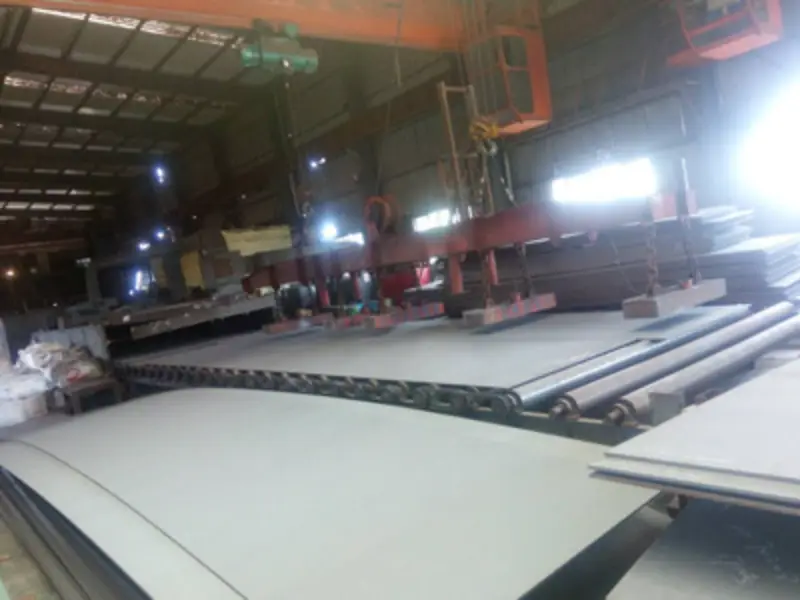
S315MC High Strength Low Alloy Steel for Cold Forming
BS EN 10149-2 S315MC Hot Rolled Steel Coil | High-Strength Cold-Forming Steel Properties
Comprehensive data sheet for S315MC hot rolled steel coil according to BS EN 10149-2. Includes chemical composition, mechanical properties, thermal and electrical properties, equivalent and similar grades, application guidelines for automotive and structural cold-formed parts.
Cold forming, bending, stamping, drawing, welding, shearing, punching
- Phone : +8618037372205
- Email : [email protected]
- WhatsApp: Contact via Whtsapp
- WeChat: +8618037372205
S315MC High Strength Low Alloy Steel for Cold Forming Introduction
BS EN 10149-2 grade S315MC is a hot-rolled, thermomechanically rolled high yield strength steel designed for cold forming. It offers a minimum yield strength of 315 MPa and excellent weldability with a fine-grained microstructure. Key features:
- Minimum yield strength 315 MPa for thicknesses up to 16 mm
- Tensile strength range 390–510 MPa
- Good cold formability and bending properties (minimum bending radius 0.5t)
- Guaranteed impact energy 40 J at -20°C
- Typical applications include chassis components, structural parts in automotive, trailers, and agricultural machinery
- Delivered in hot-rolled condition, often with pickled and oiled surface
S315MC High Strength Low Alloy Steel for Cold Forming Chemical Composition
Chemical composition limits for S315MC in accordance with BS EN 10149-2. Values represent maximum unless a range is given. Altot (total aluminium) ≥0.015%. The sum of Nb+V+Ti shall not exceed 0.22%. Residual elements such as Cr, Ni, Mo, Cu may be present but are typically limited by agreement; indicative maxima are Cr ≤0.15%, Ni ≤0.30%, Mo ≤0.08%, Cu ≤0.25%.
| Chemical Element | Standard Value (wt%) | Remarks |
|---|---|---|
| Carbon (C) | ≤0.12 | |
| Silicon (Si) | ≤0.50 | |
| Manganese (Mn) | ≤1.30 | |
| Phosphorus (P) | ≤0.025 | |
| Sulfur (S) | ≤0.020 | |
| Aluminium (Altot) | ≥0.015 | total aluminium |
| Niobium (Nb) | ≤0.09 | |
| Vanadium (V) | ≤0.20 | |
| Titanium (Ti) | ≤0.15 | |
| Nb+V+Ti | ≤0.22 | sum of microalloying elements |
S315MC High Strength Low Alloy Steel for Cold Forming Thermal and Electrical Physical Properties
Physical properties are indicative for low-alloy thermomechanical steels and are not standard requirements. They assist in engineering calculations for thermal and electrical behaviour. Values apply at room temperature unless otherwise noted. Thermal expansion coefficient varies slightly with temperature range; representative data are given.
| Property | Standard Requirement Value | Unit | Test Condition / Remarks |
|---|---|---|---|
| Density (ρ) | 7.85 | g/cm³ | Room temperature |
| Modulus of elasticity (E) | 210 | GPa | Typical for HSLA steel |
| Shear modulus (G) | 81 | GPa | Calculated from E and ν |
| Poisson's ratio (ν) | 0.30 | – | Typical for steel |
| Thermal expansion coefficient (α) | 11.5 | 10⁻⁶/K | 20–100°C |
| Thermal expansion coefficient (α) | 12.2 | 10⁻⁶/K | 20–200°C |
| Thermal expansion coefficient (α) | 12.8 | 10⁻⁶/K | 20–300°C |
| Thermal conductivity (λ) | 50 | W/(m·K) | at 20°C |
| Specific heat capacity (cp) | 460 | J/(kg·K) | at 20°C |
| Electrical resistivity (ρe) | 0.17 | µΩ·m | Typical value at 20°C |
S315MC High Strength Low Alloy Steel for Cold Forming Mechanical Properties
Minimum mechanical properties for S315MC according to BS EN 10149-2, valid for hot-rolled condition. ReH (upper yield strength) or Rp0.2 used depending on product thickness. KV2 impact energy requirements at -20°C in longitudinal direction. The bend test (180°) uses a mandrel diameter of 0.5t, where t is the thickness of the test piece. No cracks must appear.
| Property | Standard Requirement Value | Unit | Test Condition / Remarks |
|---|---|---|---|
| Yield strength (ReH) | ≥315 | MPa | Nominal thickness e ≤3 mm |
| Yield strength (ReH) | ≥315 | MPa | 3 mm < e ≤6 mm |
| Yield strength (ReH) | ≥315 | MPa | 6 mm < e ≤8 mm |
| Yield strength (ReH) | ≥315 | MPa | 8 mm < e ≤12 mm |
| Yield strength (ReH) | ≥315 | MPa | 12 mm < e ≤16 mm |
| Tensile strength (Rm) | 390 – 510 | MPa | Nominal thickness e ≤16 mm |
| Elongation (A80) | ≥20 | % | Gauge length 80 mm, e <3 mm |
| Elongation (A5) | ≥24 | % | Gauge length 5.65√S₀, 3 mm ≤ e ≤12 mm |
| Elongation (A5) | ≥21 | % | Gauge length 5.65√S₀, e >12 mm |
| Impact energy (KV2) | ≥40 | J | Charpy V-notch, longitudinal, -20°C |
| Bend test (180°) | Crack-free | – | Mandrel diameter = 0.5t (t = specimen thickness) |
S315MC High Strength Low Alloy Steel for Cold Forming Exact Equivalent Standards and Replaceable Grades
| Country/Region | Standard | Grade | Remarks |
|---|---|---|---|
| Europe/International | – | – | No fully identical international equivalent grade exists. S315MC is specifically defined in EN 10149-2. |
| United Kingdom | BS EN 10149-2 | S315MC | The grade itself; direct equivalent to the original BSI adoption. |
S315MC High Strength Low Alloy Steel for Cold Forming Application Introduction
S315MC is specifically designed for cold-formed structural components demanding high strength, good weldability, and fatigue resistance. Typical industries and products include:
Product Applications: Truck chassis frames, longitudinal and cross members, Trailer beams, drawbars, and coupling plates, Crane booms and outrigger sections, Harvesting machine frames, plow beams, Shelving uprights and horizontal braces, Roll-formed profiles for structural enclosures, High-strength welded tubes and hollow sections
Processed into products: Chassis side rails and crossmembers (stamped or roll-formed), Brackets, gussets, and reinforcement plates, Spring hangers and axle mounts, Trailer coupling components, Loader arm profiles and bucket linkages, Agricultural implement tines and toolbar sections, Cold-formed sections for truck bodies, Safety guard frames and ROPS structures
Application industries: Automotive (light and heavy commercial vehicles), Trailer and semi-trailer manufacturing, Agricultural machinery and implements, Construction and earth-moving equipment, Container and storage systems, Material handling and racking structures, Pipe and tube manufacturing
S315MC High Strength Low Alloy Steel for Cold Forming Closely Comparable / Substitute Materials
| Country/Region | Standard | Grade | Remarks |
|---|---|---|---|
| Europe | DIN EN 10149-2 (historical) | QStE340TM | Old designation in SEW 092; yield strength 340 MPa, slightly higher than S315MC. Now replaced by S315MC. |
| Europe | EN 10149-2 | S275MC | Lower strength class; yield ≥275 MPa. Suitable when 315 MPa not required. |
| Europe | EN 10149-2 | S355MC | Higher strength; yield ≥355 MPa. May be used with redesign for higher loads. |
| USA | ASTM A1011/A1011M | HSLAS Grade 45 Class 1 | Yield strength 310 MPa, similar strength level; chemistry and impact requirements differ. |
| USA | ASTM A1011/A1011M | HSLAS Grade 50 Class 1 | Yield strength 340 MPa; provides a safety margin in substitute design. |
| Japan | JIS G 3134 | SPFH 540 | Yield strength min. 325 MPa; comparable in formability and strength. |
| International | ISO 4995 | HR340 | Hot-rolled structural steel; yield 340 MPa, but different delivery condition and cold-forming suitability. |
Notes:
Material is ordered as +M (thermomechanical rolled). Welding: Excellent for all common welding processes; equivalent carbon (CEV) typically ≤0.22%, no preheat required for moderate thicknesses. Surface condition as-rolled or pickled and oiled; inspect according to EN 10163 parts 1–3. Forming recommendations: minimum inside bend radius of 0.5t with die opening 8–10t. Hot dip galvanising possible with proper composition control (avoid strains due to excessive Si+Mn). Microstructure consists of fine ferrite and pearlite with grain refinement from microalloying. This grade complies with EU Construction Products Regulation (CPR) where applicable.
- Share



