
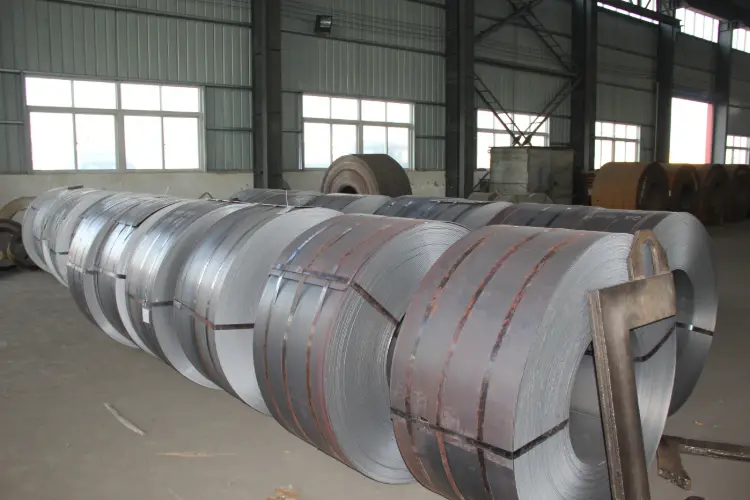
API 5CT J55 Hot Rolled Steel Coil for Oil Casing
API 5CT J55 Hot Rolled Steel Coil for Oil Casing - Full Material Specifications
Detailed technical analysis and reference data for API 5CT J55 steel, used for oil well casing and tubing. Includes chemical composition, mechanical and physical properties, international equivalents, and application guidelines.
Hot rolling, cold forming, longitudinal/helical welding, heat treatment (normalizing if required)
- Phone : +8618037372205
- Email : [email protected]
- WhatsApp: Contact via Whtsapp
- WeChat: +8618037372205
API 5CT J55 Hot Rolled Steel Coil for Oil Casing Introduction
API 5CT J55 is a low‑carbon steel grade specified by the American Petroleum Institute (API 5CT, 9th Edition) for seamless or welded casing and tubing in oil and gas wells. It is supplied primarily as hot‑rolled coil or plate. The grade offers a yield strength range of 379–552 MPa (55–80 ksi) and minimum tensile strength of 517 MPa (75 ksi). Its good weldability, formability, and cost‑effectiveness make it one of the most commonly used materials for non‑sour service casing strings. Typical delivery condition is as‑rolled or normalized; the steel is not intended for sour (H₂S) environments unless specially processed.
API 5CT J55 Hot Rolled Steel Coil for Oil Casing Chemical Composition
The chemical requirements for API 5CT J55 are maximum limits as shown. Other elements (Si, Ni, Cr, Mo, V, Cu) may be present as residuals but are not mandatory unless supplementary requirements S1‑S9 apply. The steel is essentially a simple low‑carbon manganese steel.
| Chemical Element | Standard Value | Remarks |
|---|---|---|
| Carbon (C) | ≤ 0.34 % | Heat analysis per API 5CT |
| Manganese (Mn) | ≤ 1.25 % | Heat analysis per API 5CT |
| Phosphorus (P) | ≤ 0.030 % | Heat analysis per API 5CT |
| Sulfur (S) | ≤ 0.030 % | Heat analysis per API 5CT |
| Silicon (Si) | Unot specified (typically 0.15–0.35 %) | Not mandatory in standard; may be reported |
| Residual elements (Ni, Cr, Mo, V, Cu) | ≤ 0.25 % each (typical max) | Only controlled when supplementary requirements are invoked |
API 5CT J55 Hot Rolled Steel Coil for Oil Casing Thermal and Electrical Physical Properties
The following physical properties are representative for low‑carbon steels such as J55. They are not part of the API 5CT specification but are provided for design calculations.
| Property | Typical Value | Unit | Condition |
|---|---|---|---|
| Density (ρ) | 7.85 | g/cm³ | Room temperature |
| Elastic modulus (E) | 200 – 210 | GPa | Room temperature |
| Shear modulus (G) | 77 – 81 | GPa | Room temperature |
| Poisson's ratio (ν) | 0.29 – 0.30 | — | Room temperature |
| Thermal expansion coefficient (α) | 12.0 × 10⁻⁶ | K⁻¹ | 20–100 °C |
| Thermal conductivity (λ) | 51.9 | W/(m·K) | 20 °C |
| Specific heat capacity (cp) | 486 | J/(kg·K) | 20 °C |
| Electrical resistivity (ρe) | 0.142 | μΩ·m | 20 °C |
API 5CT J55 Hot Rolled Steel Coil for Oil Casing Mechanical Properties
The mechanical properties are determined on pipe body specimens in accordance with API 5CT. Elongation requirements depend on specimen type and wall thickness; shown values are the most common minima for longitudinal strip or round specimens.
| Property | Standard Required Value | Unit | Test Condition |
|---|---|---|---|
| Yield Strength (ReH) | 379 – 552 | MPa | Room temperature, longitudinal specimen |
| Tensile Strength (Rm) | ≥ 517 | MPa | Room temperature, longitudinal specimen |
| Elongation (A, 50.8 mm gauge) | ≥ 18 % (round specimen) / ≥ 22 % (strip specimen) | % | 50.8 mm gauge length, depending on wall thickness; see API 5CT Table C.5 |
| Impact energy (KV) | Not required for J55 basic grade | J | Unless supplementary requirement SR2 is specified |
| Hardness | ≤ 200 HBW (typical as‑rolled) | HBW | Not a standard requirement; for reference only |
API 5CT J55 Hot Rolled Steel Coil for Oil Casing Equivalent Standards and Direct Substitute Grades
| Country/Region | Standard | Grade | Remarks |
|---|---|---|---|
| International | ISO 11960 | J55 | Identical technical requirements for casing and tubing |
| China | GB/T 20492 | J55 | Equivalent to API 5CT J55 for oil pipeline casing |
| Russia | GOST 632‑80 | Strength group D | Yield strength range similar to J55; for casing pipes |
| USA | API 5CT | J55 | Original specification; the grade itself |
| European Union | None (EN 10208‑2 is for linepipe) | — | API 5CT grades are directly adopted for oil country tubular goods |
API 5CT J55 Hot Rolled Steel Coil for Oil Casing Application Introduction
API 5CT J55 is primarily used in the upstream oil and gas industry. Its moderate strength and good weldability make it suitable for standard well conditions without hydrogen sulfide. Typical applications include:
Product Applications: Oil well casing (surface, intermediate, and production casing), Tubing strings, Conductor pipes, Drill pipe couplings, Line pipe (when dual‑certified), Structural pipes in offshore platforms
Processed into products: Casing joints and connectors, Threaded and coupled pipe segments, End rings for pipe connectors, Tubing hanger subs, Transition pieces
Application industries: Oil and gas exploration and production, Pipeline construction (casing strings), Energy infrastructure and tubular construction
API 5CT J55 Hot Rolled Steel Coil for Oil Casing Similar or Closely Related Material Grades
| Country/Region | Standard | Grade | Remarks |
|---|---|---|---|
| USA | API 5CT | H40 | Lower yield and tensile strength; used for less demanding structural tubulars |
| USA | API 5CT | K55 | Same chemistry, higher tensile strength (≥ 655 MPa); often used for coupling stock |
| China | GB/T 20492 | K55 | Equivalent to API 5CT K55 |
| Russia | GOST 632‑80 | K group (K55 analogue) | Strength group K, yield 379–552 MPa, tensile ≥655 MPa |
| Europe | EN 10297‑1 | E235 (St37.4) for mechanical tubes | Similar strength range but for different application (mechanical engineering) – not for oil country goods |
Notes:
API 5CT J55 is not intended for sour service (H₂S) unless additional testing (e.g., NACE TM0177) and special heat treatment are applied. For corrosive environments, grades such as L80, C95 or higher should be considered. Supplementary requirements (SR) can be specified to control residual alloying elements or to add Charpy impact testing at low temperature. Always refer to the latest edition of API 5CT for precise procurement specifications.
- Share



