
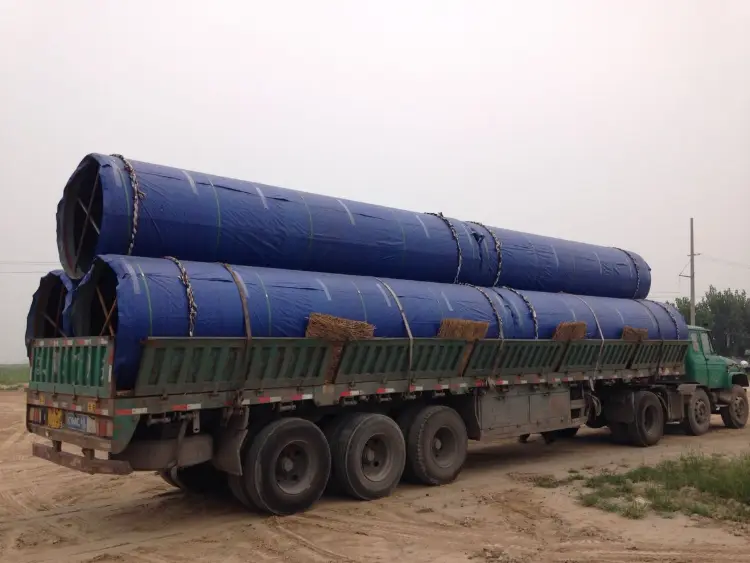
S275NLH LSAW Pipe
S275NLH LSAW Pipe: Cold-Formed Welded Structural Hollow Section per EN 10219
Comprehensive material data for S275NLH LSAW pipe according to EN 10219, including chemical composition, mechanical properties, thermal properties, equivalent grades, and applications.
Cold forming and longitudinal submerged arc welding (LSAW), followed by normalizing or normalized rolling
- Phone : +8618037372205
- Email : [email protected]
- WhatsApp: Contact via Whtsapp
- WeChat: +8618037372205
S275NLH LSAW Pipe Introduction
- S275NLH is a fine-grain structural steel grade for cold-formed welded structural hollow sections, standardized in EN 10219-1.
- 'N' denotes normalized or normalized rolled, 'L' indicates improved low-temperature impact properties (down to -50°C), and 'H' stands for hollow section.
- It offers good weldability, high strength, and excellent toughness, making it suitable for use in low-temperature environments.
- LSAW (Longitudinally Submerged Arc Welded) pipe is produced by welding from plates or coils, resulting in a reliable longitudinal weld seam.
S275NLH LSAW Pipe Chemical Composition
The following table presents the maximum or nominal chemical composition limits for S275NLH grade as specified in EN 10219-1. Additional elements like Nb, V, Ti are added for grain refinement. Elements not listed are not intentionally added.
| Element | Standard Value (max unless range) | Remarks |
|---|---|---|
| C | ≤0.20 | For t≤40 mm; ≤0.22 for t>40 mm |
| Si | ≤0.55 | |
| Mn | ≤1.60 | For t≤40 mm; ≤1.70 for t>40 mm |
| P | ≤0.025 | |
| S | ≤0.020 | |
| Al (total) | ≥0.020 | Minimum soluble aluminum to ensure fine grain |
| Nb | ≤0.05 | Grain refiner |
| V | ≤0.12 | Can be combined with Nb |
| Ti | ≤0.05 | Grain refiner |
| N | ≤0.015 | |
| CEV (max) | ≤0.43 | For t≤40 mm; ≤0.45 for t>40 mm, based on ladle analysis |
S275NLH LSAW Pipe Thermal and Electrical Physical Properties
These are generic values for structural steel; they are not specified in EN 10219 but are commonly used for design calculations. Values may vary slightly depending on precise composition and heat treatment.
| Property | Standard Reference Value | Unit | Test Condition / Remarks |
|---|---|---|---|
| Density (ρ) | 7850 | kg/m³ | or 7.85 g/cm³, typical for carbon steel |
| Elastic Modulus (E) | 210 | GPa | At room temperature |
| Shear Modulus (G) | 81 | GPa | Calculated from E and Poisson's ratio |
| Poisson's Ratio (ν) | 0.3 | – | Typical for steel in elastic range |
| Thermal Expansion (α) | 11.1 × 10⁻⁶ | /K | Between 20°C and 100°C |
| Thermal Expansion (α) | 12.5 × 10⁻⁶ | /K | Between 20°C and 200°C |
| Thermal Expansion (α) | 13.5 × 10⁻⁶ | /K | Between 20°C and 300°C |
| Thermal Conductivity (λ) | 50 | W/(m·K) | At 20°C, approximate |
| Specific Heat Capacity (cₚ) | 460 | J/(kg·K) | At room temperature |
| Electrical Resistivity (ρₑ) | 0.15 – 0.22 | μΩ·m | At 20°C, approximate range |
S275NLH LSAW Pipe Mechanical Properties
Properties are extracted from EN 10219-1 for S275NLH. Yield strength and tensile strength depend on wall thickness (t). Impact test requirements apply to Charpy V-notch specimens at -50°C. Values are minimum unless stated otherwise.
| Property | Standard Requirement | Unit | Test Condition / Remarks |
|---|---|---|---|
| Yield Strength (ReH) | 275 | MPa | t ≤ 16 mm |
| Yield Strength (ReH) | 265 | MPa | 16 < t ≤ 40 mm |
| Yield Strength (ReH) | 255 | MPa | 40 < t ≤ 63 mm |
| Yield Strength (ReH) | 245 | MPa | 63 < t ≤ 80 mm |
| Yield Strength (ReH) | 235 | MPa | 80 < t ≤ 120 mm |
| Tensile Strength (Rm) | 410 – 560 | MPa | t ≤ 3 mm |
| Tensile Strength (Rm) | 410 – 560 | MPa | 3 < t ≤ 100 mm |
| Tensile Strength (Rm) | 400 – 540 | MPa | 100 < t ≤ 120 mm |
| Elongation (A) | ≥24 | % | Longitudinal, t ≤ 40 mm |
| Elongation (A) | ≥23 | % | Longitudinal, 40 < t ≤ 63 mm |
| Elongation (A) | ≥22 | % | Longitudinal, 63 < t ≤ 100 mm |
| Elongation (A) | ≥21 | % | Longitudinal, 100 < t ≤ 120 mm |
| Elongation (A) | ≥18 | % | Transverse, t ≤ 40 mm |
| Elongation (A) | ≥17 | % | Transverse, 40 < t ≤ 63 mm |
| Elongation (A) | ≥17 | % | Transverse, 63 < t ≤ 100 mm |
| Elongation (A) | ≥16 | % | Transverse, 100 < t ≤ 120 mm |
| Impact Energy (KV) | ≥27 | J | Charpy-V, -50°C, longitudinal, 10×10 mm specimen |
| Impact Energy (KV) | ≥27 (avg) | J | Charpy-V, -50°C, transverse, alternative |
| Bend Radius | Not specified | – | Bend test not required for hollow sections per EN 10219 |
S275NLH LSAW Pipe Exact Equivalent Material Standards and Alternative Designations
| Region | Standard | Grade/Designation | Remarks |
|---|---|---|---|
| Europe / UK | EN 10219-1 | S275NLH | Original specification for cold-formed hollow sections |
| Europe / UK | EN 10210-1 | S275NLH | For hot-finished hollow sections; similar chemistry and mechanicals, but process differs |
| International | ISO 630-2 | FeE275N | Equivalent steel grade for plates, not a hollow section standard |
| No other exact equivalent exists | – | – | S275NLH is a specific product form, other national standards have similar but not identical grades |
S275NLH LSAW Pipe Application Introduction
- S275NLH LSAW pipe is widely used in welded steel structures requiring low-temperature toughness and good weldability.
- It is often selected for heavy-duty structural applications where high reliability is critical.
Product Applications: Welded steel frameworks, Bridge girders and arch ribs, Offshore platform legs and braces, Wind turbine tubular towers, Crane booms and gantry structures, Architectural exposed structures
Processed into products: Tubular columns and beams, Joints and nodes in trusses, Piled foundations (driven tubes), Machinery booms and support arms, Structural bracing members, Lattice towers
Application industries: Construction, Onshore and offshore structural engineering, Bridge building, Wind energy (tower sections), Shipbuilding and marine structures, Mining and heavy machinery, Oil and gas (structural parts, non-pressurized)
S275NLH LSAW Pipe Similar / Alternative Materials for Comparison
| Region | Standard | Grade | Remarks |
|---|---|---|---|
| USA | ASTM A500 | Grade C | Common cold-formed structural hollow section; minimum yield 345 MPa (50 ksi) but no guaranteed refined grain or low-temperature impact unless agreed |
| USA | ASTM A501 | Grade B | Hot-formed structural tubing; similar strength but lacks low-temperature toughness |
| Japan | JIS G3444 | STK490 | General structural carbon steel tube, higher strength but not required to meet S275NLH low temperature impact |
| China | GB/T 1591 | Q355NH | Weather-resistant structural steel with yield ~355 MPa, not directly a hollow section grade, but plate used for welded pipes |
| EU | EN 10219 | S355NLH | Higher yield strength fine-grain steel hollow section, often used as upgrade for heavier loads |
Notes:
- For LSAW pipe produced to EN 10219, the manufacturer must demonstrate the capability to meet the impact requirements at -50°C through production tests.
- Ultrasonic testing of the weld is often specified (e.g., according to EN 10246-14) to ensure weld integrity.
- Cold-formed sections can be stress-relief annealed if required; the normalized condition (+N) is the default delivery condition for S275NLH.
- Share



