
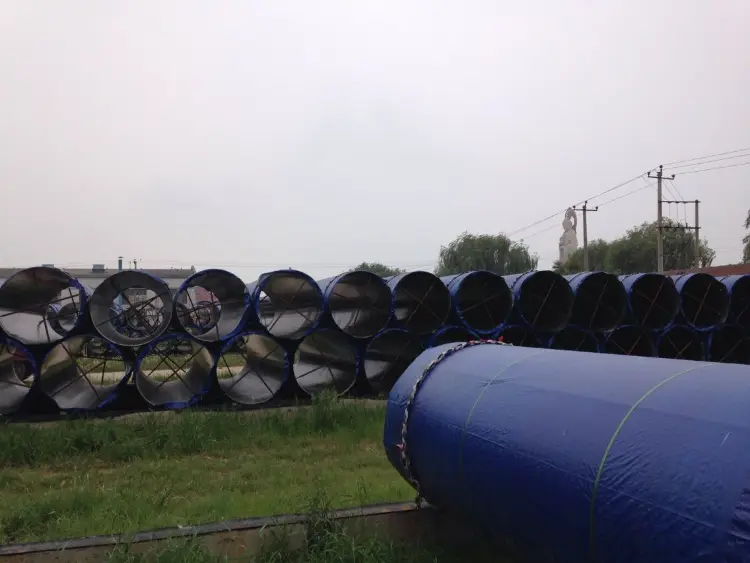
EN10219 S275NH LSAW Pipe
EN10219 S275NH LSAW Pipe: High-Strength Structural Hollow Section for Demanding Applications
Comprehensive material data for EN10219 S275NH LSAW steel pipe: chemical composition, mechanical properties, physical properties, international equivalents, and application guidelines.
Cold forming, welding (LSAW), normalizing or normalizing rolling, suitable for hot-dip galvanizing, machining, and standard fabrication
- Phone : +8618037372205
- Email : [email protected]
- WhatsApp: Contact via Whtsapp
- WeChat: +8618037372205
EN10219 S275NH LSAW Pipe Introduction
EN10219 S275NH is a cold-formed welded structural hollow section steel produced by the longitudinal submerged arc welding (LSAW) process. It belongs to the normalized fine-grain structural steel family and offers a minimum yield strength of 275 MPa. The 'NH' designation indicates a normalized or normalized-rolled condition with guaranteed impact toughness at -20°C, making it suitable for demanding structural applications, especially in cold climates. The steel exhibits good weldability, consistent mechanical properties, and excellent toughness. Its fine-grain structure ensures resistance to brittle fracture and good formability. Primary uses include load-bearing structures, bridges, offshore platforms, and heavy machinery frames.
EN10219 S275NH LSAW Pipe Chemical Composition of S275NH
The chemical composition meets the requirements of EN 10219-1 which refers to EN 10025-3 for fine-grain structural steels. The steel is fully killed with aluminium and has a fine-grain structure achieved through normalizing rolling. Microalloying elements such as niobium, vanadium or titanium may be added singly or in combination to obtain the required mechanical properties. The maximum carbon equivalent (CEV) is controlled to ensure good weldability, typically ≤ 0.40% for sections > 30 mm thickness.
| Element | Standard Value (%) | Remarks |
|---|---|---|
| Carbon (C) | ≤ 0.20 | Max, heat analysis |
| Silicon (Si) | ≤ 0.60 | Max, heat analysis |
| Manganese (Mn) | 0.50 – 1.60 | Range, heat analysis |
| Phosphorus (P) | ≤ 0.030 | Max, heat analysis |
| Sulfur (S) | ≤ 0.025 | Max, heat analysis |
| Nitrogen (N) | ≤ 0.015 | Max, for nitrogen-binding elements present; otherwise ≤ 0.012 |
| Aluminium (Al) | ≥ 0.015 (total) | Min, to ensure fine grain |
| Copper (Cu) | ≤ 0.55 | Max |
| Nickel (Ni) | ≤ 0.55 | Max |
| Niobium (Nb) | ≤ 0.05 | Optional microalloy |
| Vanadium (V) | ≤ 0.12 | Optional microalloy |
| Titanium (Ti) | ≤ 0.03 | Optional microalloy |
| Nb+V+Ti | ≤ 0.22 | If all used together |
EN10219 S275NH LSAW Pipe Physical & Thermal Properties
The following physical properties are typical for non-alloy structural steel and are based on standard data (EN 1993‑1‑1, EN 10210, specific literature). These values are valid for ambient temperatures unless otherwise noted and can be used for design calculations. Actual values may vary slightly depending on exact composition and processing.
| Property | Typical Value | Unit | Conditions / Remarks |
|---|---|---|---|
| Density (ρ) | 7850 | kg/m³ | At 20 °C |
| Elastic modulus (E) | 210 | GPa | At 20 °C |
| Shear modulus (G) | ≈ 81 | GPa | Approximate, based on E and ν=0.3 |
| Poisson's ratio (ν) | 0.3 | – | At 20 °C |
| Thermal expansion coefficient (α) | 12.3 × 10⁻⁶ | K⁻¹ | Range 20–100 °C |
| Thermal conductivity (λ) | 50 | W/(m·K) | At 20 °C (typical structural steel) |
| Specific heat capacity | 460 | J/(kg·K) | At 20 °C |
| Electrical resistivity (ρ_e) | 0.17 – 0.22 × 10⁻⁶ | Ω·m | At 20 °C |
EN10219 S275NH LSAW Pipe Mechanical Properties of S275NH
The mechanical properties are tested on full-section hollow sections or on flats from the parent strip before forming, as specified in EN 10219-1. Yield strength values apply to wall thicknesses up to 40 mm; for thicker sections, lower values may apply. Charpy impact energy is measured at -20°C on longitudinal specimens (10×10 mm or 7.5×10 mm). The minimum elongation is 24% but may be adjusted based on cross-sectional area.
| Property | Specified Requirement | Unit | Test Condition / Remarks |
|---|---|---|---|
| Yield strength (ReH) | ≥ 275 | MPa | Wall thickness ≤ 40 mm; minimum upper yield |
| Tensile strength (Rm) | 370 – 530 | MPa | t ≤ 40 mm |
| Elongation after fracture (A) | ≥ 24 (longitudinal) ≥ 21 (transverse) | % | Proportional gauge length L0 = 5.65√S0; t ≤ 40 mm |
| Impact energy (KV) | ≥ 27 | J | At -20 °C; longitudinal Charpy V-notch (average of 3 specimens) |
| Flattening test | No cracks or imperfections | – | Per EN 10219; applicable to round hollow sections only |
EN10219 S275NH LSAW Pipe Fully Equivalent Material Standards & Substitutable Grades
| Country/Region | Standard | Grade | Remarks |
|---|---|---|---|
| European Union | EN 10025-3 | S275N | Same base steel, but for plates and sections (not hollow sections); normalized fine-grain steel |
| European Union | EN 10210-1 | S275NH | Hot-finished hollow sections: same chemical and mechanical properties; direct substitute for cold-formed counterpart |
EN10219 S275NH LSAW Pipe Application Introduction
EN10219 S275NH LSAW pipes are used in demanding structural applications where toughness at sub-zero temperatures and reliable weldability are essential. The combination of fine-grain microstructure and normalizing treatment ensures consistent mechanical properties across wall thickness. Typical uses span from civil engineering to heavy machinery. The material can be easily fabricated, welded, galvanized, and machined.
Product Applications: Structural hollow profiles (LSAW pipes), Jumbo hollow sections for high-rise buildings, Offshore jacket legs and braces, Piling pipes for ports and bridges, Wind turbine tower tubes, Crane booms and lattice masts, Conveyor frames and industrial frames
Processed into products: Columns, beams, and truss members, Bracing elements in steel frames, Foundation piles and pile sleeves, Bridge piers and support structures, Welded tubular joints (e.g., K-joints), Equipment chassis and support frames, Large diameter flanges and transition pieces
Application industries: Construction and civil engineering, Offshore and marine structures, Bridge building, Wind energy (towers and foundations), Heavy equipment manufacturing, Piling and foundation engineering, Transport infrastructure (railway, highway)
EN10219 S275NH LSAW Pipe Similar / Alternative Materials for Consideration
| Country/Region | Standard | Grade | Remarks |
|---|---|---|---|
| USA | ASTM A501 / A501M | Grade B | Hot-formed welded carbon steel structural tubing; yield 275 MPa (240 for Grade A); no fine-grain requirement |
| USA | ASTM A572 / A572M | Grade 50 | High-strength low-alloy structural steel; yield 345 MPa; usable for structural hollow sections if converted |
| Japan | JIS G 3466 | STKR 490 | Carbon steel square and rectangular tubes for general structure; yield 325 MPa; closest regular strength |
| China | GB/T 1591 | Q345D | Low-alloy high-strength structural steel; normalized optional; yield 345 MPa; suitable for cold-formed hollow sections |
| International | ISO 24314 | S275N | Structural steels – Plates and sections; essentially identical to EN 10025-3; not hollow section specific |
Notes:
Note: All data is per EN 10219-1 and references therein. For precise design, the actual inspection certificate of the supplied product shall be consulted. Welding: S275NH is easily weldable with all common methods; preheating may be necessary for thick sections (>50 mm) or at low temperatures. Corrosion protection: Suitable for hot-dip galvanizing; pre-treatment may be required for heavy structural parts. CEV: Typical carbon equivalent values are between 0.38–0.42, ensuring good weldability without cold cracking.
- Share



