
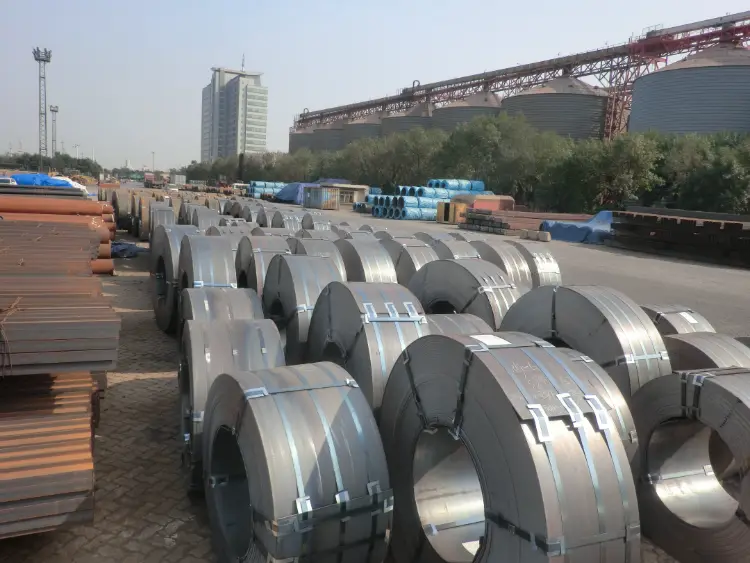
S275ML Carbon and Low-alloy High-strength Steel Coil
S275ML Carbon and Low-alloy High-strength Steel Coil - EN 10025-4 Thermomechanical Rolled Fine Grain Steel
Detailed material data for S275ML steel according to EN 10025-4. Chemical composition, mechanical and physical properties, equivalent grades, and applications.
Thermomechanical rolling, cold forming, hot-dip galvanizing, welding, oxy-fuel cutting, plasma cutting
- Phone : +8618037372205
- Email : [email protected]
- WhatsApp: Contact via Whtsapp
- WeChat: +8618037372205
S275ML Carbon and Low-alloy High-strength Steel Coil Introduction
S275ML is a thermomechanically rolled weldable fine-grain structural steel grade defined in EN 10025-4. It belongs to the carbon and low-alloy high-strength steel category and offers a minimum yield strength of 275 MPa for thicknesses ≤ 16 mm. The 'M' designation indicates a thermomechanical rolling process, which refines the grain structure and provides excellent toughness at low temperatures; the 'L' qualifier guarantees impact energy of at least 27 J at -50°C.
- Good weldability due to low carbon equivalent
- High ductility and notch toughness
- Suitable for cold forming and hot-dip galvanizing
- Predominantly supplied as coils, plates, and sections in the normalized or thermomechanical rolled delivery condition
S275ML Carbon and Low-alloy High-strength Steel Coil Chemical Composition
The chemical composition complies with EN 10025-4:2019 for grade S275ML. Values represent ladle analysis and are critical for achieving the required mechanical properties and weldability. The low carbon equivalent (CEV) ensures excellent on-site weldability without preheating for moderate thicknesses.
| Chemical Element | Standard Value (wt%) | Comment |
|---|---|---|
| Carbon (C) | ≤ 0.18 | Maximum |
| Silicon (Si) | ≤ 0.50 | Maximum |
| Manganese (Mn) | 1.00 – 1.70 | Range for product thickness ≤ 40 mm; for thicker products range may be adjusted per standard |
| Phosphorus (P) | ≤ 0.025 | Maximum |
| Sulfur (S) | ≤ 0.020 | Maximum |
| Aluminium (Al total) | ≥ 0.015 | Minimum total aluminium required for fine grain |
| Niobium (Nb) | ≤ 0.05 | Maximum; grain-refining element |
| Vanadium (V) | ≤ 0.12 | Maximum; may be used for precipitation strengthening |
| Titanium (Ti) | ≤ 0.05 | Maximum; grain-refining element |
| Nitrogen (N) | ≤ 0.015 | Maximum |
| Copper (Cu) | ≤ 0.55 | Maximum; for improved atmospheric corrosion resistance if specified |
| Chromium (Cr) | ≤ 0.30 | Residual element, maximum |
| Nickel (Ni) | ≤ 0.30 | Residual element, maximum |
| Molybdenum (Mo) | ≤ 0.10 | Residual element, maximum |
| CEV (Carbon Equivalent) | ≤ 0.39 (typical for thin gauges, may be higher for thicker sections) | Calculated using IIW formula, ensures weldability |
S275ML Carbon and Low-alloy High-strength Steel Coil Thermal and Electrical Physical Properties
Physical properties are not mandatory in EN 10025-4 but are provided as typical engineering values for grade S275ML. These values are largely independent of small compositional variations and can be used for design calculations. The thermomechanical processing does not significantly alter these bulk properties compared to hot-rolled mild steel.
| Property | Typical Value | Unit | Test Condition / Remark |
|---|---|---|---|
| Density (ρ) | 7850 | kg/m³ | At 20°C |
| Modulus of elasticity (E) | 210 | GPa | At room temperature |
| Shear modulus (G) | 80.8 | GPa | Calculated from E and ν |
| Poisson's ratio (ν) | 0.3 | – | Elastic range |
| Thermal expansion coefficient (α) | 11.7 × 10⁻⁶ | K⁻¹ | Between 20°C and 100°C |
| Thermal expansion coefficient (α) | 12.5 × 10⁻⁶ | K⁻¹ | Between 20°C and 200°C |
| Thermal expansion coefficient (α) | 13.5 × 10⁻⁶ | K⁻¹ | Between 20°C and 400°C |
| Thermal conductivity (λ) | 53 | W/(m·K) | At 20°C |
| Thermal conductivity (λ) | 51 | W/(m·K) | At 100°C |
| Thermal conductivity (λ) | 45 | W/(m·K) | At 300°C |
| Specific heat capacity (cp) | 460 | J/(kg·K) | At 20°C – 100°C |
| Electrical resistivity (ρ_e) | 0.18 × 10⁻⁶ | Ω·m | At 20°C – typical for structural steel |
S275ML Carbon and Low-alloy High-strength Steel Coil Mechanical Properties
Mechanical properties are guaranteed by the thermomechanical rolling process. Values are valid for transverse test pieces unless otherwise noted. Impact energy requirements apply down to -50°C; the minimum value is 27 J on ISO 148-1 Charpy V-notch specimens. Bend tests are performed with a former diameter related to the specified minimum yield strength and product thickness.
| Property | Standard Requirement | Unit | Test Condition |
|---|---|---|---|
| Yield strength (ReH) | ≥ 275 | MPa | Thickness t ≤ 16 mm, transverse |
| Yield strength (ReH) | ≥ 265 | MPa | Thickness 16 mm < t ≤ 40 mm, transverse |
| Yield strength (ReH) | ≥ 255 | MPa | Thickness 40 mm < t ≤ 63 mm, transverse |
| Yield strength (ReH) | ≥ 245 | MPa | Thickness 63 mm < t ≤ 80 mm, transverse |
| Yield strength (ReH) | ≥ 235 | MPa | Thickness 80 mm < t ≤ 100 mm, transverse |
| Yield strength (ReH) | ≥ 225 | MPa | Thickness 100 mm < t ≤ 120 mm, transverse |
| Tensile strength (Rm) | 370 – 530 | MPa | Thickness t ≤ 100 mm, transverse |
| Tensile strength (Rm) | 360 – 520 | MPa | Thickness 100 mm < t ≤ 120 mm, transverse |
| Elongation after fracture (A) | ≥ 24 | % | Thickness t ≤ 40 mm, transverse, gauge L0 = 5.65√S0 |
| Elongation after fracture (A) | ≥ 23 | % | Thickness 40 mm < t ≤ 63 mm |
| Elongation after fracture (A) | ≥ 22 | % | Thickness 63 mm < t ≤ 100 mm |
| Elongation after fracture (A) | ≥ 21 | % | Thickness 100 mm < t ≤ 120 mm |
| Bend test (bend angle 180°) | Pin diameter 1.0 × t | – | t ≤ 16 mm |
| Bend test | Pin diameter 1.5 × t | – | 16 mm < t ≤ 40 mm |
| Bend test | Pin diameter 2.0 × t | – | 40 mm < t ≤ 63 mm |
| Bend test | Pin diameter 2.5 × t | – | 63 mm < t ≤ 100 mm |
| Bend test | Pin diameter 3.0 × t | – | 100 mm < t ≤ 120 mm |
| Charpy impact energy (KV) | ≥ 27 (longitudinal) / ≥ 20 (transverse) | J | At -50°C, ISO V-notch |
| Charpy impact energy (KV) | ≥ 40 (longitudinal) / ≥ 27 (transverse) | J | At -20°C (if tested for information) |
S275ML Carbon and Low-alloy High-strength Steel Coil Fully Equivalent Material Standards and Substitutable Grades
| Country / Region | Standard | Grade | Remarks |
|---|---|---|---|
| Europe | EN 10025-4 | S275ML | Original standard designation; thermomechanically rolled |
| International | ISO 630-3 | S275ML | Identical technical delivery conditions |
| United Kingdom | BS EN 10025-4 | S275ML | Adopts EN standard without modification |
| Germany | DIN EN 10025-4 | S275ML | Adopts EN standard |
| France | NF EN 10025-4 | S275ML | Adopts EN standard |
| Spain | UNE EN 10025-4 | S275ML | Adopts EN standard |
| Italy | UNI EN 10025-4 | S275ML | Adopts EN standard |
S275ML Carbon and Low-alloy High-strength Steel Coil Application Introduction
S275ML steel is designed for heavy-duty welded structures where guaranteed low-temperature toughness and excellent weldability are essential. The thermomechanical rolling process yields a fine-grained microstructure, providing a favourable combination of strength, ductility, and notch toughness. Typical industries and components include:
Product Applications: Welded I-beams, H-beams, and box girders, Bridge decks and orthotropic plates, Wind turbine towers and transition pieces, Tubular structures and hollow sections, Construction machinery components such as excavator arms and dump truck bodies, Storage tanks and silos, Vehicular frames and reinforced structural members
Processed into products: Flanges, webs, and splice plates for plate girders, Bracket and node plates for tubular joints, Stiffeners, diaphragms, and stiffening rings, Base plates and anchor plates, Cut profiles for welded assemblies, Cold-formed sections (provided adequate roll-forming capacity), Pressed and bent parts with large radius
Application industries: Bridge construction (road and railway bridges), Building and civil engineering (high-rise structures, stadiums, industrial halls), Offshore and marine engineering (wind turbine foundations, jacket structures, deck plates), Pressure vessel and storage tank manufacturing (moderate temperature applications), Railway vehicle manufacturing (bogies, underframes), Crane and heavy machinery manufacturing (booms, chassis), Pipeline and penstock construction (welded pipes for water and low-pressure gas)
S275ML Carbon and Low-alloy High-strength Steel Coil Similar and Comparable Alternative Materials
| Country / Region | Standard | Grade | Remarks and Key Differences |
|---|---|---|---|
| Europe | EN 10025-3 | S275N / S275NL | Normalized rolled fine-grain steel; NL variant also offers -50°C impact but delivery condition differs (+N). Mechanical properties comparable but weldability / CEV may differ slightly. |
| Europe | EN 10025-4 | S355ML | Higher strength thermomechanical steel (min. yield 355 MPa). Can be used where higher load capacity is needed, but strength increase must be considered in design. |
| Europe | EN 10025-2 | S275J2 | Hot-rolled structural steel, not fine-grain treated. Impact at -20°C (27 J). Lower toughness and potentially higher CEV; may require preheating for thicker plates. |
| Europe | EN 10025-2 | S275JR | Basic structural steel with impact at +20°C; not suitable for low-temperature applications. |
| USA | ASTM A572 / A572M | Grade 50 [345] | Higher yield strength (345 MPa) but similar purpose. Not a direct match; requires careful comparison of CVN requirements. Grade 42 (290 MPa) closer in strength but still differs. |
| USA | ASTM A709 / A709M | Grade 50T | Structural steel for bridges, may have supplementary Charpy requirements, but base strength higher. |
| Japan | JIS G3106 | SM490A/B/C | Yield strength matches ~325 MPa; SM490B with CVN at 0°C, SM490C at -10°C. No direct Japanese equivalent for -50°C without further specification. |
| China | GB/T 1591 | Q275D | Hot-rolled low-alloy high-strength structural steel; D quality ensures -20°C impact. Not a fine-grain thermomechanical product; toughness level lower. |
| China | GB/T 1591 | Q345D | Higher strength level (345 MPa), -20°C impact. For -40°C or -50°C, Q345E may be available but still not a TMCP grade. |
Notes:
S275ML is delivered in the +M (thermomechanical) condition; the material should not be hot formed or stress-relief annealed without the manufacturer's consent, as such treatments may alter the mechanical properties. Welding procedures must follow recognized standards (e.g., EN 1011-2) considering the CEV value. Preheating may be necessary for joint thickness > 30 mm or when hydrogen input is high. The steel is suitable for hot-dip galvanizing without liquid metal embrittlement concerns under normal process conditions. Supplementary testing, such as through-thickness properties (Z-quality to EN 10164), ultrasonic inspection, and fracture toughness, can be ordered when required for critical applications.
- Share



