
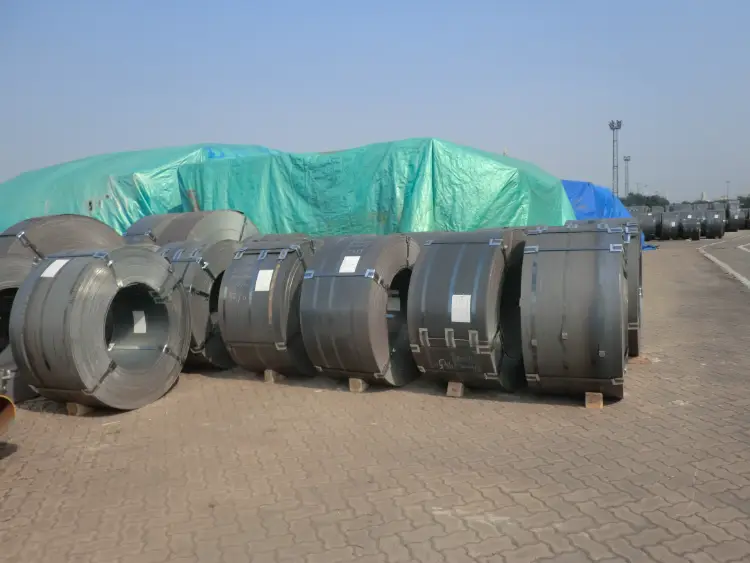
EN 10025-4 S275M Steel Coil
EN 10025-4 S275M Steel Coil: Thermomechanically Rolled High-Strength Fine Grain Structural Steel
Complete material data for S275M carbon and low-alloy high-strength steel coil according to EN 10025-4, including chemical composition, mechanical and physical properties, international equivalents, and application guidance.
Thermomechanical rolling, gas cutting, plasma cutting, laser cutting, welding (SMAW, GMAW, SAW), cold forming, hot forming, machining
- Phone : +8618037372205
- Email : [email protected]
- WhatsApp: Contact via Whtsapp
- WeChat: +8618037372205
EN 10025-4 S275M Steel Coil Introduction
S275M is a thermomechanically rolled weldable fine grain structural steel specified in EN 10025-4. It offers a minimum yield strength of 275 MPa for thicknesses up to 16 mm and excellent toughness down to -20 °C. The TMCP process refines the microstructure, providing good weldability, formability, and resistance to brittle fracture.
Key characteristics:
- Low carbon content (max 0.13 %) and low CEV for excellent weldability without preheating for moderate thicknesses.
- Fine grain structure ensures high strength and toughness.
- Guaranteed impact energy of 40 J at -20 °C, making it suitable for demanding structural applications.
- Available as hot-rolled coil, plate, and strip in various thicknesses up to 120 mm.
S275M is widely used in bridges, offshore platforms, heavy machinery, and high-rise buildings where reliability under dynamic loads and at low temperatures is essential.
EN 10025-4 S275M Steel Coil Chemical Composition
The table below lists the maximum allowable element contents unless otherwise noted. The steel is microalloyed with niobium, vanadium, and/or titanium to achieve fine grain size and high strength. The carbon equivalent value (CEV) varies with product thickness to ensure good weldability.
| Chemical Element | Standard Value (max %) | Remarks |
|---|---|---|
| Carbon (C) | 0.13 | Maximum |
| Silicon (Si) | 0.50 | Maximum |
| Manganese (Mn) | 1.50 | Maximum |
| Phosphorus (P) | 0.025 | Maximum |
| Sulfur (S) | 0.020 | Maximum |
| Aluminium (Al total) | ≥ 0.015 | Minimum, for grain refinement |
| Niobium (Nb) | 0.05 | Maximum |
| Vanadium (V) | 0.08 | Maximum |
| Titanium (Ti) | 0.05 | Maximum |
| Nitrogen (N) | 0.015 | Maximum |
| Molybdenum (Mo) | 0.20 | Maximum |
| Nickel (Ni) | 0.30 | Maximum |
| Chromium (Cr) | 0.30 | Maximum |
| Copper (Cu) | 0.35 | Maximum |
| Carbon Equivalent (CEV) | 0.34 (t ≤ 63 mm) 0.36 (63 < t ≤ 100 mm) 0.38 (100 < t ≤ 120 mm) | Max, based on CE = C + Mn/6 + (Cr+Mo+V)/5 + (Ni+Cu)/15 |
EN 10025-4 S275M Steel Coil Thermal and Electrical Physical Properties
These physical properties are typical for low-alloy structural steels and can be used for engineering calculations. Actual values may vary slightly depending on the exact composition and heat treatment. Unless specified, properties are given at room temperature.
| Property Item | Standard Value | Unit | Test Condition |
|---|---|---|---|
| Density (ρ) | 7.85 | g/cm³ | 20 °C |
| Elastic Modulus (E) | 210 | GPa | 20 °C, static |
| Shear Modulus (G) | ≈ 80 | GPa | 20 °C, derived from E and ν |
| Poisson's Ratio (ν) | 0.3 | – | 20 °C, elastic range |
| Thermal Expansion (α) | 11.1 × 10⁻⁶ | K⁻¹ | 20 – 100 °C |
| Thermal Expansion (α) | 12.2 × 10⁻⁶ | K⁻¹ | 20 – 200 °C |
| Thermal Expansion (α) | 13.0 × 10⁻⁶ | K⁻¹ | 20 – 300 °C |
| Thermal Conductivity (λ) | 42 | W/(m·K) | 20 °C |
| Thermal Conductivity (λ) | 40 | W/(m·K) | 100 °C |
| Thermal Conductivity (λ) | 37 | W/(m·K) | 200 °C |
| Thermal Conductivity (λ) | 33 | W/(m·K) | 300 °C |
| Specific Heat Capacity (cₚ) | 460 | J/(kg·K) | 20 °C (typical for low alloy steel) |
| Electrical Resistivity (ρₑ) | ≈ 0.22 × 10⁻⁶ | Ω·m | 20 °C |
EN 10025-4 S275M Steel Coil Mechanical Properties
The mechanical properties below are for the longitudinal direction at ambient temperature according to EN 10025-4. Impact tests are conducted on Charpy-V specimens at -20 °C. Bend tests are performed with a 180° bend angle; the mandrel diameter depends on thickness.
| Property Item | Required Value | Unit | Test Condition |
|---|---|---|---|
| Yield Strength (ReH) | ≥ 275 | MPa | t ≤ 16 mm |
| Yield Strength (ReH) | ≥ 265 | MPa | 16 < t ≤ 40 mm |
| Yield Strength (ReH) | ≥ 255 | MPa | 40 < t ≤ 63 mm |
| Yield Strength (ReH) | ≥ 245 | MPa | 63 < t ≤ 80 mm |
| Yield Strength (ReH) | ≥ 235 | MPa | 80 < t ≤ 100 mm |
| Yield Strength (ReH) | ≥ 225 | MPa | 100 < t ≤ 120 mm |
| Tensile Strength (Rm) | 370 – 530 | MPa | t ≤ 100 mm |
| Tensile Strength (Rm) | 360 – 520 | MPa | 100 < t ≤ 120 mm |
| Elongation (A) | ≥ 17 | % | t ≤ 100 mm, gauge length 5.65√S₀ |
| Elongation (A) | ≥ 16 | % | 100 < t ≤ 120 mm, gauge length 5.65√S₀ |
| Impact Energy (KV) | ≥ 40 | J | -20 °C, Charpy-V, longitudinal |
| Bend Test (180°) | d = 1.0 t | – | t ≤ 16 mm |
| Bend Test (180°) | d = 2.0 t | – | 16 < t ≤ 100 mm |
| Bend Test (180°) | d = 2.5 t | – | 100 < t ≤ 120 mm |
EN 10025-4 S275M Steel Coil Completely Equivalent Material Grades and Replaceable Designations
| Country/Region | Standard | Grade | Remarks |
|---|---|---|---|
| European Union | EN 10025-4 | S275M | Original thermomechanically rolled grade with 275 MPa min yield |
| International | ISO 630-3 | E275D | Direct equivalent for thermomechanically rolled structural steels |
| United Kingdom | BS EN 10025-4 | S275M | National adoption, identical technical requirements |
| Germany | DIN EN 10025-4 | S275M | National adoption, identical technical requirements |
| France | NF EN 10025-4 | S275M | National adoption, identical technical requirements |
| Italy | UNI EN 10025-4 | S275M | National adoption, identical technical requirements |
| Spain | UNE EN 10025-4 | S275M | National adoption, identical technical requirements |
EN 10025-4 S275M Steel Coil Application Introduction
S275M steel is designed for welded structures that demand high reliability, good low-temperature toughness, and efficient fabrication. Its low carbon equivalent and fine grain structure eliminate or minimize preheating during welding, reducing production costs and improving productivity.
Product Applications: Welded I-beams, H-beams, and box girders, Bridge decks, trusses, and arches, Offshore platform tubular joints and decks, Crane booms, frames, and outriggers, Wind turbine tower shells and flanges, Heavy-duty dump truck bodies and excavator buckets, Structural columns and beams in high-rise buildings, Large-diameter welded pipes and piling
Processed into products: Flanges and webs of plate girders, Stiffeners, diaphragms, and gusset plates, Pipe nodes and casting connections, Milled or turned parts like pins, shafts, and brackets (after suitable heat treatment if required), Cut and bent plates for complex welded assemblies, Turret rings and slewing bearings for cranes, Bogie frames and chassis components
Application industries: Civil construction and infrastructure (buildings, stadiums, airports), Bridge engineering (road and railway bridges, pedestrian bridges), Offshore and marine structures (platform modules, ship hulls, jack-ups), Heavy machinery and equipment (cranes, excavators, bulldozers), Mining and earth-moving equipment (dump trucks, conveyor systems), Wind energy (tower sections, transition pieces, foundations), Pressure vessels and storage tanks (when approved by relevant codes), Agricultural and forestry machinery
EN 10025-4 S275M Steel Coil Recommended Similar or Alternative Materials
| Country/Region | Standard | Grade | Remarks |
|---|---|---|---|
| Europe | EN 10025-2 | S275J2 (+N/+AR) | Same yield class, non-TM, impact 27 J at -20 °C, widely available |
| Europe | EN 10025-3 | S275N / S275NL | Normalized fine grain steel, similar strength, low-temperature variants (NL) |
| Europe | EN 10025-4 | S275ML | Same TMCP with enhanced low-temperature toughness (min 50 J at -50 °C) |
| USA | ASTM A572 / A572M | Grade 42 [290] | Min yield 290 MPa (42 ksi), no mandatory impact test, higher strength |
| USA | ASTM A709 / A709M | Grade 36T/50T | For bridges; Grade 36T ≈ 250 MPa, Grade 50T ≈ 345 MPa yield |
| China | GB/T 1591 | Q345B / Q345C | Min yield 345 MPa, higher strength, Q345C has 0 °C impact option; not directly equivalent |
| Japan | JIS G3106 | SM490A/B/C | Min yield 325–365 MPa depending on thickness, higher strength weldable structural steel |
| Russia | GOST 19281 | 15GF / 15G2AF | Low-alloy structural steels with similar strength and toughness characteristics |
Notes:
Welding recommendations: Due to low CEV (typically ≤0.34 % for thickness ≤ 63 mm), S275M exhibits excellent weldability with most arc welding processes (SMAW, GMAW, FCAW, SAW). Preheating is generally not required for thicknesses up to 50 mm, but for thicker sections or highly restrained joints, a mild preheat (50–100 °C) may be advisable. Consumables with matching strength (e.g., E42 type electrodes) are recommended. Post-weld heat treatment (stress relieving) can be applied if specified, typically at 530–580 °C, but the mechanical properties after PWHT should be verified.
Forming: Cold forming limits (minimum bending radius) should follow EN 10025-4 recommendations; hot forming is possible but may alter the thermomechanically conditioned microstructure. For severe cold forming, stress relief annealing may be required.
Surface protection: S275M can be hot-dip galvanized, painted, or metallized. No special restrictions due to silicon content (Si ≤ 0.50 %) are encountered. Shot blasting and primer application are typical before assembly.
- Share



