
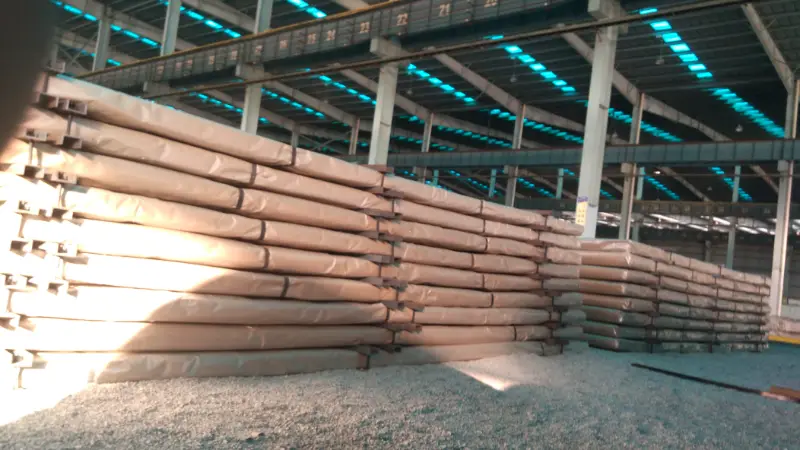
27SiMn Alloy Structural Steel
27SiMn Alloy Structural Steel - Automotive and Mechanical Structure Tube per GB/T 3077
High-strength silicon-manganese alloy steel 27SiMn for automotive and mechanical structural tubes, offering high tensile strength, good wear resistance and hardenability. Used in axles, gears, pins and other heavy-duty components.
Hot rolling, forging, cold drawing, machining, welding (with preheating)
- Phone : +8618037372205
- Email : [email protected]
- WhatsApp: Contact via Whtsapp
- WeChat: +8618037372205
27SiMn Alloy Structural Steel Introduction
27SiMn is an alloy structural steel specified in GB/T 3077, widely utilized for automotive and mechanical structural tubes. Its principal alloying elements are silicon (Si) and manganese (Mn), which provide improved strength, toughness, and hardenability compared to plain carbon steels. With a medium carbon content (0.24-0.32%), it can be quenched and tempered to achieve a good balance of high strength and ductility.
Key features:
- High yield strength (≥835 MPa) and tensile strength (≥980 MPa) in tempered condition
- Good wear resistance and fatigue performance
- Moderate hardenability suitable for medium-section components
- Excellent tempering resistance due to Si
27SiMn is commonly supplied as hot-rolled or cold-drawn tubes, bars, and forgings, and is extensively used in heavy-duty machinery and vehicle structures.
27SiMn Alloy Structural Steel Chemical Composition
Based on GB/T 3077-2015 for grade 27SiMn. The steel is a silicon-manganese alloyed grade with controlled amounts of carbon, silicon and manganese to achieve the required mechanical properties after heat treatment. Residual elements Cr, Ni, Cu are restricted to ensure hardenability and cleanliness.
| Chemical Element | Standard Value (wt%) | Remarks |
|---|---|---|
| Carbon (C) | 0.24 – 0.32 | |
| Silicon (Si) | 1.10 – 1.40 | |
| Manganese (Mn) | 1.10 – 1.40 | |
| Phosphorus (P) | ≤ 0.035 | |
| Sulfur (S) | ≤ 0.035 | |
| Chromium (Cr) | ≤ 0.30 | Residual |
| Nickel (Ni) | ≤ 0.30 | Residual |
| Copper (Cu) | ≤ 0.30 | Residual |
27SiMn Alloy Structural Steel Thermal and Electrical Physical Properties
These values are typical for heat-treated 27SiMn or similar Si-Mn steels and are provided as reference data. They are not part of GB/T 3077 but are commonly used in engineering calculations. Actual values may vary slightly depending on heat treatment and microstructural condition.
| Property | Typical Value | Unit | Test Condition / Remarks |
|---|---|---|---|
| Density (ρ) | 7.85 | g/cm³ | At 20°C |
| Elastic Modulus (E) | 206 | GPa | At 20°C, static method |
| Shear Modulus (G) | 79.3 | GPa | At 20°C, calculated from E and ν |
| Poisson's Ratio (ν) | 0.30 | - | At 20°C, typical for steel |
| Thermal Expansion Coefficient (α) | 12.0 | 10⁻⁶/K | Between 20°C and 100°C |
| Thermal Conductivity (λ) | 44 | W/(m·K) | At 20°C |
| Specific Heat Capacity (cp) | 460 | J/(kg·K) | At 20°C |
| Electrical Resistivity (ρe) | 0.25 | 10⁻⁶ Ω·m | At 20°C |
27SiMn Alloy Structural Steel Mechanical Properties
Mechanical properties according to GB/T 3077-2015, determined on specimens heat-treated as follows: quenching at 920°C in water, tempering at 450°C in water or oil. The specimen blank diameter is 25 mm. The values are minimum requirements unless indicated otherwise. Hardness in annealed or high-temperature tempered condition is ≤217 HB.
| Property | Standard Requirement | Unit | Test Condition |
|---|---|---|---|
| Yield Strength (ReH) | ≥ 835 | MPa | Quenched 920°C water, Tempered 450°C water/oil |
| Tensile Strength (Rm) | ≥ 980 | MPa | Quenched 920°C water, Tempered 450°C water/oil |
| Elongation (A) | ≥ 12 | % | Quenched 920°C water, Tempered 450°C water/oil, gauge length 5.65√S0 |
| Reduction of Area (Z) | ≥ 40 | % | Quenched 920°C water, Tempered 450°C water/oil |
| Impact Energy (KV2) | ≥ 39 | J | Quenched 920°C water, Tempered 450°C water/oil, at room temperature |
| Brinell Hardness (HBW) | ≤ 217 | - | Annealed or high-temperature tempered condition |
27SiMn Alloy Structural Steel Exact Equivalent Standards and Substitute Grades
| Country/Region | Standard | Grade | Remarks |
|---|---|---|---|
| China | GB/T 3077 | 27SiMn | Original grade; no directly identical international equivalent exists |
27SiMn Alloy Structural Steel Application Introduction
27SiMn combines high strength with reasonable toughness after quenching and tempering, making it suitable for dynamically loaded structural components. It can be used in the manufacture of parts requiring wear resistance and fatigue strength. Due to its silicon content, it maintains hardness at moderately elevated temperatures. However, it has limited weldability and usually requires preheating and post-weld heat treatment.
Product Applications: Seamless mechanical steel tubes, Hydraulic cylinder bodies, Heavy-duty shafts and axles, Gear racks and ring gears, Wear-resistant structural frames
Processed into products: Axle shafts and half shafts, Hydraulic piston rods, Pinions and gears for medium loads, Crane boom sections, Mining conveyor rollers, Pump shafts, Wear plates and liners
Application industries: Automotive and transportation, Agricultural machinery, Construction machinery, Mining equipment, General mechanical engineering
27SiMn Alloy Structural Steel Similar / Alternative Materials
| Country/Region | Standard | Grade | Remarks |
|---|---|---|---|
| China | GB/T 3077 | 30SiMn | Carbon 0.27-0.34%, slightly higher strength, same Si, Mn range |
| China | GB/T 3077 | 35SiMn | Carbon 0.32-0.40%, higher hardenability and strength, reduced toughness |
| Germany | EN 10089 / EN 10083-3 | 37MnSi5 (1.5122) | Higher carbon (0.33-0.41), similar Si and Mn; similar applications |
| China | GB/T 3077 | 20SiMn | Lower carbon (0.16-0.22), better weldability and toughness, used for welded structures |
Notes:
Heat treatment: Typical quenching temperature 920°C (water), tempering 450°C (water or oil). Cooling after tempering should be rapid to avoid temper embrittlement.
Weldability: Fair; preheat to 150–300°C and use low-hydrogen electrodes. Post-weld stress relief at 550–650°C is recommended.
Machinability: Good in annealed or tempered condition; carbide tools can be used. Si reduces machinability slightly compared to plain carbon steels.
Surface hardening: Can be induction hardened or nitrided for enhanced wear resistance.
- Share



