
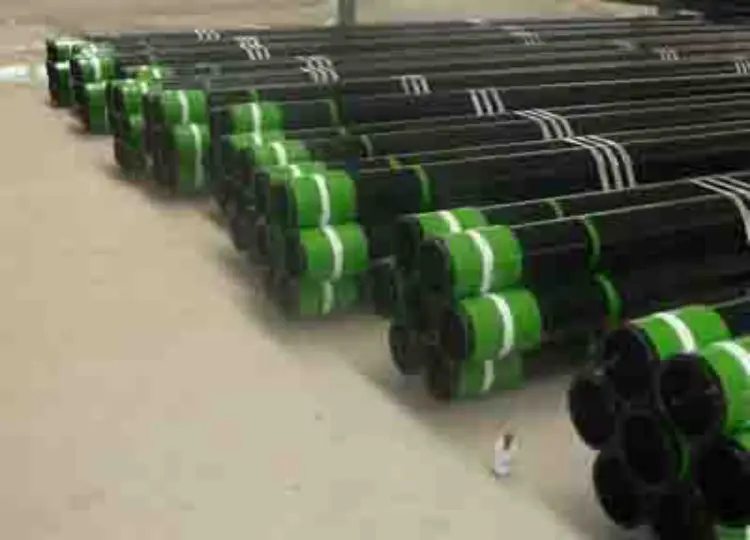
GB/T 8162 45# (045 Steel) Automotive and Mechanical Structure Pipe
GB/T 8162 45# (045 Steel) Automotive and Mechanical Structure Pipe - Properties & Equivalents
Comprehensive material data for 45# carbon steel seamless pipe under GB/T 8162-2018, including chemical composition, mechanical and physical properties, international equivalents, and application guidelines for automotive and mechanical structures.
Hot rolling, hot expansion, cold drawing, cold rolling, normalizing, annealing, quenching & tempering, machining, welding (with preheat and post-weld heat treatment)
- Phone : +8618037372205
- Email : [email protected]
- WhatsApp: Contact via Whtsapp
- WeChat: +8618037372205
GB/T 8162 45# Automotive and Mechanical Structure Pipe Introduction
45# steel, designated as grade 45 under GB/T 8162-2018, is a medium carbon quality structural steel widely used in seamless pipe form for automotive and mechanical structures. With a carbon content of approximately 0.45%, it offers a balanced combination of strength, toughness, and wear resistance. The material is readily machinable and responds well to normalizing, quenching, and tempering heat treatments, achieving tensile strengths above 600 MPa while maintaining moderate ductility.Key attributes include:
- Excellent strength-to-cost ratio for structural applications
- Good forgeability and weldability with proper preheating
- Uniform mechanical properties through controlled hot-rolling or cold-drawing processes
- Wide availability in various pipe dimensions and wall thicknesses
Note: Although the query referenced GB/T 3077, 45# is a carbon steel not covered by that alloy structural steel standard. The correct standard for structural pipes is GB/T 8162. All data herein reflect the official specifications of GB/T 8162-2018 and GB/T 699-2015.
GB/T 8162 45# Automotive and Mechanical Structure Pipe Chemical Composition
Chemical composition of 45 steel per GB/T 699-2015, which is referenced by GB/T 8162 for the base steel grade. Residual elements are controlled to ensure mechanical and processing properties.
- Carbon provides core strength; manganese improves hardenability and deoxidation.
- Low phosphorus and sulfur levels guarantee cleanliness and toughness.
- Chromium, nickel, and copper are residual impurities with limits to avoid brittleness.
Actual product analysis may have slight deviations within the specified tolerances.
| Element | Standard Value (%) | Remarks |
|---|---|---|
| Carbon (C) | 0.42 – 0.50 | Primary hardening element; determines strength and wear resistance |
| Silicon (Si) | 0.17 – 0.37 | Deoxidizer; improves strength and hardenability |
| Manganese (Mn) | 0.50 – 0.80 | Enhances hardenability and counteracts sulfur brittleness |
| Chromium (Cr) | ≤ 0.25 | Residual element; higher amounts would classify as alloy steel |
| Nickel (Ni) | ≤ 0.30 | Residual element; no intentional addition |
| Copper (Cu) | ≤ 0.25 | Residual element from scrap; may affect hot working if too high |
| Phosphorus (P) | ≤ 0.035 | Impurity; kept low to avoid cold shortness |
| Sulfur (S) | ≤ 0.035 | Impurity; kept low to avoid hot shortness |
GB/T 8162 45# Automotive and Mechanical Structure Pipe Thermal and Electrical Physical Properties
Physical properties for medium carbon steel (like 45/Grade 45) provide essential data for thermal and structural analyses. These values represent typical measurements at room temperature unless noted, and may vary slightly with processing history and microstructure. Important characteristics:
- Density is uniform and used for weight calculations.
- Thermal conductivity decreases with increasing temperature, affecting heat treatment.
- Coefficient of thermal expansion is critical for components subject to temperature changes.
- Electrical resistivity is moderate, typical for carbon steels, and influences induction heating efficiency.
Data are compiled from GB/T 699, material handbooks, and standard carbon steel references.
| Property | Typical Value | Unit | Test Conditions |
|---|---|---|---|
| Density (ρ) | 7.85 | g/cm³ | At 20°C |
| Elastic Modulus (E) | 200 – 210 | GPa | At room temperature; tension |
| Shear Modulus (G) | 80 – 81 | GPa | Calculated from E and ν |
| Poisson's Ratio (ν) | 0.27 – 0.30 | — | In elastic range |
| Thermal Expansion (α) | 11.2 – 11.9 | 10⁻⁶/K | 20–100°C range |
| Thermal Expansion (α) | 12.5 – 13.5 | 10⁻⁶/K | 20–300°C range |
| Thermal Conductivity (λ) | 50 – 51 | W/(m·K) | At 20°C |
| Thermal Conductivity (λ) | 42 – 44 | W/(m·K) | At 300°C |
| Specific Heat Capacity (c) | ~ 470 | J/(kg·K) | At 20°C |
| Electrical Resistivity (ρe) | 0.16 – 0.18 | μΩ·m | At 20°C |
GB/T 8162 45# Automotive and Mechanical Structure Pipe Mechanical Properties
Mechanical properties for seamless pipes made of 45 steel, as specified in GB/T 8162-2018. Values apply to normalized (or normalized and tempered) condition for wall thickness ≤16 mm. For other thicknesses or delivery conditions, properties may differ as agreed. Key test items include:
- Tensile testing is mandatory for all pipe deliveries.
- Hardness tests may be required for machinability assessment.
- Impact tests are optional unless specified by the purchaser.
- Bending tests are not typically specified for structural pipes but can be performed on strip or plate samples of the parent steel.
Welded pipe properties may be lower in the heat-affected zone unless post-weld heat treated.
| Property | Requirement (Min unless stated) | Unit | Test Conditions |
|---|---|---|---|
| Tensile Strength (Rm) | ≥ 600 | MPa | At room temperature; longitudinal test piece from pipe |
| Yield Strength (ReH) | ≥ 355 | MPa | Lower yield point; longitudinal direction |
| Elongation (A) | ≥ 16 | % | Longitudinal, gauge length 5.65√S₀; applicable for wall ≤16 mm |
| Elongation (A) | ≥ 8 | % | Transverse, gauge length 5.65√S₀; wall ≤16 mm (informative) |
| Brinell Hardness (HBW) | ≤ 201 (typical annealed) | HBW | Annealed condition; for normalized, hardness ≈170-210 HBW |
| Impact Energy (KV₂) | ≥ 27 (when specified) | J | Charpy V-notch, at 20°C; not mandatory in base standard |
GB/T 8162 45# Automotive and Mechanical Structure Pipe Fully Equivalent Material Standards and Replaceable Grades
International grades that offer the same chemical composition and mechanical property envelope for seamless pipe or structural steel products. Direct substitution is generally possible, subject to dimensional and delivery condition agreements.
| Country/Region | Standard | Grade | Remarks |
|---|---|---|---|
| International | ISO 683-1:2018 | C45E4 | Precision engineering steel; chemistry within 0.42-0.50% C |
| European Union | EN 10083-2:2006 | C45 | Quenched and tempered steel; equivalent general structural use |
| Germany | DIN 17200 | CK45 | Carbon steel with controlled sulfur; good machinability |
| USA | ASTM A29 / A29M | 1045 | Standard carbon steel bars; pipe grades often cross-referenced |
| USA | ASTM A108 | 1045 | Cold-finished carbon steel bars; similar mechanicals after normalizing |
| Japan | JIS G4051 | S45C | Carbon steels for machine structural use; pipe equivalent JIS G3445 STKM13A |
| United Kingdom | BS 970-1 | 080M46 | Carbon steel with 0.44-0.50% C; superseded but still referenced |
| France | NF A35-552 | XC45 | Traditional French carbon steel grade |
GB/T 8162 45# Automotive and Mechanical Structure Pipe Application Introduction
45# steel pipe is a versatile material for automotive and general mechanical structures. Its medium carbon content allows heat treatment to tailor strength and toughness, making it suitable for both static and dynamic load-bearing components. Guidelines for use:
- For welded structures, preheat to 150–200°C to avoid cracking; post-weld normalizing is recommended.
- Surface hardening (induction or flame) can achieve local hardness >55 HRC for wear-resistant areas.
- In hydraulic applications, internal cleanliness and honing are critical; specify cold-drawn or honed tubes.
- Consider corrosion protection (painting, galvanizing) for outdoor or humid environments.
The steel is easily machined in normalized or annealed condition; hardened and tempered states require sharp tools and lower speeds.
Product Applications: Seamless structural steel tubes (round, square, rectangular), Hydraulic cylinder tubes (honed or skived & roller burnished), Steel pipe for automobile transmission shafts, Precision cold-drawn tubes for shock absorber components, Mechanical tubing for agricultural equipment frames, Hollow sections for structural frameworks
Processed into products: Crankshafts and camshafts (after forging and heat treatment), Connecting rods and push rods, Axle tubes and drive shafts, Oil cylinder bodies and piston rods, Gear blanks and splined shafts, Machine tool spindles and lead screws, Bushing and bearing housings, Tie rods and steering linkages, Weld-on hubs and flanges
Application industries: Automotive manufacturing (chassis, powertrain, suspension), Agricultural machinery (frames, hitches, hydraulic cylinders), Construction and earthmoving equipment (booms, arms, structural members), General mechanical engineering (shafts, rollers, spindles), Oil and gas (pipeline supports, mechanical parts not exposed to H2S), Railway components (brackets, coupling rods)
GB/T 8162 45# Automotive and Mechanical Structure Pipe Similar or Closely Related Substitute Materials
Materials that are not chemically identical but can be considered as replacements in similar applications, with notes on property differences. Selection depends on service conditions and heat treatment capabilities.
| Country/Region | Standard | Grade | Remarks |
|---|---|---|---|
| China | GB/T 699 | 40 | Lower carbon (0.37-0.44%); slightly lower strength but better toughness |
| China | GB/T 699 | 50 | Higher carbon (0.47-0.55%); higher strength but reduced ductility |
| China | GB/T 3077 | 40Cr | Alloy steel with Cr; better hardenability and fatigue strength |
| China | GB/T 3077 | 45Mn2 | Alloy steel with Mn; higher strength after heat treatment, suitable for larger sections |
| China | GB/T 1591 | Q460 | Low-alloy high-strength steel; weldable without preheat, often used in structures |
| USA | ASTM A572 | Grade 50 | High-strength low-alloy structural steel; yield 345 MPa, alternative for welded pipes |
| Germany | EN 10025-2 | S355J2H | Structural hollow section steel; impact properties at -20°C, weldable |
Notes:
Important clarification: The initial query referenced GB/T 3077, which is the Chinese standard for alloy structural steels (e.g., 40Cr, 20CrMnTi). Grade "45#" (45 steel) is not part of that standard. The correct standard for 45# seamless pipes used in automotive and mechanical structures is GB/T 8162-2018 (Seamless steel pipes for structural purposes). The chemical composition is defined in GB/T 699-2015 (Quality carbon structural steels). All data provided here conform to those official specifications. If the intended material was an alloy steel under GB/T 3077, the nearest would be 40Cr or 45Mn2, which have different composition and properties. For any critical application, verify the current edition of the standard and agree on delivery conditions with the supplier.
Additional properties: Weldability – fair, requires preheat and low-hydrogen electrodes. Forgeability – excellent at 1200–800°C. Machinability – 55–60% compared to free-cutting steel (based on AISI 1212). Typical heat treatment: Normalizing at 840–870°C air cooling; Quenching at 820–850°C water or oil, Tempering 550–660°C for desired hardness. Case hardening is not recommended due to medium carbon content; instead use induction hardening for localized wear resistance.
- Share



