
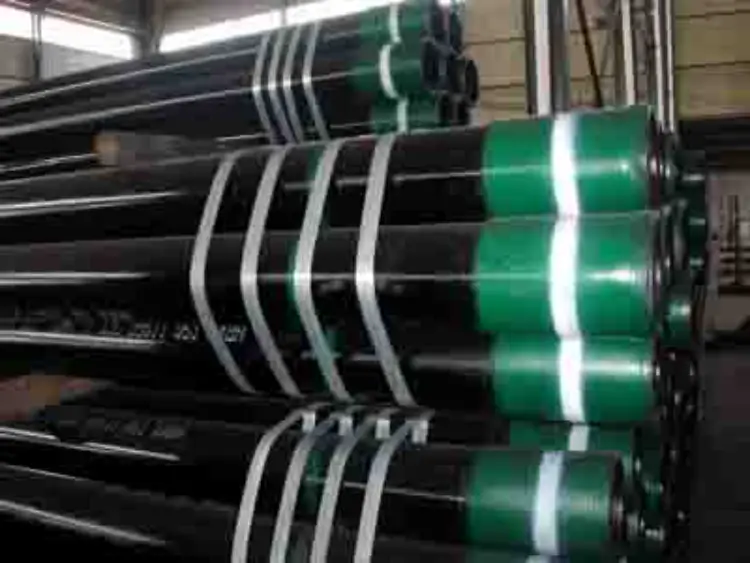
GB/T 3077 35# Automotive & Mechanical Structure Pipe
GB/T 3077 35# Automotive & Mechanical Structure Pipe | Alloy Steel
Comprehensive data for 35# steel under GB/T 3077 standard, including chemical composition, mechanical properties, physical properties, equivalent grades, and application guide for automotive and mechanical structure pipes.
Hot Rolling, Cold Drawing, Quenching and Tempering, Annealing, Normalizing, Machining, Forging
- Phone : +8618037372205
- Email : [email protected]
- WhatsApp: Contact via Whtsapp
- WeChat: +8618037372205
GB/T 3077 35# Automotive & Mechanical Structure Pipe Introduction
35# steel, as defined under the GB/T 3077 standard, is a high-quality medium-carbon alloy structural steel widely utilized in the manufacturing of seamless pipes for automotive and mechanical structural applications. It typically exhibits a good balance of strength, toughness, and wear resistance. This steel grade is characterized by a carbon content of approximately 0.32% to 0.40%, which allows for effective quenching and tempering heat treatments to achieve desired mechanical properties such as high tensile strength and yield strength. It offers excellent machinability in the normalized or hot-rolled condition. Common applications include critical components like axle shafts, gears, and structural parts in heavy machinery, owing to its reliability under dynamic loads. The material is often delivered in a hot-rolled, annealed, or quenched and tempered condition, tailored to specific fabrication requirements and end-use durability standards.
GB/T 3077 35# Automotive & Mechanical Structure Pipe Chemical Composition
The chemical composition of 35# alloy structural steel is strictly governed by GB/T 3077. This standard specifies a controlled range for key elements like Carbon (C) for strength and hardness, Silicon (Si) and Manganese (Mn) for deoxidation and strength enhancement, and strict limits on impurities like Phosphorus (P) and Sulfur (S) to ensure material toughness and ductility. Residual elements such as Chromium (Cr), Nickel (Ni), and Copper (Cu) are also controlled to maintain consistent properties.
| Chemical Element | Standard Value (wt%) | Remarks |
|---|---|---|
| Carbon (C) | 0.32 – 0.40 | Core element determining strength and hardness |
| Silicon (Si) | 0.17 – 0.37 | Deoxidizer; contributes to strength |
| Manganese (Mn) | 0.50 – 0.80 | Improves hardenability and tensile strength |
| Phosphorus (P) | ≤ 0.035 | Impurity; limited to maintain toughness |
| Sulfur (S) | ≤ 0.035 | Impurity; limited to maintain ductility |
| Chromium (Cr) | ≤ 0.25 | Residual element; content is controlled |
| Nickel (Ni) | ≤ 0.30 | Residual element; content is controlled |
| Copper (Cu) | ≤ 0.25 | Residual element; content is controlled |
GB/T 3077 35# Automotive & Mechanical Structure Pipe Thermal and Electrical Physical Properties
The thermal and electrical physical properties of 35# steel are fundamental engineering design parameters. These values are typical for medium-carbon steel and depend on factors such as microstructural state and temperature. The density (ρ) is crucial for weight calculations. Elastic modulus (E) governs stiffness. The coefficient of thermal expansion (α) is vital for tolerancing in assemblies exposed to temperature changes. Thermal conductivity (λ) and specific heat capacity are key for heat transfer analyses during processing or service. Typical values are provided for room temperature (20°C) unless otherwise noted.
| Property Item | Standard Requirement Value | Unit | Test Condition |
|---|---|---|---|
| Density (ρ) | 7.83 – 7.85 | g/cm³ | At 20°C |
| Elastic Modulus (E) | 205 – 212 | GPa | At 20°C, tensile loading |
| Shear Modulus (G) | 79 – 81 | GPa | At 20°C |
| Poisson's Ratio (ν) | 0.29 – 0.31 | At 20°C, elastic range | |
| Coefficient of Thermal Expansion (α) | 11.1 – 12.0 × 10⁻⁶ | 1/K | Between 20°C and 100°C |
| Coefficient of Thermal Expansion (α) | 12.9 – 13.7 × 10⁻⁶ | 1/K | Between 20°C and 300°C |
| Coefficient of Thermal Expansion (α) | 13.9 – 14.4 × 10⁻⁶ | 1/K | Between 20°C and 500°C |
| Thermal Conductivity (λ) | 48 – 52 | W/(m·K) | At 20°C after annealing |
| Specific Heat Capacity | 460 – 480 | J/(kg·K) | At 20°C |
| Electrical Resistivity (ρe) | 0.16 – 0.22 × 10⁻⁶ | Ω·m | At 20°C |
GB/T 3077 35# Automotive & Mechanical Structure Pipe Mechanical Properties
The mechanical properties listed are typical reference values for 35# steel pipes or bars after a standard quenching and tempering heat treatment as recommended by GB/T 3077. A common heat treatment involves quenching from 850°C in water or oil, followed by tempering at 540°C. Actual values are highly dependent on section size and specific heat treatment parameters. Properties are verified by tensile and impact testing at room temperature. Testing is typically conducted in accordance with GB/T 228.1 for tensile properties and GB/T 229 for impact toughness.
| Property Item | Standard Requirement Value | Unit | Test Condition |
|---|---|---|---|
| Yield Strength (ReH) | ≥ 450 | MPa | Room temperature, after Q&T treatment |
| Tensile Strength (Rm) | ≥ 640 | MPa | Room temperature, after Q&T treatment |
| Elongation After Fracture (A) | ≥ 15 | % | Room temperature, gauge length 5×diameter (short specimen) |
| Reduction of Area (Z) | ≥ 35 | % | Room temperature, after Q&T treatment |
| Impact Energy (KV2) | ≥ 39 | J | Room temperature, Charpy U-notch specimen |
GB/T 3077 35# Automotive & Mechanical Structure Pipe Exact Equivalent Material Standards & Replaceable Grades
| Country/Region | Standard | Grade | Remarks |
|---|---|---|---|
| China | GB/T 3077 | 35# | Benchmark standard and grade |
| International | ISO 683-1:2016 | C35E4 | Closely equivalent for heat-treatable steels |
| European Union | EN 10083-2:2006 | C35E | Non-alloy quality steel with a similar carbon range, acceptable substitute |
| USA | ASTM A29/A29M | 1035 | A direct counterpart in the AISI/SAE designation system. Verify sulfur/phos. for 1030 vs. 1035. |
| Japan | JIS G4051:2019 | S35C | Functionally interchangeable for machine structural carbon steel |
GB/T 3077 35# Automotive & Mechanical Structure Pipe Application Introduction
35# steel pipe for automotive and mechanical structures is a versatile engineering material. Its medium carbon content provides an excellent combination of strength, toughness, and fatigue resistance after appropriate heat treatment, making it ideal for dynamically loaded components. The material exhibits good machinability and is suitable for a wide range of manufacturing processes including forging, hot rolling, and cold drawing.
Product Applications: Steering knuckles and axles, Crankshafts and camshafts, Connecting rods, High-strength fasteners (e.g., wheel studs, U-bolts), Hydraulic cylinder rods and barrels, Frame and chassis structural tubing
Processed into products: Transmission shafts and axles, Differential gears and pinion shafts, Railway wagon axles, Forged lifting hooks and clevises, Machine tool spindles, Seamless mechanical tubing for roller bearings and structural supports, Heavy-duty chain pins and bushings
Application industries: Automotive Manufacturing, Heavy Machinery and Earthmoving Equipment, Agricultural Machinery, Shipbuilding, General Mechanical Engineering, Oil and Gas (for structural, not pressure, components)
GB/T 3077 35# Automotive & Mechanical Structure Pipe Similar / Analogous Substitute Material Recommendations
| Country/Region | Standard | Grade | Remarks |
|---|---|---|---|
| China | GB/T 699 | 35 | Premium quality carbon structural steel; lower hardenability due to less strict Mn content, suitable for less stringent applications. |
| USA | ASTM A108 | 1030 | Slightly lower carbon content (0.28-0.34%) provides better toughness and weldability, at a small penalty to tensile strength. |
| USA | ASTM A108 | 1040 | Slightly higher carbon content (0.37-0.44%) offers higher strength and surface hardness but reduced ductility. Suitable for high-strength shafts. |
| Japan | JIS G4052 | SCM435 | A chromium-molybdenum alloy steel offering significantly higher hardenability and strength for demanding fatigue applications like high-performance gears. |
| Germany | DIN 17200 | Ck35 | "K" designation indicates a controlled sulfur content for improved machinability, otherwise mechanically similar to C35. |
Notes:
Heat Treatment Guidelines: Typical heat treatment for achieving the specified mechanical properties involves quenching from 850°C in water or oil (<10% NaCl solution is common for water quenching), followed by tempering at 540°C to 600°C with air cooling. Weldability: As a medium-carbon steel, 35# has limited weldability and is susceptible to cracking. Preheating (150-300°C) and post-weld stress relieving are mandatory. Hardness: The hardness in the delivered hot-rolled or annealed state is typically ≤207 HBW. Surface hardening methods like induction hardening or flame hardening to a depth of 1-2 mm can achieve surface hardness of 50-55 HRC for wear-resistant components.
- Share



