
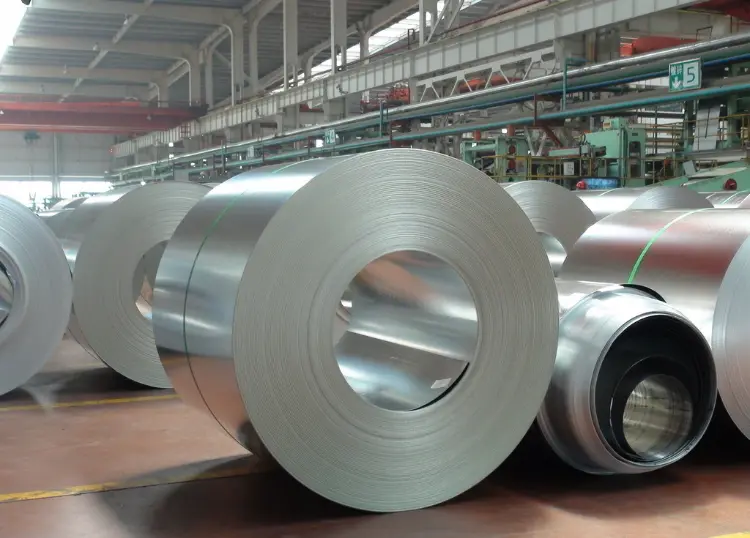
S275JR Structural Steel Coil
S275JR Structural Steel Coil: EN10025-2 Hot Rolled Non-Alloy High-Strength Steel for Construction & Engineering
Comprehensive material data for EN10025-2 S275JR hot rolled steel coil, including chemical composition, mechanical properties, thermal and electrical physical properties, international equivalents, and applications.
Hot rolling, pickling, oiling, cutting, slitting, leveling, cold forming, welding, machining, hot-dip galvanizing
- Phone : +8618037372205
- Email : [email protected]
- WhatsApp: Contact via Whtsapp
- WeChat: +8618037372205
S275JR Structural Steel Coil Introduction
S275JR is a hot rolled non-alloy structural steel grade according to EN 10025-2. It offers a minimum yield strength of 275 MPa for thicknesses ≤16 mm and good weldability and machinability. The designation "JR" guarantees a minimum Charpy impact energy of 27 J at room temperature (+20°C). This steel is widely used in welded, bolted and riveted structures for general construction, bridges, storage tanks, and mechanical engineering. It exhibits excellent formability for bending and mild forming operations. Typical delivery condition is hot rolled (as-rolled) or normalized, and it is supplied as coils, sheets, plates and wide strips. S275JR is fully traceable to melt analysis and mechanical test certificates in accordance with EN 10204.
S275JR Structural Steel Coil Chemical Composition
Typical ladle analysis according to EN 10025-2:2019 for the non-alloy grade S275JR. Elements are limited to ensure good weldability and mechanical properties. The maximum values shown are mandatory unless otherwise noted. For product thicknesses >150 mm slightly different limits may apply; consult the full standard.
| Chemical Element | Standard Value (wt%) | Remarks |
|---|---|---|
| Carbon (C) | ≤0.21 | Maximum for thickness ≤40 mm |
| Manganese (Mn) | ≤1.50 | Maximum for thickness ≤40 mm; higher Mn improves strength and weldability |
| Silicon (Si) | ~0.55 max | Not specified in standard; typically limited for good surface quality |
| Phosphorus (P) | ≤0.035 | Maximum for all thicknesses |
| Sulfur (S) | ≤0.035 | Maximum for all thicknesses |
| Nitrogen (N) | ≤0.012 | Maximum; for hot rolled products with Al addition |
| Copper (Cu) | ≤0.55 | Optional; when Cu is specified or used (e.g., weathering resistant grades not required) |
| Others | Residual elements allowed | Cr, Ni, Mo not intentionally added; remain within limits |
S275JR Structural Steel Coil Thermal and Electrical Physical Properties
Representative physical properties for non-alloy structural steel at room temperature, except where noted. These values are not part of the EN 10025-2 delivery condition but are widely accepted for design calculations. Variations may occur due to exact chemistry and thickness.
| Property | Value | Unit | Test Condition / Remarks |
|---|---|---|---|
| Density (ρ) | 7.85 | g/cm³ | At 20°C |
| Modulus of Elasticity (E) | 210 | GPa | At 20°C |
| Shear Modulus (G) | 81 | GPa | At 20°C |
| Poisson's Ratio (ν) | 0.30 | — | Elastic range |
| Thermal Expansion Coefficient (α) | 12.0 | 10&supmin;&sup6;/K | 20°C to 100°C |
| Thermal Expansion Coefficient (α) | 12.5 | 10&supmin;&sup6;/K | 20°C to 200°C |
| Thermal Conductivity (λ) | 50 - 60 | W/(m·K) | At 20°C; decreases with temperature |
| Specific Heat Capacity (c) | ~460 | J/(kg·K) | At 20°C; increases with temperature |
| Electrical Resistivity (ρe) | ~0.20 - 0.25 | μΩ·m | At 20°C |
S275JR Structural Steel Coil Mechanical Properties
Minimum tensile and impact requirements according to EN 10025-2:2019 for S275JR flat products in the longitudinal direction. Values depend on nominal thickness t (mm). Charpy V-notch impact test is carried out at +20°C with a minimum average value of 27 J. Test specimen width is 10x10 mm unless thickness is smaller, where reduced width specimens apply.
| Property | Required Value | Unit | Test Condition / Thickness Range |
|---|---|---|---|
| Yield Strength (ReH) | ≥275 | MPa | t ≤16 mm |
| Yield Strength (ReH) | ≥265 | MPa | 16 < t ≤40 mm |
| Yield Strength (ReH) | ≥255 | MPa | 40 < t ≤63 mm |
| Yield Strength (ReH) | ≥245 | MPa | 63 < t ≤80 mm |
| Yield Strength (ReH) | ≥235 | MPa | 80 < t ≤100 mm |
| Yield Strength (ReH) | ≥225 | MPa | 100 < t ≤150 mm |
| Tensile Strength (Rm) | 410 - 560 | MPa | All thicknesses |
| Elongation (A, L0=5.65√S0) | ≥23 | % | t ≤16 mm |
| Elongation (A) | ≥22 | % | 16 < t ≤40 mm |
| Elongation (A) | ≥21 | % | 40 < t ≤63 mm |
| Elongation (A) | ≥19 | % | 63 < t ≤100 mm |
| Elongation (A) | ≥18 | % | 100 < t ≤150 mm |
| Bending Test (Mandrel diameter) | 1.5 x t | mm | t ≤16 mm; 180° bend |
| Bending Test | 2.0 x t | mm | 16 < t ≤100 mm; 180° bend |
| Charpy Impact Energy (KV) | ≥27 | J | Longitudinal, +20°C, 10x10 mm specimen; for t<10 mm use sub-size specimen and reduce minimum energy acc. to standard |
S275JR Structural Steel Coil Complete Equivalent Materials & Replaceable Grade Recommendations
Grades that are technically identical to S275JR based on the same standard (EN 10025-2) or the direct ISO adoption. In many countries the same standard is implemented as a national standard; the steel from a different national source is fully interchangeable.
| Country/Region | Standard | Grade | Remarks |
|---|---|---|---|
| International | ISO 630-2 | S275JR | Identical technical requirements |
| European Union | EN 10025-2 | S275JR | Original standard; all EU national adoptions (DIN, BS, NF, UNE, etc.) |
| United Kingdom | BS EN 10025-2 | S275JR | Post-Brexit British adoption |
| Germany | DIN EN 10025-2 | S275JR | Commonly referred to as St44-2 in former DIN 17100 (now obsolete) |
| France | NF EN 10025-2 | S275JR | Former E28-2 replaced |
| Spain | UNE EN 10025-2 | S275JR | |
| Italy | UNI EN 10025-2 | S275JR | Former Fe 430 B replaced |
| Netherlands | NEN EN 10025-2 | S275JR | |
| Poland | PN-EN 10025-2 | S275JR | Former St3S (partially comparable) |
S275JR Structural Steel Coil Application Introduction
S275JR steel coil is a versatile hot rolled material suitable for a broad range of structural applications where moderate strength and room-temperature toughness are required. Its excellent weldability, formability, and cost-effectiveness make it a preferred choice for general fabrication. The coil form enables efficient processing into various downstream products.
Product Applications: Welded H-beams, I-beams, channels, angles, Hollow sections (rectangular and circular), Structural pipes and tubes, Prefabricated steel buildings, Storage tanks and silos, Offshore topside and jacket structures (non-critical members), Agricultural and earthmoving equipment, Staircases, railings, gratings
Processed into products: Columns, beams, and girder splices, Brackets, base plates, and stiffeners, Flanges and webs of built-up sections, Pressure vessel shells (non-coded, at ambient and low pressure), Transmission tower legs and bracings, Automotive chassis and frames (truck bodies, trailers), Enclosures, panels, and covers
Application industries: Construction and civil engineering (building frames, bridges, platforms), Mechanical engineering (machinery components, gears, shafts)
S275JR Structural Steel Coil Similar / Substitute Material Recommendations
Structural steel grades with comparable strength and toughness levels from other international standards. These are not fully identical but can often be substituted after evaluation of chemical and mechanical requirements, especially for thickness-dependent properties and impact testing.
| Country/Region | Standard | Grade | Remarks |
|---|---|---|---|
| USA | ASTM A36/A36M | A36 (Grade 36) | Yield strength 250 MPa; thicker sections may be comparable; toughness at room temperature is not guaranteed unless specified (impact test optional). |
| China | GB/T 700 | Q235B | Yield strength 235 MPa (t≤16 mm); Charpy impact 27 J at +20°C; widely used; weldable; limited difference in strength. |
| Japan | JIS G3101 | SS400 | Yield strength 245 MPa for t≤16 mm; 400-510 MPa tensile; no mandatory impact test unless ordered with added requirement. |
| India | IS 2062 | E250 B (Fe 410 B) | Yield 250 MPa (t≤20 mm); impact 27 J min at ambient; close in strength and weldability. |
| Russia | GOST 380 | St3sp (S275) | Yield 245 MPa (t≤20 mm); similar concept; requires careful comparison of deoxidation practice. |
| European/EN | EN 10025-2 | S235JR | Lower strength (min 235 MPa), same impact toughness class; can be substituted if lower strength is acceptable. |
| European/EN | EN 10025-2 | S355JR | Higher strength (min 355 MPa); thicker sections may require control of chemistry and preheat for welding. |
Notes:
Welding: Generally good weldability by all common methods (SMAW, GMAW, SAW). Preheat is typically not required for thicknesses below 30 mm at ambient temperature. For thicker sections or when carbon equivalent exceeds 0.41%, preheating to 80-150°C may be beneficial. Forming: Suitable for cold bending with a minimum inner radius of 1.5-2.0 times thickness. Hot forming should be followed by normalizing to restore mechanical properties. Corrosion protection: In aggressive environments, the product should be painted or hot-dip galvanized. The silicon content should be controlled for good galvanizing adherence. Certification: Standard inspection certificates EN 10204 Type 2.2 or 3.1 are typically supplied.
- Share



