
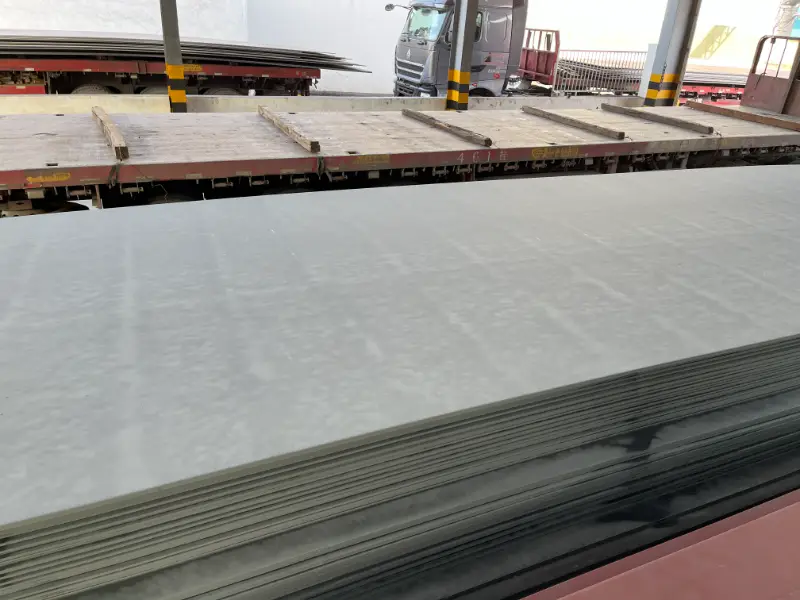
EN10025-2 S235J2
EN10025-2 S235J2: Carbon Structural Steel with Guaranteed Impact Toughness at -20°C
Detailed material data for S235J2 structural steel according to EN10025-2, including chemical composition, mechanical properties, physical properties, and equivalent grades.
Welding, cutting, bending, drilling, machining, hot-dip galvanizing, cold forming (limited)
- Phone : +8618037372205
- Email : [email protected]
- WhatsApp: Contact via Whtsapp
- WeChat: +8618037372205
EN10025-2 S235J2 Introduction
S235J2 is a non-alloy structural steel grade according to EN10025-2. It offers a minimum yield strength of 235 MPa for thicknesses up to 16 mm and guaranteed Charpy impact energy of 27 J at -20°C (J2 quality). This grade is supplied in hot-rolled coil form and is often used in welded, bolted, and riveted structures. Typical applications include building frames, bridges, machinery components, and general engineering. The steel is fully killed and fine-grain treated, ensuring good weldability and toughness.
EN10025-2 S235J2 Chemical Composition per EN 10025-2:2019
The chemical composition of S235J2 is designed for good weldability and low-temperature toughness. Maximum limits are shown unless a range is specified. Fine-grain practice requires sufficient aluminum or other nitrogen-binding elements.
| Element | Standard Value (wt%) | Remarks |
|---|---|---|
| Carbon (C) | ≤0.17 | Max |
| Manganese (Mn) | ≤1.40 | Max |
| Silicon (Si) | ≤0.04 (optional) | For non-alloy steel, Si is not specified but typically ≤0.04 for Al-killed fine-grain practice. In some product analyses, Si may be 0.05–0.20%. |
| Phosphorus (P) | ≤0.025 | Max |
| Sulfur (S) | ≤0.025 | Max |
| Nitrogen (N) | ≤0.012 | Max |
| Copper (Cu) | ≤0.55 | Max |
| Aluminum (Al) | ≥0.015 (total) or ≥0.020 (acid soluble) | Required for fine-grain practice and J2 quality |
| Others (Cr, Ni, Mo, etc.) | Not specified, typically residual | May be present as residuals |
EN10025-2 S235J2 Physical Properties
The following physical properties are typical for S235J2 non-alloy steel at room temperature unless noted. These values are provided for engineering calculations and are not guaranteed by the standard.
| Property | Typical Value | Unit | Test Condition / Temperature |
|---|---|---|---|
| Density (ρ) | 7.85 | g/cm³ | At 20°C |
| Modulus of elasticity (E) | 210 | GPa | At 20°C |
| Shear modulus (G) | 81 | GPa | At 20°C |
| Poisson's ratio (ν) | 0.3 | — | At 20°C |
| Thermal expansion coefficient (α) | 11.1 | 10⁻⁶/K | 20–100°C |
| Thermal expansion coefficient (α) | 12.1 | 10⁻⁶/K | 20–200°C |
| Thermal expansion coefficient (α) | 12.9 | 10⁻⁶/K | 20–300°C |
| Thermal conductivity (λ) | 53 | W/(m·K) | At 20°C |
| Specific heat capacity (c) | 461 | J/(kg·K) | At 20°C |
| Electrical resistivity (ρ_e) | 0.16 | µΩ·m | At 20°C |
EN10025-2 S235J2 Mechanical Properties per EN 10025-2
Mechanical properties are determined at room temperature on standard test specimens. Yield strength values vary with thickness; elongation is measured using a gauge length of 5.65√So (A5) or 80 mm (A80) for thin strips. Impact test is performed on longitudinal Charpy-V specimens at -20°C.
| Property | Standard Value | Unit | Test Condition |
|---|---|---|---|
| Yield strength (ReH) | ≥235 | MPa | Thickness ≤16 mm |
| Yield strength (ReH) | ≥225 | MPa | Thickness >16 mm to ≤40 mm |
| Yield strength (ReH) | ≥215 | MPa | Thickness >40 mm to ≤63 mm |
| Yield strength (ReH) | ≥215 | MPa | Thickness >63 mm to ≤80 mm |
| Yield strength (ReH) | ≥215 | MPa | Thickness >80 mm to ≤100 mm |
| Yield strength (ReH) | ≥195 | MPa | Thickness >100 mm to ≤150 mm |
| Yield strength (ReH) | ≥185 | MPa | Thickness >150 mm to ≤200 mm |
| Tensile strength (Rm) | 360–510 | MPa | Thickness ≥3 mm and ≤100 mm |
| Tensile strength (Rm) | 350–500 | MPa | Thickness >100 mm to ≤150 mm |
| Tensile strength (Rm) | 340–490 | MPa | Thickness >150 mm to ≤200 mm |
| Elongation (A80) | ≥26 | % | Thickness ≥3 mm to ≤40 mm, gauge length 80 mm (or 5.65√So) |
| Elongation (A80) | ≥25 | % | Thickness >40 mm to ≤63 mm |
| Elongation (A80) | ≥24 | % | Thickness >63 mm to ≤100 mm |
| Elongation (A80) | ≥22 | % | Thickness >100 mm to ≤150 mm |
| Elongation (A80) | ≥21 | % | Thickness >150 mm to ≤200 mm |
| Bend test | No cracks | — | Bend angle 180°; mandrel diameter: 1a for t≤16 mm, 2a for t>16–100 mm (a=thickness) |
| Impact energy (KV2) | ≥27 | J | Longitudinal, at -20°C |
EN10025-2 S235J2 Full Equivalent Standards and Grades
| Country/Region | Standard | Grade | Remarks |
|---|---|---|---|
| European Union | EN 10025-2:2019 | S235J2 | Identical |
| Germany | DIN EN 10025-2 | S235J2 | Identical |
| UK | BS EN 10025-2 | S235J2 | Identical |
| France | NF EN 10025-2 | S235J2 | Identical |
| Italy | UNI EN 10025-2 | S235J2 | Identical |
| International | ISO 630-2:2011 | S235C (qualitative match for J2) | ISO grade S235C also requires impact at -20°C; may be considered equivalent. |
EN10025-2 S235J2 Application Introduction
S235J2 is widely used in construction and engineering where guaranteed low-temperature toughness is essential. Its good weldability and formability make it suitable for a wide range of structural components.
Product Applications: Steel structures (beams, columns, trusses), Bridges and pedestrian bridges, Crane rails and crane girders, Offshore structural components (non-critical), Pipe supports and pipe racks, Vehicle chassis and frames, Machine bases and frames
Processed into products: Welded beams and girders, Bolted connection plates, Gusset plates, Base plates, Stiffeners, Brackets, Lifting lugs, Cable tray supports, Handrails and platforms, Ductwork and hoppers
Application industries: Building and Civil Engineering, Bridge Construction, Machinery Manufacturing, Automotive and Transportation, Energy and Transmission Towers, Shipbuilding (non-marine class), Storage Tanks and Silos, Agricultural Equipment
EN10025-2 S235J2 Similar or Alternative Materials with Comparable Performance
| Country/Region | Standard | Grade | Remarks |
|---|---|---|---|
| USA | ASTM A36/A36M | A36 | Similar yield strength but no impact guarantee; impact-tested variants like A572 Gr. 50 may be closer if toughness required. |
| USA | ASTM A283/A283M | Gr. C | Lower strength; not impact tested. |
| Japan | JIS G3101 | SS400 | Similar strength; no impact requirement. |
| Japan | JIS G3106 | SM400A/B/C | SM400B (0°C) or SM400C (-20°C) may be comparable to S235J2. |
| China | GB/T 700 | Q235B / Q235C / Q235D | Q235D requires impact 27J at -20°C, close to S235J2. Q235B (20°C) and Q235C (0°C) have lower toughness. |
| International | ISO 630-2 | S235B or S235C | S235C matches -20°C impact; S235B matches 0°C. |
Notes:
- S235J2 is typically supplied with a mill test certificate according to EN 10204, indicating the actual chemical and mechanical results.
- CEV (carbon equivalent) is usually controlled for weldability; typical CEV ≤0.35% for S235J2.
- For cold forming, care must be taken due to the reduced elongation relative to mild steel; minimum bending radii should be observed.
- This grade is not intended for applications requiring through-thickness properties (Z-quality); if needed, specify additional tests per EN 10164.
- Share



