
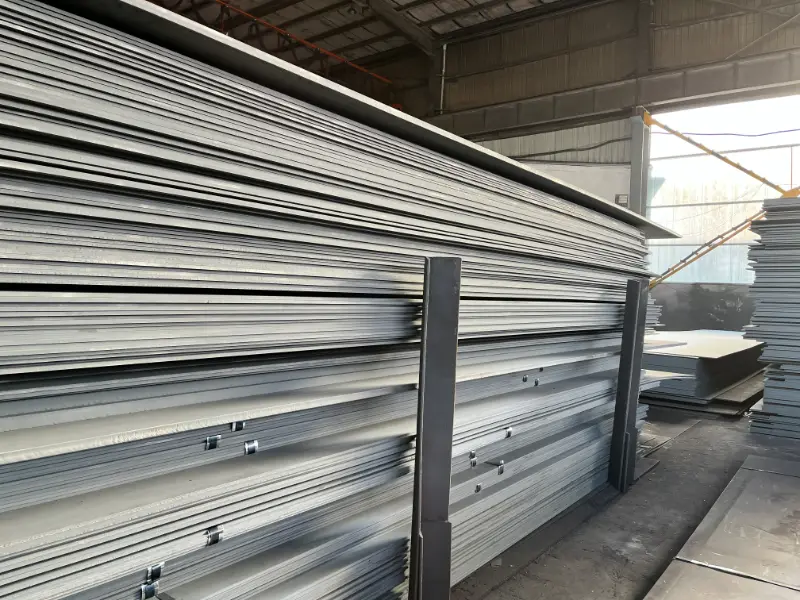
EN 10025-2 S235J0 Steel
EN 10025-2 S235J0 Steel: Hot-Rolled Structural Carbon Steel Properties
Complete material analysis of S235J0 carbon and low-alloy high-strength steel coil according to EN 10025-2, including chemical composition, mechanical and thermal properties, international equivalents, and application guidance.
Hot Rolling, Normalizing Rolling, Cold Forming, Welding, Cutting, Drilling, Bending, Stamping, Punching, Machining
- Phone : +8618037372205
- Email : [email protected]
- WhatsApp: Contact via Whtsapp
- WeChat: +8618037372205
EN 10025-2 S235J0 Steel Introduction
S235J0 is a non-alloy structural steel grade defined in the European standard EN 10025-2 for hot-rolled products. It is designed for welded, bolted, and riveted structures in construction, mechanical engineering, and general fabrication. With a minimum yield strength of 235 MPa and guaranteed impact energy of 27 J at 0 °C (designated by 'J0'), this grade offers a balanced combination of strength, ductility, and toughness at moderate service temperatures.
The steel is typically supplied in as-rolled condition, but normalized rolling may be specified to achieve improved mechanical properties and weldability. S235J0 exhibits excellent cold forming characteristics and good weldability, making it suitable for a wide range of structural components. It is fully recyclable and conforms to the EU Construction Products Regulation. Compared to lower grades like S235JR, the J0 variant ensures reliable performance in sub-zero environments down to 0 °C, which extends its usability in outdoor structures.
EN 10025-2 S235J0 Steel Chemical Composition
The chemical composition limits for S235J0 are specified in EN 10025-2:2019, Table 2. The values below apply to products with thickness ≤ 40 mm. Silicon (Si) is not mandated but is typically present in the range 0.15–0.55 %. For improved weldability, the carbon equivalent value (CEV) is usually controlled to ≤ 0.35. Trace elements and residuals are permitted within standard maximum limits. All values are maximum unless a range is indicated.
| Element | Standard Value (max) | Remarks |
|---|---|---|
| Carbon (C) | 0.17 | Ladle analysis; for thickness > 40 mm max is 0.20 |
| Manganese (Mn) | 1.40 | Mandatory for long products; for flat products, may be lower by agreement |
| Silicon (Si) | — (not specified) | Typical range 0.15–0.55; not routinely reported unless requested |
| Phosphorus (P) | 0.035 | Deoxidation control ensures low P content |
| Sulfur (S) | 0.035 | For enhanced machinability, higher S may be ordered (optional) |
| Nitrogen (N) | 0.012 | Must be bound by aluminium or other grain refiners; otherwise max 0.009 |
| Copper (Cu) | 0.55 | May be restricted when hot-dip galvanizing is required |
| Carbon Equivalent (CEV) | typically ≤ 0.35 | Based on formula: C+Mn/6+(Cr+Mo+V)/5+(Ni+Cu)/15; not a standard max but widely used for weldability evaluation |
EN 10025-2 S235J0 Steel Thermal and Electrical Physical Properties
The physical properties presented below are typical for carbon-manganese structural steels similar to S235J0 and are based on commonly accepted reference data for design purposes. These values are not part of the mandatory delivery specification but are essential for thermal and structural analyses. They are valid at room temperature unless otherwise indicated. Slight variations may occur depending on actual composition and processing.
| Property | Typical Value | Unit | Test Condition |
|---|---|---|---|
| Density (ρ) | 7850 | kg/m³ | 20 °C |
| Elastic modulus (E) | 210 | GPa | 20 °C, tensile |
| Shear modulus (G) | 81 | GPa | 20 °C, from E and ν |
| Poisson's ratio (ν) | 0.3 | — | Elastic range |
| Thermal expansion coefficient (α) | 11.7 × 10⁻⁶ | K⁻¹ | 20–100 °C |
| Thermal expansion coefficient (α) | 12.2 × 10⁻⁶ | K⁻¹ | 20–200 °C |
| Thermal expansion coefficient (α) | 12.9 × 10⁻⁶ | K⁻¹ | 20–400 °C |
| Thermal conductivity (λ) | 53 | W/(m·K) | 20 °C |
| Thermal conductivity (λ) | 51 | W/(m·K) | 100 °C |
| Thermal conductivity (λ) | 42 | W/(m·K) | 400 °C |
| Specific heat capacity (cp) | 475 | J/(kg·K) | 20 °C |
| Specific heat capacity (cp) | 550 | J/(kg·K) | 500 °C |
| Electrical resistivity (ρe) | 0.18 × 10⁻⁶ | Ω·m | 20 °C |
| Electrical resistivity (ρe) | 0.30 × 10⁻⁶ | Ω·m | 200 °C |
EN 10025-2 S235J0 Steel Mechanical Properties
Mechanical properties according to EN 10025-2:2019 Table 6. Values are for longitudinal test pieces taken from hot-rolled flat and long products in as-rolled or normalized-rolled condition. Impact test applies to thickness ≥ 6 mm. For thicknesses below 3 mm, elongation is measured on gauge length A80; otherwise A5 is used. Bending test requirements vary with product form and thickness.
| Property | Standard Requirement | Unit | Test / Condition |
|---|---|---|---|
| Yield strength (ReH) | ≥ 235 | MPa | Nominal thickness ≤ 16 mm |
| Yield strength (ReH) | ≥ 225 | MPa | 16 < t ≤ 40 mm |
| Yield strength (ReH) | ≥ 215 | MPa | 40 < t ≤ 63 mm |
| Yield strength (ReH) | ≥ 215 | MPa | 63 < t ≤ 80 mm |
| Yield strength (ReH) | ≥ 215 | MPa | 80 < t ≤ 100 mm |
| Yield strength (ReH) | ≥ 195 | MPa | 100 < t ≤ 150 mm |
| Tensile strength (Rm) | 360 – 510 | MPa | t ≤ 100 mm |
| Tensile strength (Rm) | 350 – 500 | MPa | 100 < t ≤ 150 mm |
| Elongation after fracture (A5) | ≥ 26 | % | t ≤ 40 mm, longitudinal |
| Elongation after fracture (A5) | ≥ 25 | % | 40 < t ≤ 63 mm |
| Elongation after fracture (A5) | ≥ 24 | % | 63 < t ≤ 100 mm |
| Elongation after fracture (A5) | ≥ 22 | % | 100 < t ≤ 150 mm |
| Charpy-V impact energy (KV) | ≥ 27 (longitudinal) | J | Test temperature 0 °C, thickness ≥ 6 mm |
| Charpy-V impact energy (KV) | ≥ 27 (transverse) | J | Optional for products ordered with improved through-thickness properties |
| Bending test (180°) | Mandrel diameter = 1.0a | — | t ≤ 16 mm, where a = specimen thickness |
| Bending test (180°) | Mandrel diameter = 2.0a | — | 16 < t ≤ 100 mm |
EN 10025-2 S235J0 Steel Completely Equivalent Material Standards & Substitute Grades
The following grades are internationally recognized as direct equivalents to EN 10025-2 S235J0, meeting the same chemical and mechanical property requirements, including Charpy V-notch impact energy of 27 J at 0 °C. Substitution can be made without additional design modifications, provided the delivery condition and product form are compatible.
| Country/Region | Standard | Grade | Remarks |
|---|---|---|---|
| International | ISO 630-2 | E235C | Former designation Fe 360C; includes 0 °C impact requirement |
| United Kingdom | BS 4360 | 40C | Historical standard; grade 40C corresponds to S235J0 |
| Germany | DIN 17100 | St37-3U | Ungassed/tempered; impact at 0 °C; equivalent in obsolete standard |
| France | NF A 35-501 | E24-3 | Old French designation for structural steel with 0 °C toughness |
| Spain | UNE 36080 | AE 235 C | National equivalent with impact test at 0 °C |
| Italy | UNI 7070 | Fe 360 C | Corresponds to S235J0 with guaranteed toughness |
| Japan | JIS G3106 | SM400A (with 0 °C impact) | SM400A base grade; requires supplementary agreement for 0 °C impact to match J0 |
| USA | ASTM A283/A283M | Grade C (with Charpy at 0 °C) | Must be ordered with impact testing per ASTM A673 to achieve 27 J at 0 °C |
EN 10025-2 S235J0 Steel Application Introduction
S235J0 is a versatile structural steel commonly employed in welded, bolted, and riveted constructions. Its guaranteed toughness at 0 °C makes it particularly suitable for exposed structures in moderate climates. The steel can be readily cut, formed, and machined using standard workshop methods.
Product Applications: Structural frameworks and beams, Welded plate girders, Floor plates and decking, Pipelines and pressure vessels (low pressure), Storage tanks and silos, Transmission line towers, Railcar underframes, Metal stairs and handrails, Scaffolding and formwork
Processed into products: Flanges and gusset plates, Welded brackets and supports, Anchor plates and base plates, Brake press formed brackets, Machine frames and housings, Pipe connections and fittings, Coupling rods and hinge plates, Stamped chassis parts, Foundation bolts (with appropriate heat treatment)
Application industries: Civil engineering and construction, Bridge building, Mechanical engineering, Automotive and transportation, Pipe and tank manufacturing, Energy and offshore (non-critical components), Agricultural equipment, Prefabricated housing modules
EN 10025-2 S235J0 Steel Similar / Alternative Materials with Close Performance
These materials exhibit analogous mechanical or chemical properties and can serve as practical alternatives in many applications where the exact impact temperature specification is less critical or where slight differences in strength/formability are acceptable. Swapping requires engineering evaluation to ensure compliance with service conditions.
| Country/Region | Standard | Grade | Remarks |
|---|---|---|---|
| European Union | EN 10025-2 | S235JR | Impact at 20 °C (27 J); lower notch toughness temperature margin; otherwise identical chemistry and strength |
| European Union | EN 10025-2 | S235J2 | Impact at -20 °C; improved toughness; suitable for more demanding cold environments |
| European Union | EN 10025-2 | S275J0 | Higher strength (275 MPa yield); slightly different chemical range; suitable when higher load capacity is required |
| Japan | JIS G3101 | SS400 | Similar strength but no mandatory impact requirement; widely used general structural steel |
| USA | ASTM A36 | A36 | Comparable strength; impact properties are not mandatory unless specified by supplementary requirements |
| China | GB/T 700 | Q235C | Chinese structural carbon steel; Q235C guarantees impact at 0 °C analogous to J0; slight differences in trace elements |
Notes:
Weldability: S235J0 can be welded by all common welding processes (manual metal arc, MIG/MAG, submerged arc). Preheating is generally not required for thicknesses up to 30 mm when using low-hydrogen consumables and ambient temperatures above 0 °C.
Cold forming: The steel exhibits good cold formability with minimum bending radii according to EN 10025-2. For severe forming operations, normalized condition is recommended.
Hot-dip galvanizing: Suitable for galvanizing; however, excessive silicon content (above ~0.04 %) can lead to thick, brittle zinc-iron coatings. When galvanizing is specified, a restricted silicon range (e.g., 0.15–0.25 %) should be ordered.
CE marking: This grade fulfills the requirements of EU regulation 305/2011 for construction products when produced by an approved manufacturer.
- Share



