
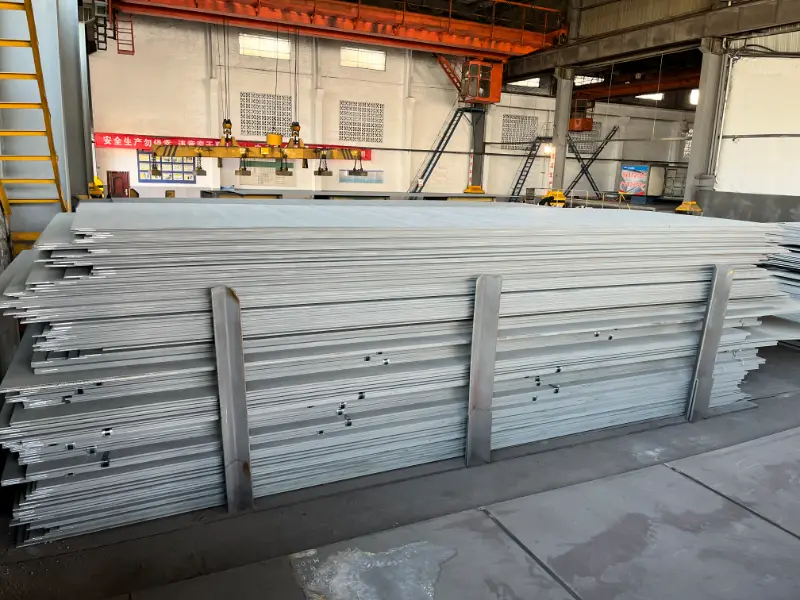
EN10025-2 S235JR Steel
S235JR Steel Explained: EN 10025-2 Grade Composition, Properties & Global Equivalents
Detailed technical data for S235JR structural steel coil under EN 10025-2. Get chemical composition, mechanical and thermal properties, international equivalent standards, and application guidance.
Welding, bolting, riveting, machining, forming, cutting, bending, and cold-forming (suitable for moderate cold deformation)
- Phone : +8618037372205
- Email : [email protected]
- WhatsApp: Contact via Whtsapp
- WeChat: +8618037372205
EN10025-2 S235JR Steel Introduction
S235JR is a widely used non-alloy structural steel grade defined in the European standard EN 10025-2. It is designed for general structural and engineering purposes, offering a good balance between strength, ductility, and weldability. Key characteristics include a minimum yield strength of 235 MPa (for thicknesses ≤16 mm), guaranteed impact toughness at +20°C (JR quality), and reliable formability. The grade is typically supplied in hot-rolled condition and can be used directly in welded, bolted, or riveted structures. Common applications range from building frames and bridges to machinery parts and storage tanks. S235JR is part of the S235 family, where the letter 'J' indicates minimum impact energy of 27 J, and 'R' specifies the test temperature of 20°C. Its chemical composition is controlled to ensure good weldability without preheating in most cases, making it a cost-effective choice for large-scale construction projects.
EN10025-2 S235JR Steel Chemical Composition
Heat analysis values according to EN 10025-2:2004 for grade S235JR. All elements are expressed as maximum weight percentages unless stated otherwise. The carbon content limit depends on the nominal product thickness. Copper is only restricted when the product is intended for subsequent hot-dip zinc coating or when agreed between purchaser and manufacturer.
| Element | Value (max %) | Remarks |
|---|---|---|
| Carbon (C) | ≤0.17 for t ≤ 16 mm; ≤0.20 for t > 16 mm | Ladle analysis |
| Manganese (Mn) | ≤1.40 | Max. |
| Silicon (Si) | Not specified (typical ≤0.55) | Informational, no maximum |
| Phosphorus (P) | ≤0.035 | Max. |
| Sulfur (S) | ≤0.035 | Max. |
| Nitrogen (N) | ≤0.012 | Max. |
| Copper (Cu) | ≤0.55 (when required) | Optional; maximum if agreed |
EN10025-2 S235JR Steel Thermal & Electrical Physical Properties
Representative physical properties for S235JR carbon steel. These values are typical for mild structural steels and are not mandatory in the product standard. They depend slightly on composition and temperature. Data are provided for general engineering calculations.
| Property | Typical Value | Unit | Test Condition / Remarks |
|---|---|---|---|
| Density (ρ) | 7.85 | g/cm³ | At 20 °C |
| Modulus of elasticity (E) | 210 | GPa | In tension, 20 °C |
| Shear modulus (G) | ≈81 | GPa | Calculated from E and ν |
| Poisson's ratio (ν) | 0.3 | – | In elastic range |
| Thermal expansion coefficient (α) | 12.0 × 10⁻⁶ | K⁻¹ | Between 20 °C and 100 °C |
| Thermal conductivity (λ) | 53 | W/(m·K) | At 20 °C |
| Specific heat capacity (cp) | 460 | J/(kg·K) | At 20 °C |
| Electrical resistivity (ρ_e) | 0.13 × 10⁻⁶ | Ω·m | At 20 °C (equivalent to 13 μΩ·cm) |
EN10025-2 S235JR Steel Mechanical Properties
Tensile and impact properties as specified in EN 10025-2:2004 for S235JR. Yield strength and tensile strength are dependent on product thickness and test orientation (transverse values are slightly lower; values below refer to longitudinal tensile tests unless noted). Impact test is mandatory for JR quality at 20°C with a minimum average absorbed energy of 27 J on longitudinal Charpy-V specimens. The bend test is optional and may be required by the purchaser. For thicknesses below 3 mm, elongation is measured on an 80 mm gauge length (A80); for 3 mm and above, a proportional gauge length (L0 = 5.65√S0) is used, generally giving A5 minimum values shown. (t = nominal thickness).
| Property | Value | Unit | Test Condition / Remarks |
|---|---|---|---|
| Yield strength (ReH) | ≥235 | MPa | t ≤ 16 mm |
| Yield strength (ReH) | ≥225 | MPa | 16 mm < t ≤ 40 mm |
| Yield strength (ReH) | ≥215 | MPa | 40 mm < t ≤ 63 mm |
| Yield strength (ReH) | ≥215 | MPa | 63 mm < t ≤ 80 mm |
| Yield strength (ReH) | ≥215 | MPa | 80 mm < t ≤ 100 mm |
| Yield strength (ReH) | ≥195 | MPa | 100 mm < t ≤ 150 mm |
| Yield strength (ReH) | ≥185 | MPa | 150 mm < t ≤ 200 mm |
| Yield strength (ReH) | ≥175 | MPa | 200 mm < t ≤ 250 mm |
| Tensile strength (Rm) | 360 – 510 | MPa | t ≤ 100 mm |
| Tensile strength (Rm) | 350 – 500 | MPa | 100 mm < t ≤ 200 mm |
| Tensile strength (Rm) | 340 – 490 | MPa | t > 200 mm |
| Elongation (A80, t < 3 mm) | ≥17 (t ≤ 1 mm); ≥18 (1| % | Gauge length 80 mm, longitudinal | |
| Elongation (A5, t ≥ 3 mm) | ≥26 (t ≤ 100 mm); ≥24 (100| % | Proportional gauge L0=5.65√S0, longitudinal | |
| Charpy-V impact energy (KV2) | ≥27 | J | At 20 °C; longitudinal, average of 3 tests |
| Bend test – bend diameter (longitudinal, when required) | d = a | – | t ≤ 16 mm; 180° bending, optional |
| Bend test – bend diameter (transverse, when required) | d = 1.5a (t≤16 mm); d = 2a (16| – | 180° bending, optional; 'a' = specimen thickness | |
EN10025-2 S235JR Steel Fully Equivalent Standards & Recommended Substitute Grades
| Country / Region | Standard | Grade | Remarks |
|---|---|---|---|
| Europe | EN 10025-2 | S235JR | Original standard designation |
| International | ISO 630-2 | S235B | Structural steel – technical delivery conditions for structural steels; similar chemical and mechanical requirements, JR corresponds to quality J0/J2 under ISO depending on impact temperature |
| USA | ASTM A283/A283M | Grade C | Low and intermediate tensile strength carbon steel plates; comparable weldable structural steel with slightly lower yield (205 MPa) but similar usage |
| Japan | JIS G3101 | SS400 | General structural rolled steel; yield strength 245 MPa (t ≤ 16 mm), tensile 400-510 MPa; fully accepted substitute |
| China | GB/T 700 | Q235B | Carbon structural steel; 235 MPa yield, 20 °C impact 27 J; equivalent quality level, widely used for substitution |
| Russia | GOST 380 | St3ps | Common structural carbon steel; similar C-Mn basis, yield ≥245 MPa; suitable replacement after verification of impact requirements |
EN10025-2 S235JR Steel Application Introduction
S235JR steel coil and products find extensive use across general construction and mechanical engineering sectors where a good combination of moderate strength, easy fabrication, and low cost is required. The material is suitable for both indoor and outdoor applications when protected from corrosion. Typical processing includes hot rolling, cutting, bending, and welding. Design engineers choose S235JR for non-critical structural members, secondary frames, and welded assemblies where high toughness at low temperatures is not mandatory.
Product Applications: Steel framework for buildings, warehouses, and factories, Bridge beams, girders, and deck plates, Storage tanks and silos for liquids and bulk materials, Agricultural machinery (e.g., ploughs, harrows, trailers), Rail and road vehicle bodies, trailer chassis, Prefabricated modular structures and kiosks, Scaffolding tubes and formwork panels, General light-duty welded and bolted structures, Steel coils for cold forming, tube and pipe production
Processed into products: Hot-rolled beams (IPE, HEA, HEB), Channels (UPE, UPN), Equal and unequal angles, Flat bars and strips, Hot-rolled plates cut to shape for gussets, base plates, stiffeners, Machine frames and bases, Welded brackets, lugs, and fastening elements, Crane runway beams and monorails, Agricultural tillage tools (cutting discs, shanks), Tubular hollow sections for trusses and space frames, Pressed and formed parts for automotive chassis
Application industries: Building construction (commercial, industrial, residential), Civil engineering (bridges, viaducts, walkways), Agricultural machinery and equipment, Shipbuilding (secondary structures, not for primary hull plates), Transport and automotive (chassis, trailers, rail wagons), Storage and tank manufacturing (non-pressure, atmospheric tanks), Machinery and plant engineering (frames, supports, guards), Energy and power (support structures, cable trays, platforms), Container and packaging (ISO containers, pallets)
EN10025-2 S235JR Steel Near / Similar Alternative Materials
| Country / Region | Standard | Grade | Remarks |
|---|---|---|---|
| Europe | EN 10025-2 | S235J0 | Same strength level, but impact test at 0 °C (27 J); better low-temperature toughness, substitutable if lower temperature toughness needed, generally higher cost. |
| Europe | EN 10025-2 | S235J2 | Same strength, impact test at -20 °C; even better toughness for cold climates, can replace S235JR where specified. |
| USA | ASTM A36/A36M | A36 | Widely used structural steel with yield ≥250 MPa (≤200 mm); slightly higher strength but overlapping properties; commonly accepted as alternate for S235JR in many applications. |
| China | GB/T 700 | Q235A | Same base strength, but no impact test required (quality A); lower notch toughness at room temperature; can replace S235JR only in static, non-critical structures. |
| Japan | JIS G3106 | SM400A | Welded structural steel with similar tensile range; better weldability guarantees; suitable for more demanding welded constructions. |
Notes:
- S235JR is not intended for heat treatment (quenching and tempering); it may be normalized if required by the purchaser.
- Weldability is generally good without preheating for thicknesses up to about 30 mm; for thicker sections or hydrogen-controlled conditions, a preheat of approximately 100–150°C may be advisable.
- Surface condition: mill scale (unless pickled or shot-blasted). For higher corrosion resistance, S235JR can be hot-dip galvanized, painted, or coated.
- CEV (Carbon Equivalent Value) is typically below 0.35% for thickness ≤30 mm, which allows welding to EN 1011-2 without extensive preheat.
- This grade does not have specific resistance to atmospheric corrosion; for such purposes, weathering steel grades (e.g., S235J0W, S235J2W) should be considered.
- Share



