
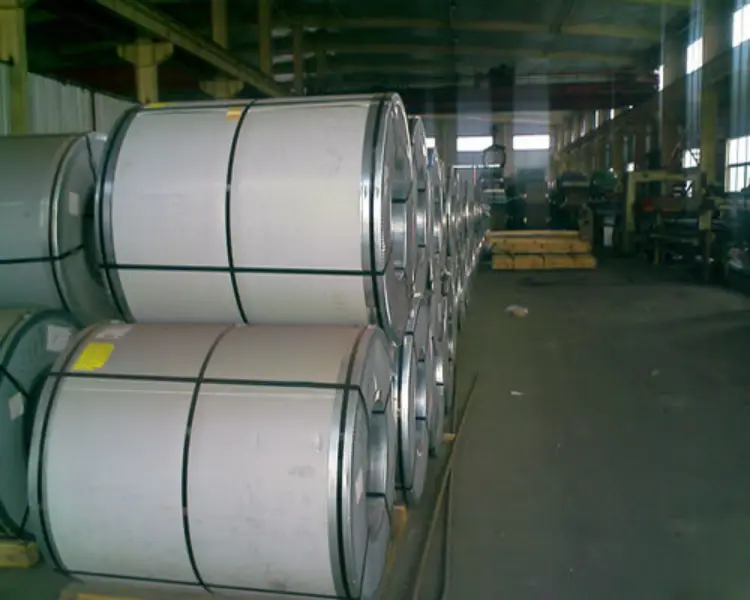
ASME SA709 Gr.100W Carbon Steel Coil
ASME SA709 Gr.100W Carbon & Low-Alloy High-Strength Weathering Steel Coil
Comprehensive technical data for ASME SA709/SA709M Grade 100W high-strength low-alloy weathering steel coil, including chemical composition, mechanical properties, thermal and electrical properties, equivalent grades, and application guidelines.
Hot rolling, cold rolling (optional), welding, cutting, bending, machining
- Phone : +8618037372205
- Email : [email protected]
- WhatsApp: Contact via Whtsapp
- WeChat: +8618037372205
ASME SA709 Gr.100W Carbon Steel Coil Introduction
ASME SA709/SA709M Grade 100W is a high-strength low-alloy structural steel with improved atmospheric corrosion resistance (weathering steel). It is primarily intended for use in bridges and other structures where weight savings and durability are critical. The '100' designates a minimum yield strength of 100 ksi (690 MPa), and 'W' stands for weathering characteristics, achieved through controlled additions of copper, chromium, and nickel. This material offers excellent weldability, toughness, and corrosion resistance, forming a protective patina when exposed to the atmosphere, which eliminates the need for painting in many environments. It is typically supplied in the as-rolled, normalized, or quenched-and-tempered condition, depending on thickness and required properties.
ASME SA709 Gr.100W Carbon Steel Coil Chemical Composition
The chemical composition is in accordance with ASME SA709/SA709M for Grade 100W. Weathering elements (Cu, Cr, Ni) are added to provide atmospheric corrosion resistance. Maximum limits ensure good weldability. The steel is typically fully killed and made to fine grain practice. Values are from the standard's Table 1, Heat Analysis.
| Element | Standard Value (wt%) | Remarks |
|---|---|---|
| Carbon (C) | ≤ 0.20 | Maximum |
| Manganese (Mn) | 0.60 - 1.20 | Heat analysis range |
| Phosphorus (P) | ≤ 0.030 | Maximum |
| Sulfur (S) | ≤ 0.030 | Maximum |
| Silicon (Si) | 0.15 - 0.50 | Heat analysis range |
| Copper (Cu) | 0.20 - 0.60 | Weathering element |
| Nickel (Ni) | ≤ 0.50 | Maximum, may be specified higher for thicker sections |
| Chromium (Cr) | 0.40 - 1.00 | Weathering element |
| Vanadium (V) | ≤ 0.08 | Maximum, optional microalloy |
| Niobium (Nb, Columbium) | ≤ 0.06 | Maximum, optional microalloy |
| Molybdenum (Mo) | ≤ 0.10 | Maximum, optional |
| Titanium (Ti) | ≤ 0.06 | Maximum, optional |
| Nitrogen (N) | ≤ 0.015 | Maximum, if specified |
| Aluminium (Al) | ≥ 0.02 | Minimum (total or soluble) for fine grain practice |
ASME SA709 Gr.100W Carbon Steel Coil Thermal and Electrical Physical Properties
The following physical properties are typical for high-strength low-alloy steel in the quenched and tempered condition. Actual values may vary with temperature and manufacturing route. These data are not mandatory requirements but provide useful design information.
| Property | Typical Value | Unit | Test Condition / Remarks |
|---|---|---|---|
| Density (ρ) | 7.85 | g/cm³ | Ambient temperature |
| Modulus of Elasticity (E) | 207 | GPa | At 20°C (68°F) |
| Shear Modulus (G) | 80 | GPa | Estimated from E and Poisson's ratio |
| Poisson's Ratio (ν) | 0.30 | – | At 20°C |
| Thermal Expansion Coefficient (α) | 11.7 | 10⁻⁶/°C | 20°C to 100°C |
| Thermal Expansion Coefficient (α) | 12.5 | 10⁻⁶/°C | 20°C to 200°C |
| Thermal Expansion Coefficient (α) | 13.0 | 10⁻⁶/°C | 20°C to 300°C |
| Thermal Conductivity (λ) | 42 | W/(m·K) | At 20°C |
| Thermal Conductivity (λ) | 40 | W/(m·K) | At 100°C |
| Specific Heat Capacity | 480 | J/(kg·K) | At 20°C |
| Electrical Resistivity (ρ_e) | 0.25 | µΩ·m | At 20°C, typical for low-alloy steel |
ASME SA709 Gr.100W Carbon Steel Coil Mechanical Properties
Requirements for Grade 100W per ASME SA709/SA709M. Tensile and yield strength apply to test specimens taken perpendicular to final rolling direction. Impact properties are specified for non-fracture critical members if required. Actual properties depend on product thickness and heat treatment condition. Note: 100W is supplied as quenched and tempered for thicknesses up to 4 in. (100 mm).
| Property | Standard Required Value | Unit | Test Condition / Remarks |
|---|---|---|---|
| Yield Strength (ReH) | ≥ 690 | MPa | For thickness ≤ 4 in. (100 mm); Transverse specimen, 0.2% offset |
| Yield Strength (ReH) | ≥ 620 | MPa | For thickness > 4 in. to 6 in. (100-150 mm) |
| Tensile Strength (Rm) | 760 - 895 | MPa | For thickness ≤ 4 in. (100 mm) |
| Tensile Strength (Rm) | 690 - 895 | MPa | For thickness > 4 in. to 6 in. (100-150 mm) |
| Elongation (A) | ≥ 18 | % | Gauge length 50 mm (2 in.), transverse specimen, for thickness ≤ 4 in. |
| Elongation (A) | ≥ 16 | % | Gauge length 50 mm, for thickness > 4 in. |
| Bend test (D = mandrel diameter, a = specimen thickness) | D = 3a | – | Bend to 180°, no cracks on outside of bent portion |
| Charpy V-notch impact (KV) | ≥ 34 / ≥ 27 (varies) | J | At specified temperature (Zone 1: 0°C; Zone 2: -18°C; Zone 3: -34°C), minimum average for three specimens; single minimum may be lower. Exact value depends on user specification. |
| Hardness (typical) | 235 - 280 | HBW | Estimated typical for quenched and tempered condition, not a requirement |
ASME SA709 Gr.100W Carbon Steel Coil Fully Equivalent Material Standards & Replaceable Grades
| Country/Region | Standard | Grade | Remarks |
|---|---|---|---|
| USA | ASTM A709/A709M | Grade 100W | Identical to ASME SA709/SA709M; primary source for bridge steels. |
| Canada | CSA G40.21 | 700WT | Weathering high-strength structural steel; yield strength 700 MPa. Not completely identical but often accepted as equivalent. |
| Europe | EN 10025-6 | S690QLW (or S690Q weathering variant) | EN quenched and tempered weathering steel; added suffix 'W' for weathering; not a direct copy but close in strength and corrosion resistance. Check specific chemical requirements. |
| Japan | JIS G 3140 | SMA690W (higher strength bridge steel) | High yield strength weathering steel for bridges; strength level matches 690 MPa. Equivalent if certified to similar impact and chemical requirements. |
ASME SA709 Gr.100W Carbon Steel Coil Application Introduction
ASME SA709 Grade 100W is engineered for heavy structural applications where high strength-to-weight ratio and atmospheric corrosion resistance are required. The material is weldable and formable, making it suitable for both bolted and welded construction. Typical applications include long-span bridges, highway girders, railway bridges, and offshore platform components. It is also used in architectural exposed steel structures where the natural rust-like patina is desired for aesthetic reasons. When used in bridges, the material is often specified with additional Charpy V-notch requirements based on the temperature zone to ensure fracture toughness.
Product Applications: Bridge main girders and cross frames, Box girders and trusses, Highway bridge decks and orthotropic decks, Railway bridge spans, Structural columns and beams in high-rise buildings, Exposed architectural frameworks and sculptures, Welded built-up sections
Processed into products: Longitudinal stiffeners and diaphragms, Bracing members and gusset plates, Bolted connection plates, Welded splice plates, Cantilever arm brackets, Pylons and support structures for cable-stayed bridges, Transition beams at expansion joints
Application industries: Civil Engineering & Bridge Construction, Heavy Infrastructure, Railway Engineering, Architectural & Structural Steel, Offshore & Marine (with supplementary corrosion protection), Energy (transmission towers, wind turbine towers)
ASME SA709 Gr.100W Carbon Steel Coil Similar / Alternative Materials with Comparable Performance
| Country/Region | Standard | Grade | Remarks |
|---|---|---|---|
| USA | ASTM A514/A514M | Grade F (Quenched & Tempered Alloy Steel) | High-strength structural steel with yield 690 MPa (100 ksi). Not inherently weathering (requires painting), but similar strength and weldability. |
| USA | ASTM A709/A709M | Grade HPS 100W | High Performance Steel with enhanced toughness and improved weathering; modern variant often used in bridges. Slightly different chemistry and higher Charpy requirements. |
| USA | ASTM A588/A588M | Grade B (weathering steel, 345 MPa yield) | Lower strength (50 ksi) weathering steel; can be substituted if strength is not critical, offering similar corrosion resistance. |
| Europe | EN 10025-6 | S690QL (without W) | High-strength Q&T steel without guaranteed weathering; used in structures where painting is applied. Mechanical properties comparable. |
| International | ASTM A572/A572M | Grade 65 (450 MPa) with copper addition | Intermediate strength with limited weathering; not fully equivalent but sometimes used with thickness penalties. |
Notes:
For thicknesses above 6 in. (150 mm), the standard may require supplementary specification S91 for through-thickness properties (Z-quality). Weathering steels should not be used in environments with high chloride exposure (e.g., direct de-icing salt spray without drainage) unless detailed corrosion protection is applied. The protective patina develops best under alternating wet/dry cycles; buried or continuously submerged conditions may lead to localized corrosion. Always consult the latest ASME/ASTM standard for exact product analysis tolerances and supplementary requirements. Weld preheat and interpass temperature control are essential due to the alloy content and high strength levels. Typical welding consumables include E11018-M or equivalent with matching strength and weathering capabilities.
- Share



