
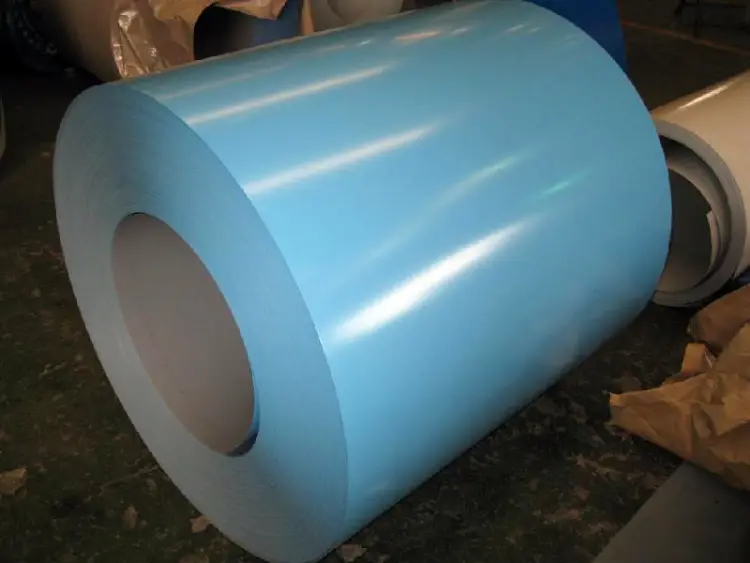
S275J0 Structural Steel Coil to EN 10025-2
S275J0 Structural Steel Coil to EN 10025-2 - High Strength & 0°C Impact Tested
S275J0 is a hot-rolled non-alloy structural steel according to EN 10025-2, offering minimum yield strength of 275 MPa and Charpy impact energy of 27 J at 0°C. Ideal for construction, bridges, and machinery.
Hot rolling, cold forming, welding, machining, flame cutting, shearing
- Phone : +8618037372205
- Email : [email protected]
- WhatsApp: Contact via Whtsapp
- WeChat: +8618037372205
S275J0 Structural Steel Coil to EN 10025-2 Introduction
S275J0 is a non-alloy structural steel grade defined in the European standard EN 10025-2. It belongs to the family of hot-rolled products for structural applications, characterized by a minimum yield strength of 275 MPa for thicknesses up to 16 mm. The designation 'J0' signifies that the material is subjected to a Charpy V-notch impact test at 0°C with a minimum absorbed energy of 27 Joules in the longitudinal direction, ensuring reliable toughness under moderate temperature conditions.
This steel is widely used in welded, bolted, and riveted structures because of its excellent balance between strength, ductility, and weldability. The controlled carbon equivalent (CEV) enables safe welding without the need for extensive preheating. Typical applications include:
- Structural steelwork in commercial and industrial buildings
- Bridge construction
- Offshore and shipbuilding secondary structures
- Frames and chassis for heavy machinery
- Storage tanks and pressure vessels
- Piling and foundation elements
S275J0 is available in various forms, primarily as hot-rolled coils, plates, strips, and sections. Depending on the end use, it can be supplied in the as-rolled (AR) condition or after normalizing treatment (N). The standard allows a wide thickness range, and the exact mechanical properties are tailored by adjusting the chemical composition within permitted limits. This grade is often chosen for projects that require a reliable, cost-effective structural steel with guaranteed low-temperature toughness, making it a preferred option in European construction projects and in many international applications through recognized equivalent standards such as ISO 630-2.
S275J0 Structural Steel Coil to EN 10025-2 Chemical composition
The chemical composition of S275J0 is controlled to ensure the required mechanical properties and weldability while maintaining good toughness at 0°C. The table below lists the maximum permissible contents for the main elements according to EN 10025-2:2004. Values may vary depending on product thickness; the most restrictive limits for thinner sections are commonly used. Carbon equivalent (CEV) is optional but often guaranteed to enhance weldability.
| Chemical element | Standard value (max % unless range) | Remarks |
|---|---|---|
| Carbon (C) | ≤0.18 | For thickness ≤ 16 mm. For 16 |
| Silicon (Si) | ≤0.60 | Applicable to all thicknesses. |
| Manganese (Mn) | ≤1.50 | For thickness ≤ 40 mm. For 40 |
| Phosphorus (P) | ≤0.030 | Upper limit for all thicknesses. |
| Sulfur (S) | ≤0.030 | Upper limit to ensure cleanliness and impact properties. |
| Nitrogen (N) | ≤0.012 | Applies to all products. |
| Copper (Cu) | ≤0.55 | Maximum content, if agreed between manufacturer and purchaser. |
| Carbon Equivalent Value (CEV) | ≤0.40 | Optional agreement; typical max for t≤16 mm. Higher values may apply for thicker products. |
S275J0 Structural Steel Coil to EN 10025-2 Thermal and electrical physical properties
The physical properties given below are typical for carbon‑manganese structural steels of the S275 class at room temperature. Exact values may slightly vary depending on composition and heat treatment. These data are useful for design calculations involving thermal expansion, heat transfer, and electrical resistance.
| Property | Typical value | Unit | Test conditions |
|---|---|---|---|
| Density (ρ) | 7850 | kg/m³ | At 20°C |
| Modulus of elasticity (E) | 200 | GPa | At 20°C |
| Shear modulus (G) | ≈80 | GPa | At 20°C |
| Poisson ratio (ν) | 0.29 | – | At 20°C |
| Thermal expansion coefficient (α) | 11.1 × 10⁻⁶ | K⁻¹ | 20 – 100°C |
| Thermal expansion coefficient (α) | 12.1 × 10⁻⁶ | K⁻¹ | 20 – 200°C |
| Thermal conductivity (λ) | 53 | W/(m·K) | At 20°C |
| Specific heat capacity (c) | 460 | J/(kg·K) | At 20°C |
| Electrical resistivity (ρₑ) | 0.17 | μΩ·m | At 20°C |
S275J0 Structural Steel Coil to EN 10025-2 Mechanical properties
The mechanical properties of S275J0 are defined in EN 10025-2 for different thickness ranges, at ambient temperature. The values below represent the minimum required in the longitudinal direction for flat and long products. Impact toughness is verified using Charpy V-notch specimens at 0°C. Bend tests are conducted to confirm the material's formability.
| Property | Standard required value | Unit | Test conditions |
|---|---|---|---|
| Yield strength (ReH) | ≥275 | MPa | Thickness ≤ 16 mm |
| Yield strength (ReH) | ≥265 | MPa | 16 < t ≤ 40 mm |
| Yield strength (ReH) | ≥255 | MPa | 40 < t ≤ 63 mm |
| Yield strength (ReH) | ≥245 | MPa | 63 < t ≤ 80 mm |
| Yield strength (ReH) | ≥235 | MPa | 80 < t ≤ 100 mm |
| Yield strength (ReH) | ≥225 | MPa | 100 < t ≤ 150 mm |
| Tensile strength (Rm) | 430 – 580 | MPa | Thickness < 3 mm |
| Tensile strength (Rm) | 410 – 560 | MPa | 3 ≤ t ≤ 100 mm |
| Tensile strength (Rm) | 400 – 560 | MPa | 100 < t ≤ 150 mm |
| Elongation (A) after fracture | ≥17 | % | Thickness < 3 mm, gauge L₀ = 80 mm |
| Elongation (A5) | ≥23 | % | 3 ≤ t ≤ 40 mm, L₀ = 5.65√S₀ |
| Elongation (A5) | ≥22 | % | 40 < t ≤ 63 mm |
| Elongation (A5) | ≥21 | % | 63 < t ≤ 100 mm |
| Elongation (A5) | ≥20 | % | 100 < t ≤ 150 mm |
| Charpy impact energy (KV₂) | ≥27 | J | Lengthwise, 0°C, V‑notch, thickness ≥ 6 mm |
| Bend test (mandrel diameter) | 1.0 × t | – | Thickness ≤ 16 mm, nominal ReH min 275 MPa |
| Bend test (mandrel diameter) | 1.5 × t | – | 16 < t ≤ 40 mm |
| Bend test (mandrel diameter) | 2.0 × t | – | 40 < t ≤ 150 mm |
S275J0 Structural Steel Coil to EN 10025-2 Exact equivalent material standards and replaceable grades
| Country/Region | Standard | Grade | Remarks |
|---|---|---|---|
| Europe | EN 10025-2 | S275J0 | Original standard and grade. |
| International | ISO 630-2 | S275J0 | Identical mechanical and chemical requirements. |
| United Kingdom | BS EN 10025-2 | S275J0 | UK adoption of European standard, fully interchangeable. |
| Germany | DIN EN 10025-2 | S275J0 | German edition, identical properties. |
S275J0 Structural Steel Coil to EN 10025-2 Application Introduction
S275J0 is a versatile structural steel suitable for a broad range of industries. Its guaranteed toughness at 0°C makes it a reliable choice for outdoor structures in moderate climates. The steel can be easily formed, welded, and machined with standard workshop practices.
Product Applications: Hot-rolled steel coils and cut-to-length plates, Universal beams, columns, channels and angles, Welded structural hollow sections and pipes, Cold-formed sections for light‑gauge construction, Prefabricated building frames and trusses, Bridges and pedestrian bridges, Storage tank shells and roofs
Processed into products: Main and secondary beams in steel frameworks, Columns and stanchions in multi-storey buildings, Truss members and lattice girders, Crane rails and runway beams, Chassis and sub‑frames for heavy trucks, Bogie frames for railway coaches, Deck plates and stiffeners in ship structures, Foundation piles and sheet piles, Flanges and supports in pressure vessels, Structural parts of water gates and penstocks
Application industries: Construction & Civil Engineering, Bridge & Infrastructure Engineering, Machinery & Equipment Manufacturing, Automotive & Heavy Vehicle Industry, Shipbuilding & Offshore Structures, Storage Tanks, Silos & Pressure Vessels, Material Handling & Mining Equipment
S275J0 Structural Steel Coil to EN 10025-2 Similar / alternative grades recommendation
| Country/Region | Standard | Grade | Remarks |
|---|---|---|---|
| China | GB/T 700 | Q275C | Yield strength 275 MPa, impact test at 0°C (C quality). Closest Chinese grade; check CEV and specific product standard. |
| USA | ASTM A36 | A36 | Yield 250 MPa (slightly lower), Charpy optional. Commonly substituted in static applications. |
| USA | ASTM A572 | Grade 42 | Yield 290 MPa, comparable tensile range. Higher strength, verify toughness requirements. |
| Japan | JIS G3106 | SM490A | Yield 325 MPa for t≤16 mm, higher strength; requires careful design adaptation. |
| India | IS 2062 | E275 C | Grade with 275 MPa yield; 'C' indicates impact test at 0°C, very similar to S275J0. |
Notes:
S275J0 is an intermediate toughness grade within the EN 10025‑2 family, positioned between S275JR (impact at 20°C) and S275J2 (impact at -20°C). When the structure is exposed to lower temperatures, upgrading to S275J2 is recommended. The material can be welded by all common methods without preheating when section thickness is moderate (typically ≤ 30 mm) and the carbon equivalent is below 0.40. For hot‑dip galvanizing, the low silicon content (< 0.05%) option can be specified to avoid excessive coating thickness. Always refer to the latest edition of the standard for advances in specifications and the most current mechanical property tables.
- Share



