
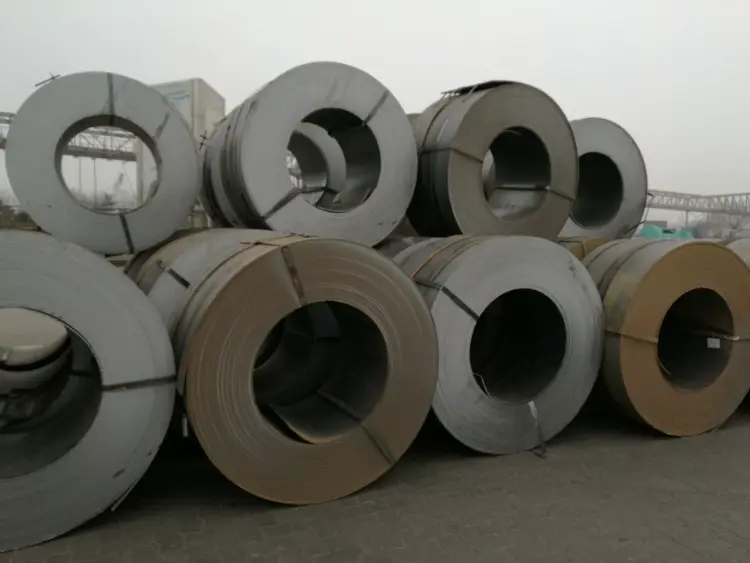
RINA F690 Shipbuilding Steel Coil
RINA F690 Shipbuilding Steel Coil: High-Strength Quenched & Tempered Grade for Marine Structures
Detailed material data for RINA F690 shipbuilding steel coil including chemical composition, mechanical properties, thermal and electrical data, equivalent grades, and application guidance.
Hot rolling, quenching and tempering (Q&T); optional normalizing or stress-relieving heat treatment
- Phone : +8618037372205
- Email : [email protected]
- WhatsApp: Contact via Whtsapp
- WeChat: +8618037372205
RINA F690 Shipbuilding Steel Coil Introduction
RINA F690 is a high-strength, quenched and tempered structural steel specifically designed for shipbuilding and offshore engineering. Certified by the Italian classification society RINA (Registro Italiano Navale), it offers a minimum yield strength of 690 MPa in the thinner gauge ranges, combined with excellent low-temperature toughness and good weldability. Its controlled chemical composition and fine-grain microstructure ensure reliable performance in critical welded applications, such as ship hulls, decks, and heavy lifting equipment. The steel is supplied as coil, plate, or sheet in the quenched and tempered condition, meeting the stringent requirements of RINA Rules Part D for high-strength hull steels. The grade is part of the international family of F690 steels recognized by major classification societies under IACS UR W28, facilitating global procurement and interchangeability.
RINA F690 Shipbuilding Steel Coil Chemical Composition
The chemical composition of RINA F690 is closely controlled to ensure high strength, good toughness, and reliable weldability. Low phosphorus and sulfur levels improve cleanliness and avoid hot cracking. Microalloying elements such as niobium, vanadium, and titanium provide grain refinement and precipitation hardening, while aluminum ensures fine grain size through deoxidation. Boron may be added to enhance hardenability in thicker sections. The typical ranges align with IACS UR W28 for F690 grade.
| Element | Standard Value (wt%) | Remarks |
|---|---|---|
| Carbon (C) | ≤0.20 | Ladle analysis |
| Silicon (Si) | ≤0.55 | |
| Manganese (Mn) | 0.70 – 1.70 | |
| Phosphorus (P) | ≤0.025 | |
| Sulfur (S) | ≤0.020 | |
| Chromium (Cr) | ≤1.50 | |
| Nickel (Ni) | ≤2.00 | |
| Molybdenum (Mo) | ≤0.70 | |
| Copper (Cu) | ≤0.50 | |
| Vanadium (V) | ≤0.12 | |
| Niobium (Nb) | ≤0.06 | |
| Titanium (Ti) | ≤0.05 | |
| Aluminum (Al), total | ≥0.020 | Minimum for fine grain practice |
| Nitrogen (N) | ≤0.012 | |
| Boron (B) | ≤0.005 | Optional addition for hardenability |
| Iron (Fe) | Balance |
RINA F690 Shipbuilding Steel Coil Thermal and Electrical Properties
The following thermal and electrical properties are typical for quenched and tempered structural steels of this strength class. They are provided for engineering calculations and process design. Actual values can vary slightly depending on exact composition and heat treatment conditions.
| Property | Typical Value | Unit | Test Condition |
|---|---|---|---|
| Density (ρ) | 7850 | kg/m³ | Ambient temperature |
| Modulus of elasticity (E) | 205 | GPa | Room temperature |
| Shear modulus (G) | 80 | GPa | Typical for steel |
| Poisson's ratio (ν) | 0.3 | — | Elastic range |
| Thermal expansion coefficient (α), 20 – 100 °C | 11.5 | 10⁻⁶ / K | Approximate |
| Thermal conductivity (λ) | 45 | W/(m·K) | At 20 °C |
| Specific heat capacity (cp) | 460 | J/(kg·K) | At 20 °C |
| Electrical resistivity (ρe) | 0.22 | µΩ·m | At 20 °C |
RINA F690 Shipbuilding Steel Coil Mechanical Properties
The mechanical properties of RINA F690 are determined according to the RINA Rules, tested on transverse specimens taken from the final heat-treated condition. Yield and tensile strengths vary with product thickness; the values below represent the minimum requirements for the specified thickness ranges. Charpy V-notch impact tests are conducted at -20 °C to guarantee low-temperature toughness. Bend test requirements ensure adequate ductility for forming and welding operations.
| Property | Standard Requirement | Unit | Test Condition |
|---|---|---|---|
| Yield strength (ReH), t ≤ 50 mm | ≥ 690 | MPa | Transverse, ambient |
| Yield strength (ReH), 50 < t ≤ 100 mm | ≥ 670 | MPa | Transverse, ambient |
| Yield strength (ReH), 100 < t ≤ 150 mm | ≥ 630 | MPa | Transverse, ambient |
| Tensile strength (Rm) | 770 – 940 | MPa | Transverse, ambient, all thicknesses |
| Elongation after fracture (A5), longitudinal | ≥ 14 | % | Gauge length Lo = 5.65√So |
| Elongation after fracture (A5), transverse | ≥ 12 | % | Gauge length Lo = 5.65√So |
| Charpy impact energy (KV2), longitudinal, t ≤ 50 mm | ≥ 50 | J | At -20 °C |
| Charpy impact energy (KV2), longitudinal, t > 50 mm | ≥ 40 | J | At -20 °C |
| Charpy impact energy (KV2), transverse, t ≤ 50 mm | ≥ 35 | J | At -20 °C |
| Charpy impact energy (KV2), transverse, t > 50 mm | ≥ 27 | J | At -20 °C |
| Bend test (180°) | Mandrel diameter D = 3t for t ≤ 20 mm; D = 4t for t > 20 mm | — | No cracks or defects |
RINA F690 Shipbuilding Steel Coil Fully Equivalent Material Standards and Replaceable Grades
| Country / Region | Standard | Grade | Remarks |
|---|---|---|---|
| International (IACS) | IACS UR W28 | F690 | Common IACS high strength quenched & tempered hull steel |
| France | BV Rules | F690 | Bureau Veritas equivalent |
| Norway / Germany | DNV Rules | F690 | DNV (now DNV GL) grade |
| UK | LR Rules | F690 | Lloyd's Register equivalent |
| USA | ABS Rules | F690 | American Bureau of Shipping grade |
| China | CCS Rules | F690 | China Classification Society equivalent |
| International (Europe) | EN 10225 | S690Q/QL1 | Offshore structural steel – may be accepted by RINA after additional certification |
RINA F690 Shipbuilding Steel Coil Application Introduction
RINA F690 combines exceptional strength with reliable ductility and crack resistance, making it the material of choice for weight-critical and safety-relevant marine structures. Its good weldability allows efficient shipyard fabrication using conventional welding procedures, usually with preheat for thicker sections. Typical applications focus on areas subjected to high static and dynamic loads, often in heavy plate thicknesses.
Product Applications: Ship hull plates and shell plating, Deck plates and strength decks, Longitudinal stiffeners and frames, Offshore module support beams, Crane booms and lattice structures, Jack-up rig legs and spudcans
Processed into products: Welded hull stiffeners and brackets, Frame rings and web frames, Bulkhead panels and collision bulkheads, Lifting lugs and pad eyes, Bearing plates for heavy machinery, Transition joints and reinforcement pads
Application industries: Shipbuilding (naval and commercial vessels), Offshore oil and gas platforms, Heavy lifting and crane engineering, Bridge construction (especially long-span welded bridges), Pressure vessel and storage tank manufacturing, Renewable energy (offshore wind turbine foundations)
RINA F690 Shipbuilding Steel Coil Similar / Comparable Material Standards and Grades
| Country / Region | Standard | Grade | Remarks |
|---|---|---|---|
| Europe | EN 10025-6 | S690QL | Structural steel, quenched & tempered, min. yield 690 MPa; not specifically shipbuilding but mechanically close |
| USA | ASTM A514 / A517 | Grade Q | High yield strength quenched & tempered plate, yield ≥ 690 MPa; similar chemical approach but different certification |
| Japan | JIS G 3128 | SHY 685 / SHY 685N | High yield strength steels for welded structures, yield ≥ 685 MPa; comparable in strength and toughness |
Notes:
Steel can be supplied in coil form with thickness up to approximately 25 mm, or as plate for thicker dimensions. Preheating before welding is typically required for sections over 20 mm; interpass temperature should be controlled. Post-weld heat treatment (PWHT) may be necessary for stress relief in highly restrained joints. Inspection and certification are provided with RINA Class 3.2 material certificates. Coil and plate surfaces are descaled, and temporary protection (oil or dry coating) may be applied.
- Share



