
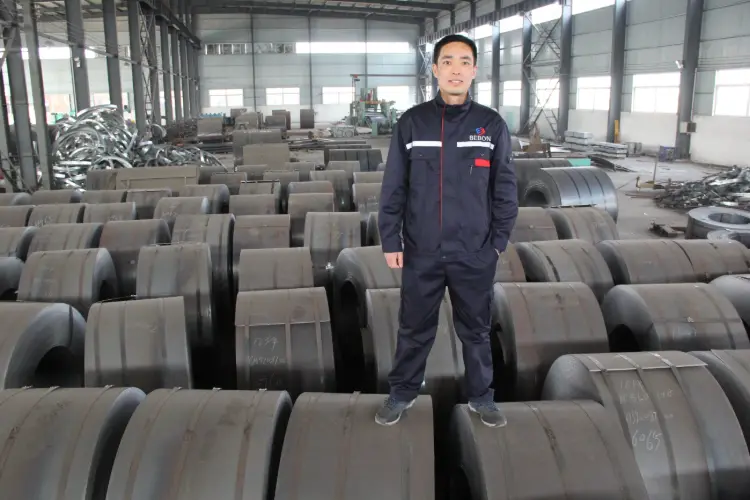
RINA E690 Shipbuilding Steel Coil
RINA E690 Shipbuilding Steel Coil - High-Strength Quenched & Tempered Marine Steel for Ship and Offshore Structures
Explore the chemical composition, mechanical properties, thermal characteristics, and international equivalents of RINA E690 shipbuilding steel coil. A 690 MPa yield strength marine-grade steel for demanding ship and offshore engineering applications.
Cutting, welding, forming, bending, machining, surface treatment
- Phone : +8618037372205
- Email : [email protected]
- WhatsApp: Contact via Whtsapp
- WeChat: +8618037372205
RINA E690 Shipbuilding Steel Coil Introduction
RINA E690 is a high-strength, quenched and tempered shipbuilding steel grade certified by the Registro Italiano Navale (RINA). It belongs to the extra-high-strength structural steel family (EHSS) with a minimum specified yield strength of 690 MPa, making it suitable for critical load-bearing components in large vessels and offshore structures. The 'E' designation indicates excellent low-temperature toughness, with impact testing performed at -40°C, ensuring reliable performance in cold environments.
The steel is produced as hot-rolled coils and plates, subsequently heat-treated to achieve a fine-grained bainitic/martensitic microstructure that provides an optimal balance of strength, ductility, and weldability. Chemical composition is carefully controlled with microalloying elements (niobium, vanadium, titanium, and optionally boron) to enhance hardenability and grain refinement. Typical applications include hull plating, deck structures, and stiffeners in container ships, LNG carriers, naval vessels, and offshore platforms. Delivery condition is generally quenched and tempered (Q&T), with additional requirements for through-thickness properties (Z-quality) and ultrasonic testing if specified. RINA E690 is recognized as equivalent to other IACS member grades such as ABS EQ70, DNV E690, and LR E690, facilitating global material sourcing and substitution.
RINA E690 Shipbuilding Steel Coil Chemical Composition
The chemical composition of RINA E690 conforms to RINA Rules Part D, Chapter 3, Section 1, Table 3 for quenched and tempered steels. Values represent maximum limits unless a range is given. Microalloying elements such as Nb, V, and Ti are added singly or in combination to achieve the required strength and toughness. The carbon equivalent (CEV) is typically controlled below 0.52% to ensure good weldability. Residual elements like Cu, Ni, Cr, Mo may vary within the specified limits; when combined, their total content usually does not exceed 0.80%.
| Chemical Element | Standard Value (max, %) | Remarks |
|---|---|---|
| Carbon (C) | 0.20 | max, product analysis +0.02 |
| Silicon (Si) | 0.10–0.55 | typical range |
| Manganese (Mn) | 1.00–1.70 | upper limit may be increased for thick sections |
| Phosphorus (P) | 0.025 | max |
| Sulfur (S) | 0.025 | max |
| Chromium (Cr) | 0.30 | max |
| Nickel (Ni) | 1.00 | max |
| Molybdenum (Mo) | 0.30 | max |
| Copper (Cu) | 0.35 | max |
| Niobium (Nb) | 0.05 | max |
| Vanadium (V) | 0.10 | max |
| Titanium (Ti) | 0.02 | max |
| Aluminium (Al) total | ≥ 0.015 | minimum for grain refining |
| Nitrogen (N) | 0.012 | max |
| Boron (B) | 0.005 | max, when added |
RINA E690 Shipbuilding Steel Coil Thermal & Electrical Physical Properties
The following physical properties are typical for quenched and tempered structural steels of this strength level and are provided for design calculations. Actual values may vary slightly depending on specific chemical composition, heat treatment, and temperature. Thermal conductivity and specific heat are measured at room temperature and decrease/increase with rising temperature. Thermal expansion coefficient is averaged over the temperature range. Electrical resistivity is given for direct current at 20°C.
| Property | Typical Value | Unit | Test Conditions / Remarks |
|---|---|---|---|
| Density (ρ) | 7850 | kg/m³ | 20°C |
| Modulus of Elasticity (E) | 205–210 | GPa | 20°C, static tensile |
| Shear Modulus (G) | 80–81 | GPa | 20°C, calculated from E and ν |
| Poisson's Ratio (ν) | 0.28–0.30 | – | Elastic range |
| Thermal Expansion Coefficient (α) | 11.5 × 10⁻⁶ | K⁻¹ | 20–100°C average |
| Thermal Conductivity (λ) | 42–48 | W/(m·K) | 20°C |
| Specific Heat Capacity (cₚ) | 460–480 | J/(kg·K) | 20°C |
| Electrical Resistivity (ρₑ) | 0.20–0.25 | µΩ·m | 20°C |
RINA E690 Shipbuilding Steel Coil Mechanical Properties
Mechanical properties are determined according to RINA testing requirements. Tensile and impact tests are performed on samples taken from the final heat-treated condition. The yield strength is defined as the upper yield point (ReH) or 0.2% proof stress (Rp0.2). Elongation is measured on a gauge length of 5.65√S₀ (A5). Charpy V-notch impact tests are conducted at -40°C; the minimum average energy values apply for both longitudinal and transverse specimens. Bending test requires a 180° bend without cracking. Actual properties may vary depending on thickness; thicker sections (>50 mm) may show slightly reduced strength and toughness values.
| Property | Required Value | Unit | Test Conditions |
|---|---|---|---|
| Yield Strength (ReH) | ≥ 690 | MPa | Transverse, room temperature, t ≤ 50 mm |
| Tensile Strength (Rm) | 770–940 | MPa | Transverse, room temperature, t ≤ 50 mm |
| Elongation (A5) | ≥ 14 | % | Transverse, gauge length 5.65√S₀, t ≤ 50 mm |
| Charpy V-Notch Impact (Longitudinal) | ≥ 46 (average) | J | at -40°C, t ≤ 50 mm |
| Charpy V-Notch Impact (Transverse) | ≥ 31 (average) | J | at -40°C, t ≤ 50 mm |
| Bend Test (180°) | d = 3a | – | Mandrel diameter = 3 × thickness, no cracks |
RINA E690 Shipbuilding Steel Coil Fully Equivalent Material Standards and Substitute Grades
| Country / Region | Standard | Grade | Remarks |
|---|---|---|---|
| International (IACS) | IACS UR W11 | E690 | Unified Requirement for high-strength hull structural steel |
| USA (ABS) | ABS Rules | EQ70 | American Bureau of Shipping, identical yield and impact requirements |
| Norway / Germany (DNV) | DNV Rules | E690 | Det Norske Veritas, directly equivalent |
| France (BV) | BV Rules | E690 | Bureau Veritas, directly equivalent |
| United Kingdom (LR) | LR Rules | E690 | Lloyd's Register, directly equivalent |
| China (CCS) | CCS Rules | E690 | China Classification Society, directly equivalent |
| Japan (NK) | NK Rules | E690 | Nippon Kaiji Kyokai (ClassNK), directly equivalent |
| South Korea (KR) | KR Rules | E690 | Korean Register, directly equivalent |
| India (IRS) | IRS Rules | E690 | Indian Register of Shipping, directly equivalent |
| Russia (RMRS) | RMRS Rules | E690 | Russian Maritime Register of Shipping, similar with possible modifications |
RINA E690 Shipbuilding Steel Coil Application Introduction
RINA E690 steel coil is primarily used in the shipbuilding and offshore industries where high strength-to-weight ratio and excellent low-temperature toughness are critical. It can be formed, welded, and machined to produce a wide range of structural elements. The quenched and tempered condition ensures homogeneous mechanical properties across the thickness, making it ideal for thick sections. Common processing techniques include plasma/laser cutting, submerged arc welding (SAW), and cold forming. Preheating and post-weld heat treatment may be necessary depending on thickness and hydrogen control requirements.
Product Applications: Hot-rolled steel coils and plates, Cold-bent profiles and sections, Welded beams and columns, Prefabricated ship sub-assemblies, Flame-cut and machined mechanical parts
Processed into products: Hull shell plates and decks, Longitudinal and transverse frames, Bulkhead stiffeners and girders, Offshore platform leg chords and bracings, Crane jibs and lifting eyes, Padeyes and mooring brackets, Pressure hull rings
Application industries: Shipbuilding: hulls, decks, bulkheads of cargo ships, tankers, LNG carriers, cruise vessels, Offshore engineering: jackets, topside modules, flare booms, living quarters, Naval defence: frigate hulls, submarine pressure hulls (with additional certifications), Heavy machinery: cranes, earth-moving equipment, structural booms, Pressure vessel manufacturing: gas storage spheres, high-pressure piping (with RINA additional approval)
RINA E690 Shipbuilding Steel Coil Similar / Neighbouring Substitute Materials
| Country / Region | Standard | Grade | Remarks |
|---|---|---|---|
| Europe | EN 10025-6 | S690Q / S690QL / S690QL1 | Quenched and tempered structural steel; compare impact test temperature (-20°C / -40°C / -60°C) and may require additional approval for marine use |
| USA | ASTM A514 / A517 | Grade Q / Q modified | High-yield-strength quenched and tempered alloy steel plate; yield 690 MPa min but different chemistry and not directly recognized by classification societies |
| Japan | JIS G 3128 | SHY685 / SHY685N | High yield strength steel plate for welded structures; 685 MPa min yield, often accepted as near equivalent with supplementary testing |
| China | GB/T 712 | E690 | Chinese national standard for shipbuilding steel; same grade designation but verify classification society approval |
| Worldwide | API RP 2Z | Grade 690 | Recommended practice for preproduction qualification of steel plates for offshore structures; similar mechanical requirements |
Notes:
- For thicknesses above 50 mm, reduced mechanical properties or higher alloy contents may apply; consult the RINA thickness supplement.
- Through-thickness (Z-quality) testing to EN 10164 can be specified to ensure lamellar tearing resistance.
- Ultrasonic testing to EN 10160 or RINA specification is common for safety-critical components.
- Welding procedures must be qualified according to RINA Rules, using low-hydrogen consumables and controlled heat input to avoid cold cracking.
- This data is for general guidance; always refer to the latest official RINA Rules and the specific material certificate for the project.
- Share



