
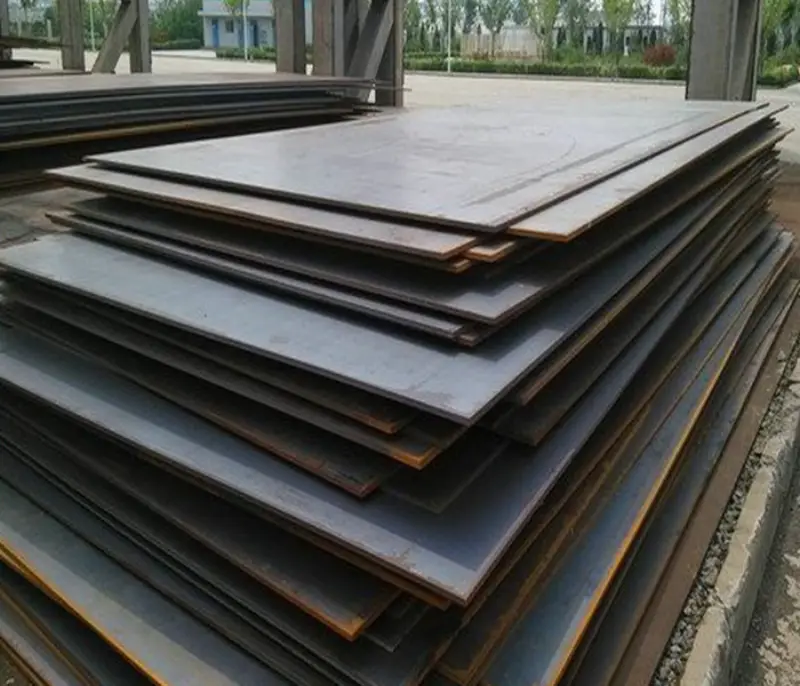
Austenitic 347 (S34700) Stainless Steel Plate/Coil
Austenitic 347 (S34700) Stainless Steel Plate/Coil: High-Temperature & Corrosion Resistant Alloy
Explore comprehensive data on 347 (S34700) austenitic stainless steel plate and coil, including chemical composition, mechanical properties, physical properties, international equivalents, and application guide for high-temperature and corrosive environments.
Hot rolling, cold rolling, solution annealing, pickling, descaling
- Phone : +8618037372205
- Email : [email protected]
- WhatsApp: Contact via Whtsapp
- WeChat: +8618037372205
Austenitic 347 Stainless Steel Plate/Coil Introduction
AISI 347 (UNS S34700) is an austenitic stainless steel stabilized with niobium (columbium). The addition of niobium prevents intergranular corrosion caused by chromium carbide precipitation during welding or high-temperature service (427–816 °C). It exhibits excellent oxidation resistance and creep strength, making it suitable for prolonged use at elevated temperatures. The alloy possesses good ductility, formability, and weldability typical of 18-8 stainless steels. It is widely used in chemical processing, heat exchanger tubing, boiler shrouds, and aircraft exhaust stacks. As plate and coil, it is supplied in solution-annealed condition per ASTM A240/A240M.
Austenitic 347 Stainless Steel Plate/Coil Chemical Composition
The chemical composition conforms to ASTM A240/A240M for grade 347 (S34700). The niobium content is specified as 10 times the carbon content minimum to ensure stabilization, with a maximum of 1.00%. Other elements are controlled within typical ranges for austenitic stainless steels.
| Element | Standard Value (%) | Remarks |
|---|---|---|
| Carbon (C) | 0.08 max | Maximum for stabilized grade |
| Manganese (Mn) | 2.00 max | |
| Phosphorus (P) | 0.045 max | |
| Sulfur (S) | 0.030 max | |
| Silicon (Si) | 1.00 max | For plates/coils |
| Chromium (Cr) | 17.0–19.0 | Key corrosion resistance element |
| Nickel (Ni) | 9.0–13.0 | Austenite stabilizer |
| Niobium (Nb) | 10×C min – 1.00 max | Stabilizing element; also referred to as columbium (Cb) |
| Iron (Fe) | Balance |
Austenitic 347 Stainless Steel Plate/Coil Thermal and Electrical Physical Properties
Physical properties are representative for austenitic 347 stainless steel in the annealed condition. Values are sourced from published engineering data and may vary slightly with product form and temperature.
| Property | Standard Required Value | Unit | Test Condition / Temperature |
|---|---|---|---|
| Density (ρ) | 8.0 | g/cm³ | 20 °C |
| Elastic Modulus (E) | 195 | GPa | 20 °C |
| Shear Modulus (G) | 75 | GPa | 20 °C |
| Poisson's Ratio (ν) | 0.30 | — | 20 °C |
| Thermal Expansion Coefficient (α) | 16.6 | 10⁻⁶/K | 20–100 °C |
| Thermal Expansion Coefficient (α) | 17.3 | 10⁻⁶/K | 20–315 °C |
| Thermal Expansion Coefficient (α) | 17.8 | 10⁻⁶/K | 20–538 °C |
| Thermal Expansion Coefficient (α) | 18.4 | 10⁻⁶/K | 20–650 °C |
| Thermal Conductivity (λ) | 15.0 | W/m·K | 100 °C |
| Thermal Conductivity (λ) | 18.2 | W/m·K | 500 °C |
| Specific Heat Capacity | 500 | J/kg·K | 20 °C |
| Electrical Resistivity (ρ_e) | 0.73 | μΩ·m | 20 °C |
Austenitic 347 Stainless Steel Plate/Coil Mechanical Properties
Mechanical properties are based on ASTM A240/A240M for solution-annealed plate/coil at room temperature. The values represent minimum requirements except elongation which is minimum in 2 in. (50 mm) gauge length. Bending test is specified for plates subject to fabrication; typical bend factor is N=2 for thickness ≤ 10 mm. No specific impact toughness requirements are given in the base standard, so those values are omitted.
| Property | Standard Required Value | Unit | Test Condition / Gauge Length |
|---|---|---|---|
| Tensile Strength (Rm) | 515 min | MPa | Room temperature |
| Yield Strength (Rp0.2 or ReH) | 205 min | MPa | 0.2% offset |
| Elongation (A) | 40 min | % | 2 in. (50 mm) gauge |
| Elongation (A) | 35 min | % | For thickness ≤ 0.015 in. (0.38 mm), gauge length 2 in. |
| Bend Test (Bend Angle) | 180° | deg | Bend diameter factor N = 2 × thickness for t ≤ 10 mm |
Austenitic 347 Stainless Steel Plate/Coil Fully Equivalent Standards and Alternative Grade Designations
| Country/Region | Standard | Grade | Remarks |
|---|---|---|---|
| Europe | EN 10088-2/-3 | 1.4550 (X6CrNiNb18-10) | Identical composition except C ≤ 0.08%, Nb ≤ 1.0% |
| Japan | JIS G4304/G4305 | SUS347 | Direct equivalent |
| China | GB/T 3280/T 4237 | 06Cr18Ni11Nb | Former 0Cr18Ni11Nb; Nb content matches |
| International | ISO 15510 | X6CrNiNb18-10 | Corresponds to EN 1.4550 |
| USA (SAE) | AMS 5512/5513 | 347 (S34700) | Sheet, strip and plate for aerospace |
Austenitic 347 Stainless Steel Plate/Coil Application Introduction
347 stainless steel is selected for applications requiring resistance to intergranular corrosion after welding or long-term exposure in the sensitisation range (425–815 °C). Its high creep strength and oxidation resistance up to 800 °C make it a preferred material for high-temperature environments. Typical industries and products include:
Product Applications: Heat exchangers and condensate coolers, Boiler tubes, superheater and reheater tubing, Furnace muffles, retorts, and radiant tubes, Expansion joints and bellows, Aircraft exhaust stacks and collector rings, Chemical reactor vessels and storage tanks, Welded pipe and fittings for high-temperature service, Distillation trays and column internals
Processed into products: Tube-to-tubesheet welds in shell-and-tube heat exchangers, Flanges and gaskets for high-temperature piping, Bolting and fasteners (when supplied as bar but used in plate-based assemblies), Support grids and baffles in process columns, Flexible metallic hoses, Custom-fabricated expansion joints, Welded fabrication parts subject to post-weld annealing constraints (347 eliminates need for post-weld anneal in many cases)
Application industries: Chemical and petrochemical processing, Power generation (fossil fuel and nuclear), Aerospace and aviation, Food and beverage equipment, Pharmaceutical manufacturing, Marine and offshore (elevated temperature components)
Austenitic 347 Stainless Steel Plate/Coil Similar or Near-Equivalent Alternative Materials
| Country/Region | Standard | Grade | Remarks |
|---|---|---|---|
| USA | ASTM A240 | 347H (S34709) | Higher carbon (0.04–0.10%) for improved high-temperature strength |
| USA | ASTM A240 | 321 (S32100) | Titanium stabilized; similar corrosion resistance but different welding characteristics |
| Europe | EN 10088-2 | 1.4541 (X6CrNiTi18-10) | Titanium stabilized equivalent to 321, often used interchangeably with 347 in non-sensitizing environments |
| Germany | DIN 17440 | X6CrNiNb1810 | Obsolete designation but compositionally matches 1.4550 |
Notes:
Welding: 347 can be welded by all common processes (GTAW, GMAW, SMAW, SAW). Filler metal ER347 or E347 is recommended. Post-weld heat treatment is generally not required for most corrosive environments due to niobium stabilization.
Corrosion resistance: Comparable to 304/304L in most media, but superior resistance to intergranular attack after welding or thermal exposure. Not as resistant to reducing acids as molybdenum-bearing grades (316).
Forming: Cold forming is possible but the alloy work-hardens moderately; lower forming speeds and intermediate annealing may be necessary for severe deformations. Hot forming temperature range 1149–1177 °C.
Machinability: Similar to other austenitic stainless steels; requires rigid tooling, positive feeds, and adequate lubrication. Sulfurized cutting oils are recommended.
- Share



