
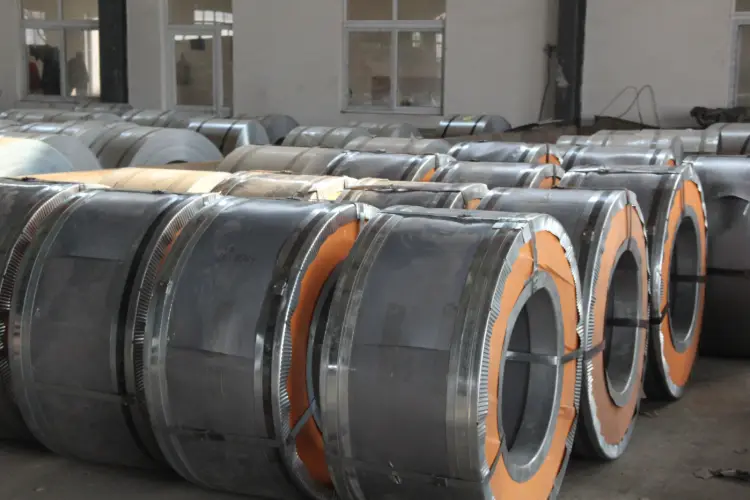
RINA D690 Shipbuilding Steel Coil
RINA D690 Shipbuilding Steel Coil - High Strength Quenched & Tempered Marine Steel with 690 MPa Yield
Comprehensive material data sheet for RINA D690 high strength shipbuilding steel coil: chemical composition, mechanical properties, thermal & electrical performance, international equivalents, and application guidance.
Hot rolling followed by quenching and tempering (Q&T); also available via TMCP plus tempering
- Phone : +8618037372205
- Email : [email protected]
- WhatsApp: Contact via Whtsapp
- WeChat: +8618037372205
RINA D690 Shipbuilding Steel Coil Introduction
RINA D690 is a high strength quenched and tempered steel for shipbuilding, classified under the Registro Italiano Navale (RINA) rules for hull structural materials. It belongs to the 'D' category with guaranteed impact toughness at -20°C, while delivering a minimum yield strength of 690 MPa. This grade is typically supplied in coil form and subsequently processed into plates, profiles, or built-up sections. The steel is designed for critical load-bearing components in marine environments, offering a balanced combination of elevated strength, good weldability, and low‑temperature notch toughness. Its chemical composition is carefully controlled to meet a carbon equivalent (CEV) limit, ensuring reliable weldability without excessive preheat. Mechanical properties, verified by tensile and Charpy V‑notch tests, are valid for thicknesses up to 100 mm. RINA D690 is the direct counterpart of IACS DH690 and is fully equivalent to the D690 grades issued by other major classification societies such as ABS, BV, DNV, and LR. The delivery condition is quenched and tempered (Q&T), although some producers may use a thermomechanically controlled process with tempering to achieve the specified mechanical properties. Typical applications include primary ship hull structures, offshore platform frames, heavy‑duty marine machinery supports, and other welded fabrications where strength and fracture resistance are paramount.
RINA D690 Shipbuilding Steel Coil Chemical Composition
The chemical composition of RINA D690 is tailored to achieve the required strength and toughness after quenching and tempering. Limits are given as ladle analysis for thicknesses up to 100 mm. The carbon equivalent (CEV) is controlled to ensure satisfactory weldability. All values are maximum unless a range or minimum is indicated.
- CEV = C + Mn/6 + (Cr+Mo+V)/5 + (Ni+Cu)/15
- PCM = C + Si/30 + (Mn+Cu+Cr)/20 + Ni/60 + Mo/15 + V/10 + 5B (optional value ≤ 0.28%)
| Chemical Element | Standard Value | Remarks |
|---|---|---|
| Carbon (C) | 0.20 max | 0.20 % |
| Silicon (Si) | 0.55 max | 0.55 % |
| Manganese (Mn) | 1.70 max | 1.70 % |
| Phosphorus (P) | 0.025 max | 0.025 % |
| Sulfur (S) | 0.025 max | 0.025 % |
| Chromium (Cr) | 0.80 max | 0.80 % |
| Nickel (Ni) | 2.00 max | 2.00 % |
| Molybdenum (Mo) | 0.70 max | 0.70 % |
| Copper (Cu) | 0.50 max | 0.50 % |
| Vanadium (V) | 0.10 max | 0.10 % |
| Titanium (Ti) | 0.05 max | 0.05 % |
| Niobium (Nb) | 0.05 max | 0.05 % |
| Aluminium (Alsol) | 0.015 min | Acid soluble, minimum for grain refinement |
| Nitrogen (N) | 0.020 max | 0.020 % |
| Boron (B) | 0.005 max | If added intentionally |
| CEV | 0.53 max | Carbon equivalent (IIW formula) |
RINA D690 Shipbuilding Steel Coil Thermal and Electrical Physical Properties
Physical data are not mandated by the RINA rule and are provided as typical values for quenched and tempered low‑alloy steel with yield strength around 690 MPa. Values are valid at room temperature unless otherwise noted. Slight variations may occur depending on the exact chemical composition and heat treatment.
| Property | Typical Value | Unit | Test Conditions / Remarks |
|---|---|---|---|
| Density (ρ) | 7850 | kg/m³ | At 20 °C |
| Elastic modulus (E) | 210 | GPa | Static tension, room temperature |
| Shear modulus (G) | 80 | GPa | Calculated from E and Poisson's ratio |
| Poisson's ratio (ν) | 0.3 | – | Typical for steel |
| Thermal expansion coefficient (α) | 12.0 | 10⁻⁶/K | Temperature range 20–100 °C |
| Thermal conductivity (λ) | 42 | W/(m·K) | At 20 °C |
| Specific heat capacity (c_p) | 460 | J/(kg·K) | At 20 °C |
| Electrical resistivity (ρ_e) | 0.25 | µΩ·m | At 20 °C |
RINA D690 Shipbuilding Steel Coil Mechanical Properties
Mechanical properties are determined on test pieces taken in the as‑delivered (quenched and tempered) condition. Specimen orientation is longitudinal. For plate and coil products the specified values apply up to a thickness of 100 mm. Charpy V‑notch impact test temperature: -20 °C (D‑grade). Bend tests are performed with mandrel diameter dependent on thickness.
| Property | Minimum Value | Unit | Test Conditions / Remarks |
|---|---|---|---|
| Yield Strength (ReH) | 690 | MPa | t ≤ 100 mm, transverse or longitudinal |
| Tensile Strength (Rm) | 770 – 940 | MPa | t ≤ 100 mm |
| Elongation after fracture (A) | 14 | % | L₀ = 5.65√S₀, longitudinal |
| Charpy impact energy (KV) at -20 °C | 69 (average) / 49 (single) | J | Longitudinal, standard V‑notch |
| Bend test (180°) | d = 3a (t ≤ 25 mm); d = 4a (25 < t ≤ 50 mm); d = 5a (50 < t ≤ 100 mm) | – | Mandrel diameter d, specimen thickness a |
RINA D690 Shipbuilding Steel Coil Fully Equivalent Standards and Replaceable Grades
| Country / Region | Standard | Grade | Remarks |
|---|---|---|---|
| International (IACS) | IACS UR W28 | DH690 | Same strength and impact class |
| USA | ABS Rules | DH690 | American Bureau of Shipping |
| France | BV Rules | DH690 | Bureau Veritas |
| China | CCS Rules | DH690 | China Classification Society |
| Norway/Germany | DNV Rules | DH690 | DNV (ex DNV GL) |
| UK | LR Rules | DH690 | Lloyd's Register |
| Japan | NK Rules | DH690 | ClassNK |
| Korea | KR Rules | DH690 | Korean Register |
| Italy | RINA Rules | D690 | RINA – the applied standard |
RINA D690 Shipbuilding Steel Coil Application Introduction
RINA D690 steel is utilized wherever high structural strength and resistance to brittle fracture at low temperatures are required. The grade's excellent weldability and consistent through‑thickness properties make it suitable for primary load‑carrying members in shipbuilding and offshore engineering. Common use areas and fabricated products include:
Product Applications: Ship hull plates (bottom, side, deck, bulkhead), Main frames, girders, stringers, and stiffeners, Casings, rudder horns, and stern frames, Offshore module support beams and braces, Crane pedestals and heavy‑duty lifting equipment, Mooring components and fairleads
Processed into products: Longitudinal and transverse frames, Hull plating up to 100 mm thickness, Reinforced stiffeners and brackets, Heavy‑wall tubular joints for offshore structures, Anchor flanges and thrust blocks, Bearing plates and load distribution pads
Application industries: Shipbuilding and ship repair (merchant vessels, naval ships, cruise liners), Offshore oil & gas (jack‑up rigs, semisubmersibles, FPSO hulls), Marine engineering (harbour structures, lock gates, dry docks), Bridge construction (especially moveable bridges and heavy traffic spans), Pressure vessel manufacturing (for low‑temperature service where notch toughness is critical), Wind energy (offshore wind turbine foundations, transition pieces)
RINA D690 Shipbuilding Steel Coil Similar Materials with Close Performance
| Country / Region | Standard | Grade | Remarks |
|---|---|---|---|
| EU | EN 10025-6 | S690Q | Yield ≥690 MPa, impact at -20 °C, but minimum KV 27 J vs 69 J for DH690 |
| USA | ASTM A514/A514M | Grade Q | Yield ≥690 MPa, quenched & tempered, non‑marine specification |
| Japan | JIS G 3128 | SHY685 | High yield strength steel for welded structures, similar strength level |
| China | GB/T 1591 | Q690D | High strength low alloy structural steel, impact -20 °C |
| Worldwide | API 2Y | Grade 60 | Offshore structural steel with 60 ksi (415 MPa) yield – lower strength but similar application area |
Notes:
RINA D690 must be ordered with the required impact test temperature confirmed (‑20 °C for D‑grade). Supplementary requirements such as ultrasonic testing (UT), through‑thickness tensile testing (Z35/Z25), or controlled fracture appearance transition temperature (FATT) can be agreed upon between buyer and manufacturer. Welding should follow approved procedures, with attention to heat input and preheat/interpass temperature control to preserve heat‑affected zone toughness. This steel is not typically supplied in the as‑rolled condition; the default delivery is quenched and tempered.
- Share



