
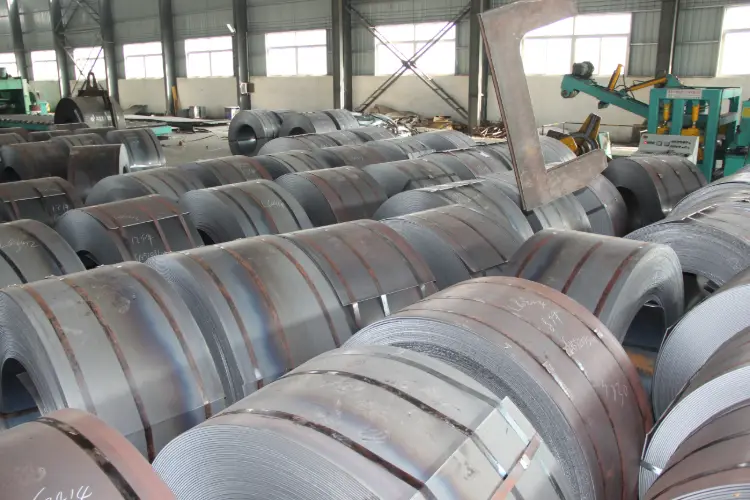
RINA A690 High-Strength Shipbuilding Steel Coil
RINA A690 High-Strength Shipbuilding Steel Coil - Ultra-High Yield Strength Marine Plate
Detailed technical data for RINA A690 (AH690) shipbuilding steel coil: chemical composition, mechanical and physical properties, international equivalents, and application insights for marine and offshore structures.
Cutting, bending, welding, machining, thermal cutting
- Phone : +8618037372205
- Email : [email protected]
- WhatsApp: Contact via Whtsapp
- WeChat: +8618037372205
RINA A690 High-Strength Shipbuilding Steel Coil Introduction
RINA A690 (typically referred to as AH690) is an ultra-high-strength shipbuilding steel grade certified by the Registro Italiano Navale (RINA). It is designed for critical structural applications in shipbuilding and offshore engineering where high yield strength and excellent weldability are required. This grade offers a minimum yield strength of 690 MPa in thicknesses up to 100 mm (depending on classification rules), combined with good notch toughness at 0 °C (A-grade impact test temperature). It is delivered in the normalized or quenched-and-tempered condition to achieve the required mechanical properties. Typical applications include decks, hulls, and heavy-lift crane structures in large container vessels, icebreakers, and offshore platforms. The steel exhibits low carbon equivalent (CEV) to ensure reliable weldability and avoids brittle fracture under dynamic loading. Key characteristics:
- Minimum yield strength 690 MPa
- Excellent low-temperature toughness (A-grade: 0 °C impact test)
- Good weldability with controlled CEV
- Normalized or quenched-and-tempered delivery condition
- Compliant with IACS UR W11 and RINA Rules for classification of ships
RINA A690 High-Strength Shipbuilding Steel Coil Chemical Composition for RINA A690
The chemical composition of A690 is formulated to achieve ultra-high strength while maintaining good weldability and toughness. Carbon content is limited to ≤0.20%, and microalloying elements such as Nb, V, Ti are added for grain refinement. Low sulphur and phosphorus ensure cleanliness. The Carbon Equivalent Value (CEV) is strictly controlled to ≤0.60% (typical) to avoid cold cracking.
- All values are in weight-%.
- Elements not listed may be residual from steelmaking; precise limits per RINA Rules.
| Chemical Element | Standard Value (max unless range) | Remarks |
|---|---|---|
| C (Carbon) | ≤ 0.20% | Ladle analysis; lower for better weldability |
| Si (Silicon) | 0.10 – 0.55% | Deoxidation requirement |
| Mn (Manganese) | 0.70 – 1.70% | High Mn for strength and hardenability |
| P (Phosphorus) | ≤ 0.025% | Low for toughness |
| S (Sulfur) | ≤ 0.025% | Low for through-thickness properties |
| Cr (Chromium) | ≤ 0.25% | Optional microalloying; may be higher if intentionally added |
| Ni (Nickel) | ≤ 0.40% | Residual; may be increased for toughness |
| Mo (Molybdenum) | ≤ 0.08% | Residual |
| Cu (Copper) | ≤ 0.35% | Residual; weather resistance |
| N (Nitrogen) | ≤ 0.012% | Controlled for grain refinement |
| Nb (Niobium) | ≤ 0.05% | Microalloy |
| V (Vanadium) | ≤ 0.10% | Precipitation hardening |
| Ti (Titanium) | ≤ 0.02% | Grain refinement |
| Al (Aluminium) | ≥ 0.015% (total) | Killing element |
| CEV (IIW) | Typically ≤ 0.60% | CEV = C+Mn/6+(Cr+Mo+V)/5+(Ni+Cu)/15 |
RINA A690 High-Strength Shipbuilding Steel Coil Thermal and Electrical Physical Properties
Physical properties are typical for quenched and tempered high-strength structural steels and can vary slightly with exact heat treatment and alloy content. Values are provided for general engineering calculations.
- Density based on standard steel composition.
- Thermal conductivity decreases with increasing alloy content.
- Electrical resistivity is typical for microalloyed steels.
| Property | Standard Value | Unit | Test Condition |
|---|---|---|---|
| Density (ρ) | ~7850 | kg/m³ | At 20 °C |
| Young's Modulus (E) | ~205 | GPa | At 20 °C, tension |
| Shear Modulus (G) | ~80 | GPa | Calculated |
| Poisson's Ratio (ν) | ~0.30 | – | Elastic range |
| Thermal Expansion Coefficient (α) | ~11.5 × 10⁻⁶ | K⁻¹ | Between 20 °C and 100 °C |
| Thermal Conductivity (λ) | ~42 – 45 | W/(m·K) | At 20 °C; slight decrease at higher temperatures |
| Specific Heat Capacity (cₚ) | ~480 – 500 | J/(kg·K) | At 20 °C |
| Electrical Resistivity (ρₑ) | ~0.20 – 0.25 | μΩ·m | At 20 °C |
RINA A690 High-Strength Shipbuilding Steel Coil Mechanical Properties – RINA A690/AH690
Mechanical properties are verified on test pieces taken from the final product condition (normalized or quenched+tempered). Values depend on thickness range. The table shows minimum requirements per RINA rules for thicknesses up to 100 mm. Impact energy tests are performed on Charpy V-notch specimens at 0 °C (grade A).
- Yield strength is the lower yield stress (ReH).
- Elongation measured on gauge length 5.65√S₀.
- Bend test mandrel diameter varies with thickness.
| Property | Standard Requirement Value | Unit | Test Condition / Thickness |
|---|---|---|---|
| Yield Strength (ReH) | ≥ 690 | MPa | t ≤ 100 mm; transverse or longitudinal |
| Tensile Strength (Rm) | 770 – 940 | MPa | t ≤ 100 mm |
| Elongation (A5) | ≥ 14 | % | Longitudinal, gauge 5.65√S₀ |
| Charpy Impact Energy (KV₂) | ≥ 69 (average) / 52 (single) | J | At 0 °C; longitudinal; -20 °C for D-grade option |
| Bend Test (180°) | D = 4a (t ≤ 16 mm); D = 5a (16 < t ≤ 25 mm); D = 6a (25 < t ≤ 40 mm); D = 7a (40 < t ≤ 63 mm) | – | Mandrel diameter (D) as function of specimen thickness (a); no cracks |
RINA A690 High-Strength Shipbuilding Steel Coil Fully Equivalent Material Standards and Substitutable Grades
| Country/Region | Standard | Grade | Remarks |
|---|---|---|---|
| International | IACS UR W11 | AH690 | Unified requirement for yield strength 690 MPa, impact 0°C |
| USA | ABS Rule | AH690 | American Bureau of Shipping |
| UK | LR Rule | AH690 | Lloyd's Register |
| Norway/Germany | DNV Rule | AH690 | Now DNV |
| France | BV Rule | AH690 | Bureau Veritas |
| China | CCS Rule | AH690 | China Classification Society |
| Japan | NK Rule | AH690 | ClassNK |
| South Korea | KR Rule | AH690 | Korean Register |
| India | IRS Rule | AH690 | Indian Register of Shipping |
| Croatia | CRS Rule | AH690 | Croatian Register |
| Italy (original) | RINA Rule | A690/AH690 | Registered as A690 or AH690 |
RINA A690 High-Strength Shipbuilding Steel Coil Application Introduction
RINA A690/AH690 steel coil and plate are primarily used in heavy-duty marine and offshore constructions where high strength-to-weight ratio is essential. They enable design of lighter structures with reduced welding volumes. The material is suitable for cold forming, bending, and welding under controlled heat input. Typical application areas and products:
Product Applications: Hull plates and stiffening sections for demanding areas (deck, bottom, sheer strake), Modular offshore accommodation units, Submarine pressure hull rings (with appropriate toughness), Ice belt structural laminates, Welded tubular joints and nodes
Processed into products: Bulk carrier top side tanks, Jack-up leg chords and bracings, Crane pedestal and boom plates, Transverse web frames of container ships, Fatigue-critical brackets and gussets
Application industries: Shipbuilding (large container ships, ice-class vessels, naval ships), Offshore oil & gas (jack-up rig legs, helideck structures, flare booms), Marine renewable energy (wind turbine foundations, subsea frames), Heavy lifting and transport (ship cranes, RoRo ramp sections), Railway and heavy machinery (where marine certification is required)
RINA A690 High-Strength Shipbuilding Steel Coil Similar / Alternative High-Strength Steels with Comparable Performance
| Country/Region | Standard | Grade | Remarks |
|---|---|---|---|
| International | EN 10025-6 | S690QL / S690QL1 | Quenched and tempered structural steel plate; yield 690 MPa, but not specifically marine-approved unless certified. |
| International | ASTM A514 | Grade B, H, F, Q (yield ~690 MPa) | High-strength quenched and tempered alloy steel; often used for offshore structures but requires marine certification. |
| International | API 2W / 2Y | Grade 60 (yield 60 ksi ≈ 414 MPa) | Not a direct replacement due to lower strength; offshore structural steel. |
| International | WELDOX 700 / Hardox 700 | Proprietary grade | High-strength branded steel with yield ≈ 700 MPa; may be accepted with marine society approval. |
| Russia | GOST 19281 | 10G2S1D (yield depends) | Not equivalent strength; needs case-by-case assessment. |
Notes:
- RINA A690 may also be supplied as D690 (impact at -20°C) and E690 (-40°C) according to the desired toughness.
- Welding consumables should be matched to achieve tensile strength of 770–940 MPa with hydrogen control; preheat temperature typically 100–175 °C depending on thickness and CEV.
- Post-weld heat treatment (PWHT) is generally not required for thicknesses below 50 mm, but should follow fabrication specification.
- All test certificates must be endorsed by RINA surveyor for final product acceptance.
- Coil form is often further processed by decoiling, cutting to length, or slitting; minimum order conditions may apply.
- Share



