
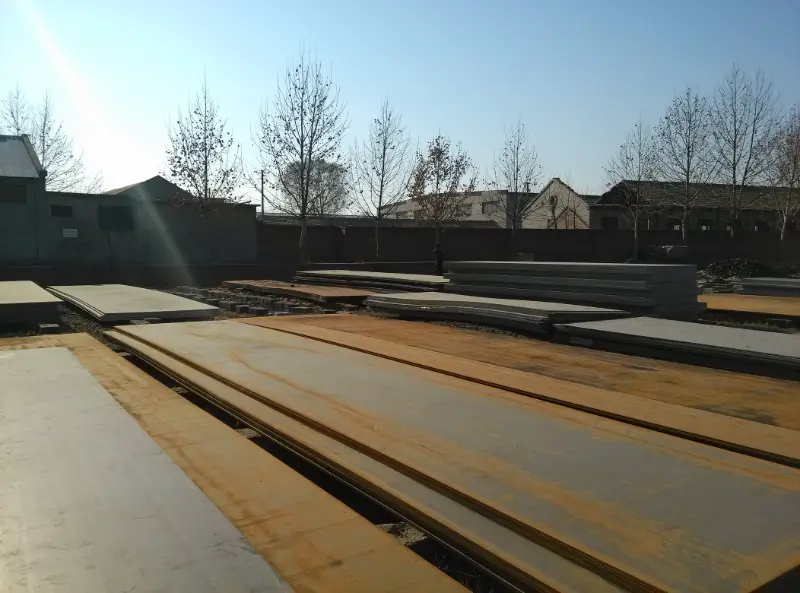
RINA F620 Shipbuilding Steel
RINA F620 Shipbuilding Steel: Comprehensive Data, Equivalents & Applications
In-depth technical profile of RINA F620 high-strength shipbuilding steel coil, including chemical composition, mechanical and thermo-physical properties, international equivalents, and application guide, complying with RINA standards.
Hot rolling, thermomechanical controlled processing (TMCP), quenching and tempering, cold forming, welding, cutting, machining.
- Phone : +8618037372205
- Email : [email protected]
- WhatsApp: Contact via Whtsapp
- WeChat: +8618037372205
RINA F620 Shipbuilding Steel Introduction
RINA F620 is a high-strength structural steel for shipbuilding, governed by the rules of the Registro Italiano Navale (RINA). As a Grade F620 steel with a specified minimum yield strength of 620 MPa, it belongs to the Extra High Strength group of shipbuilding steels. Key characteristics include excellent weldability, high impact toughness at low temperatures, and superior strength-to-weight ratio. This grade is designed for critical structural components in large vessels and offshore structures, enabling weight reduction without compromising structural integrity. Its delivery condition is typically thermomechanically rolled (TMCP) or quenched and tempered to achieve the required mechanical properties.
RINA F620 Shipbuilding Steel Chemical Composition
The chemical composition of RINA F620 steel is carefully controlled to achieve high strength and excellent weldability. The ladle analysis must comply with the specified limits. Microalloying elements such as niobium, vanadium, and titanium are added for grain refinement and precipitation strengthening. Carbon equivalent (Ceq) is strictly limited to ensure good field weldability without preheating, a critical requirement in shipbuilding.
| Chemical Element | Standard Value | Remarks |
|---|---|---|
| Carbon (C) | ≤ 0.20 | Ladle analysis |
| Manganese (Mn) | 0.70 - 1.70 | Ladle analysis |
| Silicon (Si) | 0.10 - 0.55 | Ladle analysis |
| Phosphorus (P) | ≤ 0.025 | Ladle analysis |
| Sulfur (S) | ≤ 0.025 | Ladle analysis |
| Nitrogen (N) | ≤ 0.020 | Ladle analysis |
| Aluminum (Al), acid-soluble | ≥ 0.020 | Minimum for fine grain practice |
| Niobium (Nb) | 0.02 - 0.05 | Microalloying element |
| Vanadium (V) | 0.05 - 0.10 | Microalloying element |
| Titanium (Ti) | ≤ 0.02 | Microalloying element |
| Copper (Cu) | ≤ 0.35 | Residual element |
| Chromium (Cr) | ≤ 0.20 | Residual element |
| Nickel (Ni) | ≤ 0.40 | Residual element |
| Molybdenum (Mo) | ≤ 0.08 | Residual element |
| Boron (B) | ≤ 0.0005 | Residual element |
RINA F620 Shipbuilding Steel Thermo-Physical & Electrical Properties
Thermo-physical properties are important for calculation of thermal expansion, heat transfer in structural fire design, and weld simulation. Values are typical for low-alloy structural steels of this class and may vary slightly depending on specific chemical composition and heat treatment. The data below are provided for general design guidance at room temperature unless otherwise noted.
| Property Item | Standard Required Value | Unit | Test Conditions |
|---|---|---|---|
| Density (ρ) | ~ 7850 | kg/m³ | At 20 °C |
| Modulus of Elasticity (E) | ~ 210 | GPa | At 20 °C |
| Shear Modulus (G) | ~ 80.8 | GPa | At 20 °C |
| Poisson's Ratio (ν) | ~ 0.3 | - | In elastic range |
| Thermal Expansion Coefficient (α) | ~ 11.8 x 10⁻⁶ | K⁻¹ | Between 20 °C and 100 °C |
| Thermal Expansion Coefficient (α) | ~ 12.8 x 10⁻⁶ | K⁻¹ | Between 20 °C and 200 °C |
| Thermal Expansion Coefficient (α) | ~ 13.8 x 10⁻⁶ | K⁻¹ | Between 20 °C and 300 °C |
| Thermal Conductivity (λ) | ~ 42.6 | W/(m·K) | At 20 °C |
| Thermal Conductivity (λ) | ~ 41.7 | W/(m·K) | At 100 °C |
| Thermal Conductivity (λ) | ~ 39.3 | W/(m·K) | At 200 °C |
| Specific Heat Capacity | ~ 461 | J/(kg·K) | At 20 °C |
| Electrical Resistivity (ρ_e) | ~ 2.5 x 10⁻⁷ | Ω·m | At 20 °C |
RINA F620 Shipbuilding Steel Mechanical Properties
The mechanical properties of RINA F620 are validated through tensile and impact testing on specimens taken from delivery condition. The minimum specified yield strength is 620 MPa, which dictates the design load of the structure. Charpy V-notch impact tests are conducted at -40 °C or -60 °C, designated as E or F grade suffix, to guarantee toughness in frigid environments. Bend testing confirms the steel's formability.
| Property Item | Standard Required Value | Unit | Test Conditions |
|---|---|---|---|
| Yield Strength (ReH) | ≥ 620 | MPa | Transverse, t ≤ 100 mm, TMCP or Q+T |
| Tensile Strength (Rm) | 720 - 890 | MPa | Transverse, t ≤ 100 mm |
| Elongation (A5) | ≥ 15 | % | Transverse, t ≤ 100 mm, gauge length L0 = 5.65√S0 |
| Bend Test (Bend Angle) | 180 | ° | Bend diameter = 3t (t: specimen thickness) |
| Impact Energy (KV2) at -60 °C, Transverse | ≥ 27 (Average), ≥ 20 (Individual) | J | Charpy V-notch, specimen 10x10 mm, F-grade |
| Impact Energy (KV2) at -40 °C, Transverse | ≥ 27 (Average), ≥ 20 (Individual) | J | Charpy V-notch, specimen 10x10 mm, E-grade equivalent |
RINA F620 Shipbuilding Steel Completely Equivalent Material Standards and Replaceable Designations
| Country/Region | Standard | Designation | Remarks |
|---|---|---|---|
| International | IACS UR W31 | F620 | International Association of Classification Societies unified requirement, basis for class rules. |
| Italy | RINA Rules | F620 | Original grade under discussion. |
| USA | ABS Rules | EQ620 | American Bureau of Shipping equivalent. |
| France | BV Rules | E620 | Bureau Veritas equivalent. |
| China | CCS Rules | E620 | China Classification Society equivalent. |
| Norway/Germany | DNV Rules | E620 | DNV GL (now DNV) equivalent. |
| UK | LR Rules | E620 | Lloyd's Register equivalent. |
| South Korea | KR Rules | RE620 | Korean Register equivalent. |
| Japan | NK Rules | KE620 | Nippon Kaiji Kyokai equivalent. |
RINA F620 Shipbuilding Steel Application Introduction
RINA F620 steel is strategically used in the construction of ships and offshore structures where maximum weight reduction combined with high structural integrity is paramount. Its high strength allows for thinner plate sections compared to lower grades (like FH36 or FH40), reducing overall vessel weight and increasing cargo capacity. The steel's excellent low-temperature toughness ensures reliable performance in cold climate operations. It is readily weldable using all common shipyard welding procedures, with attention to heat input control to preserve the TMCP properties.
Product Applications: Large Container Ship Deck and Longitudinal Strength Members, Bilge Strakes and Keels for High-Stress Zones, Offshore Jack-up Rig Chord and Bracing Members, Tubular Nodes and Jacket Legs for Fixed Platforms, Main Deck Plating for Heavy-Lift Crane Vessels
Processed into products: Hull plating, strakes, and panels, Longitudinal and transverse stiffeners and frames, Watertight and structural bulkheads, Rudder horns and stern frames, Deck crane pedestals and foundation plates, Brackets and complex welded assemblies
Application industries: Commercial Shipbuilding (Container Ships, Bulk Carriers, Tankers), Naval Shipbuilding (Surface Vessels), Offshore Oil & Gas (Jack-up rigs, Semisubmersibles, Platform topsides), Renewable Energy (Offshore wind turbine foundations, Jacket structures), Heavy Lifting and Transport (Crane booms, Heavy-duty barges)
RINA F620 Shipbuilding Steel Recommendations for Similar/Alternative Materials
| Country/Region | Standard | Designation | Remarks |
|---|---|---|---|
| Europe | EN 10025-6 | S690QL | Structural steel, quenched and tempered, with similar yield strength but different carbon equivalent and toughness requirements. Suitable for nautical and offshore construction if agreed by the classification society. |
| USA | ASTM A514 / A517 | Grade B, Q, or F | High-yield-strength, quenched and tempered alloy steel plate for structural and pressure vessel applications. Requires extra scrutiny for weldability specifications compared to F620. |
| USA | API 2W | Grade 60 | Steel plates for offshore structures, thermomechanically rolled, with a minimum yield strength of 414 MPa. Not a direct strength match but a common offshore steel in a lower class. |
| Europe | EN 10025-4 | S620M | Thermomechanically rolled structural steel with a minimum yield strength of 620 MPa. Similar mechanical properties but designed for non-marine structural applications. |
Notes:
Critical Consideration: Weldability Procedure Qualification. For RINA F620 steel, strict adherence to an approved welding procedure specification (WPS) is mandatory. The heat input and cooling rate must be controlled to prevent softening in the heat-affected zone (HAZ). Hydrogen-induced cold cracking (HICC) must be prevented by using low-hydrogen welding consumables and appropriate preheating, especially in thick sections. A post-weld heat treatment (PWHT) is typically not recommended for TMCP grades as it may degrade the mechanical properties of the base metal. Any engineering and procurement document should specify testing in accordance with the current RINA Material and Welding Rules.
- Share



