
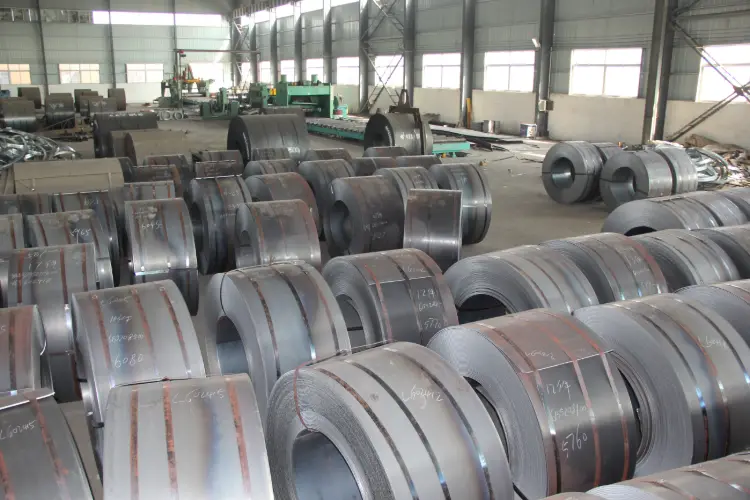
RINA E620 Shipbuilding Steel Coil
RINA E620 Shipbuilding Steel Coil - High-Strength Quenched & Tempered Marine Steel
Explore RINA E620 shipbuilding steel coil: a high-yield-strength 620 MPa grade for hull and offshore structures, certified by RINA and fully compliant with IACS UR W31. Data on chemical composition, mechanical properties, thermal and electrical characteristics, equivalent grades, and applications.
Hot rolling, quenching and tempering, welding, cutting, forming
- Phone : +8618037372205
- Email : [email protected]
- WhatsApp: Contact via Whtsapp
- WeChat: +8618037372205
RINA E620 Shipbuilding Steel Coil Introduction
RINA E620 shipbuilding steel coil is a high-strength quenched and tempered structural steel specifically designed for marine and offshore applications. Certified by Registro Italiano Navale (RINA) in accordance with IACS UR W31, this grade offers a minimum yield strength of 620 MPa, excellent toughness at temperatures down to -40°C, and good weldability. It belongs to the EH620 class under IACS unified requirements, making it suitable for heavily loaded ship hulls, decks, and critical structural components where weight reduction and high load-bearing capacity are essential. The steel is typically supplied in coil or plate form, with controlled chemical composition and fine grain practice to ensure uniform properties.
RINA E620 Shipbuilding Steel Coil Chemical Composition – Typical Range per IACS UR W31 for EH620
The chemical composition is designed to achieve the required high strength and low-temperature toughness after quenching and tempering. Values shown are typical limits according to IACS UR W31 (Rev.5, 2018) and RINA rules. Fine grain elements (Nb, V, Ti) are added individually or in combination to ensure grain refinement. Carbon equivalent (CEV) is normally controlled to ≤0.55 for improved weldability. Note: Actual values may be tightened by manufacturer's practices.
| Element | Standard Value (max % unless range) | Remarks |
|---|---|---|
| Carbon (C) | ≤ 0.20 | Max for strength and weldability |
| Silicon (Si) | 0.10 – 0.55 | Deoxidation element |
| Manganese (Mn) | 0.90 – 1.70 | Strengthening and deoxidation |
| Phosphorus (P) | ≤ 0.025 | Low for toughness |
| Sulfur (S) | ≤ 0.025 | Low to prevent hot cracking |
| Aluminum (Al, acid sol.) | ≥ 0.020 | Grain refinement |
| Nitrogen (N) | ≤ 0.020 | Controlled to avoid aging |
| Chromium (Cr) | ≤ 0.30 (residual) | May be added for hardenability |
| Copper (Cu) | ≤ 0.35 (residual) | Corrosion resistance aid |
| Molybdenum (Mo) | ≤ 0.10 (residual) | Optional hardenability element |
| Nickel (Ni) | ≤ 0.30 (residual) | Toughness improvement |
| Niobium (Nb) | ≤ 0.05 | Microalloy grain refiner |
| Vanadium (V) | ≤ 0.10 | Optional microalloy |
| Titanium (Ti) | ≤ 0.05 | Grain refinement / inclusion control |
| Carbon Equivalent (CEV) | ≤ 0.55 (typical) | CEV = C + Mn/6 + (Cr+Mo+V)/5 + (Ni+Cu)/15 |
RINA E620 Shipbuilding Steel Coil Thermal and Electrical Physical Properties
The physical properties listed are typical for quenched and tempered low-alloy steels with similar composition and strength level. They are not specific mandatory norms but represent engineering design data. Density is approximately 7.85 g/cm³; elastic modulus values are typical for structural steel. Thermal expansion, conductivity, and specific heat are given for a range of temperatures. Electrical resistivity is low, typical for carbon-manganese steels.
| Property | Standard Value (Typical) | Unit | Test Condition / Remarks |
|---|---|---|---|
| Density (ρ) | 7.85 | g/cm³ | Room temperature |
| Elastic Modulus (E) | 210 | GPa | Room temperature, tension |
| Shear Modulus (G) | 81 | GPa | Calculated from E and ν |
| Poisson's Ratio (ν) | 0.3 | – | Elastic range |
| Thermal Expansion Coeff. (α) | 11.5 – 13.0 | ×10⁻⁶ /K | 20 – 100°C |
| Thermal Expansion Coeff. (α) | 12.5 – 14.0 | ×10⁻⁶ /K | 20 – 400°C |
| Thermal Conductivity (λ) | ~ 42 | W/(m·K) | At 20°C |
| Thermal Conductivity (λ) | ~ 38 | W/(m·K) | At 200°C |
| Specific Heat Capacity | ~ 460 – 500 | J/(kg·K) | 20 – 200°C |
| Electrical Resistivity (ρₑ) | ~ 0.25 – 0.30 | µΩ·m | At 20°C |
RINA E620 Shipbuilding Steel Coil Mechanical Properties
Mechanical properties are verified by tensile and impact tests on specimens taken from the final heat-treated condition. Values are in accordance with IACS UR W31 for EH620 grade. Tensile strength range is 720–890 MPa, yield strength ≥620 MPa for thickness ≤50 mm (may be slightly reduced for thicker sections, refer to standard). Impact test temperature: -40°C (E grade). Average absorbed energy ≥27 J (longitudinal) for standard 10×10 mm specimen. Bending test is required with mandrel diameter = 3a for thickness ≤20 mm.
| Property | Standard Requirement | Unit | Test Condition / Thickness |
|---|---|---|---|
| Yield Strength (ReH) | ≥ 620 | MPa | t ≤ 50 mm (transverse) |
| Yield Strength (ReH) | ≥ 580 | MPa | 50 < t ≤ 100 mm (transverse) |
| Tensile Strength (Rm) | 720 – 890 | MPa | t ≤ 100 mm |
| Elongation (A) | ≥ 15 | % | Gauge length 5.65√So, transverse |
| Bend Test (Mandrel Diameter) | 3a (no cracks) | – | t ≤ 20 mm; bending angle 180° |
| Bend Test (Mandrel Diameter) | 4a (no cracks) | – | 20 < t ≤ 30 mm |
| Impact Energy (KV, longitudinal) | ≥ 27 (avg, single min 19) | J | -40°C, 10×10 mm specimen, t ≤ 50 mm |
| Impact Energy (KV, transverse) | ≥ 18 (avg, single min 13) | J | -40°C, 10×10 mm specimen (when required by specification) |
RINA E620 Shipbuilding Steel Coil Fully Equivalent Material Standards and Replaceable Grades
| Country / Region | Standard / Specification | Grade | Remarks |
|---|---|---|---|
| International (IACS) | IACS UR W31 | EH620 | Uniform requirement for high-strength Q&T hull structural steel |
| Italy (RINA) | RINA Rules Part D, Ch.3 | E620 | Original designation; identical to EH620 |
| USA (ABS) | ABS Rules, Part 2, Ch.1 | EH620 | American Bureau of Shipping equivalent |
| Norway (DNV) | DNV Rules Pt.2 Ch.2 | EH620 | Det Norske Veritas classification |
| UK (LR) | Lloyd's Register Rules | EH620 | Marine & offshore structural steel |
| France (BV) | Bureau Veritas Rules NR216 | EH620 | High-strength hull steel |
| China (CCS) | CCS Rules Part 1, Ch.3 | EH620 | China Classification Society; identical to IACS |
| Japan (NK) | ClassNK Rules Part K | EH620 | Nippon Kaiji Kyokai |
| Europe (EN) | EN 10025-6 | S620Q (with impact test at -40°C, Option 1) | Quenched and tempered structural steel; close in chemistry and properties, may require additional agreement on toughness |
RINA E620 Shipbuilding Steel Coil Application Introduction
RINA E620 steel coil is engineered for demanding marine and offshore structures where high strength, excellent low-temperature toughness, and good weldability are required. Its 620 MPa minimum yield strength allows down-gauging and weight savings in large welded assemblies. It is best processed by modern welding techniques with appropriate preheat and heat input control.
Product Applications: Hull plating and stiffeners for high-stress areas, Deck sections and hatch coamings, Legs and rack chocks for self-elevating platforms, Heavy-duty crane booms and pedestals, Pressure vessels for marine service (with supplementary requirements), Subsea structural components
Processed into products: Transverse frames and longitudinal girders, Upper deck stringers, Rudder horns and skeg structures, Welded tubular joints for offshore frames, Pinions, gears, and wear plates (when flame cut and machined), Bearing housings and support brackets
Application industries: Shipbuilding (merchant ships, naval vessels), Offshore oil & gas platforms (jack-ups, semi-submersibles), Marine crane and lifting equipment, Heavy structural engineering (bridges, mining equipment), Renewable energy (wind turbine foundations at sea)
RINA E620 Shipbuilding Steel Coil Similar / Alternative High-Strength Steels
| Country / Region | Standard | Grade | Remarks |
|---|---|---|---|
| International (IACS) | IACS UR W31 | EH690 | Higher strength (690 MPa yield), same -40°C; suitable for heavier loads but with slightly different welding parameters |
| Europe (EN) | EN 10025-6 | S690Q | 690 MPa yield Q&T steel; widely used in offshore and heavy construction |
| USA (ASTM) | ASTM A514 / A517 | Grade Q | 690 MPa yield, quenched & tempered; over 620 MPa but shares similar processing |
| International (IACS) | IACS UR W31 | EH550 | 550 MPa yield, still high-strength; may be considered if lower strength is acceptable |
| Japan (JIS) | JIS G 3128 | SHY 685 (old type) | 685 MPa yield; sometimes referenced in similar applications |
| API | API Spec 2Y | Grade 60 (620 MPa) | Steel for offshore structures with comparable yield strength |
Notes:
Welding: RINA E620 steel requires low-hydrogen welding processes and controlled heat input to avoid cold cracking. Preheat and interpass temperatures typically 100–150°C depending on thickness. Post-weld heat treatment is generally not required but may be applied for stress relief. Certification: Material is supplied with RINA inspection certificate 3.1 or 3.2 according to EN 10204.
Additional testing: Ultrasonic examination, Z-direction through-thickness tensile (for lamellar tearing resistance), and fracture toughness (CTOD) tests can be arranged upon customer request. All properties listed are typical reference values based on IACS UR W31 and general industry practice; specific values should be confirmed against the actual mill test certificate.
- Share



