
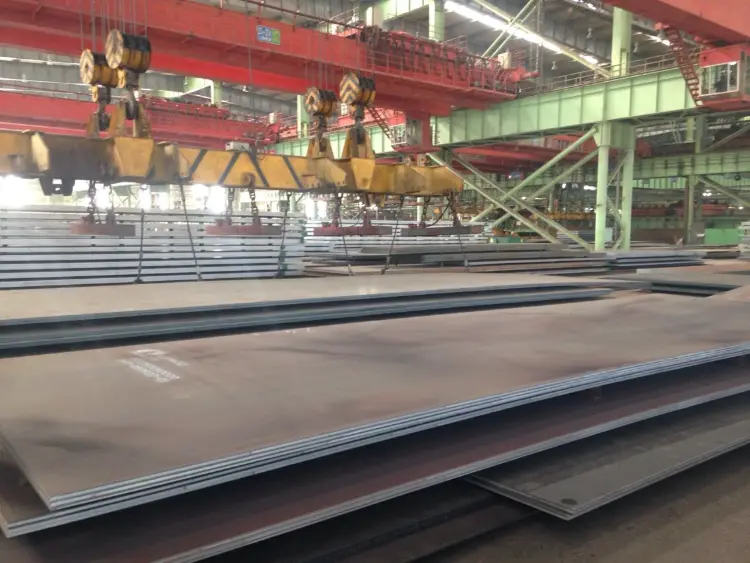
Austenitic 347H (S34709) Stainless Steel Plate & Coil
Austenitic 347H (S34709) Stainless Steel Plate & Coil - High-Carbon Nb-Stabilized Grade for Elevated Temperatures
Comprehensive technical data for 347H (UNS S34709) stainless steel plate/coil: chemical composition, mechanical properties, physical performance, and international equivalents.
Hot rolling, cold rolling, solution annealing, pickling; suitable for welding, machining, and forming
- Phone : +8618037372205
- Email : [email protected]
- WhatsApp: Contact via Whtsapp
- WeChat: +8618037372205
Austenitic 347H Stainless Steel Plate & Coil Introduction
UNS S34709 (347H) is a high-carbon, niobium-stabilized austenitic stainless steel intended for elevated-temperature service. The higher carbon content (0.04–0.10%) improves creep and stress-rupture properties compared to the standard 347 grade, while the addition of niobium prevents intergranular corrosion and sensitization during welding or high-temperature exposure. The alloy combines excellent oxidation resistance up to 816°C (1500°F) with good mechanical strength and fabricability. It is widely supplied as plate, sheet, and coil in accordance with ASTM A240/A240M and ASME SA-240, and is typically delivered in the solution-annealed condition.
Austenitic 347H Stainless Steel Plate & Coil Chemical Composition
Chemical requirements as specified in ASTM A240/A240M for UNS S34709 (347H). Niobium is added as a stabilizing element to tie up carbon and prevent chromium carbide precipitation, thereby maintaining corrosion resistance in welded structures. The carbon range is intentionally higher than that of 347 to enhance high-temperature strength.
| Element | Standard Value (%) | Remarks |
|---|---|---|
| Carbon (C) | 0.04 – 0.10 | Higher than 347 for improved creep strength |
| Manganese (Mn) | ≤ 2.00 | |
| Phosphorus (P) | ≤ 0.045 | |
| Sulfur (S) | ≤ 0.030 | |
| Silicon (Si) | ≤ 0.75 | |
| Chromium (Cr) | 17.0 – 19.0 | Primary element for oxidation resistance |
| Nickel (Ni) | 9.0 – 13.0 | Stabilizes austenitic structure |
| Niobium (Nb) + Tantalum (Ta) | ≥ 10×C up to 1.00 | Stabilization against intergranular attack |
Austenitic 347H Stainless Steel Plate & Coil Thermal & Electrical Physical Properties
Representative physical data for 347/347H stainless steel in the annealed condition. Values are typical and may vary depending on exact composition and processing. Thermal expansion is given for several temperature ranges; thermal conductivity decreases with increasing temperature.
| Property | Standard Value | Unit | Test Condition |
|---|---|---|---|
| Density (ρ) | 8.0 | g/cm³ | 20°C |
| Elastic Modulus (E) | 193 | GPa | 20°C |
| Shear Modulus (G) | 77 | GPa | 20°C |
| Poisson's Ratio (ν) | 0.27 – 0.30 | - | Typical for austenitic stainless |
| Thermal Expansion Coeff. (α) | 17.2 | µm/m·°C | 20 – 100°C |
| Thermal Expansion Coeff. (α) | 17.8 | µm/m·°C | 20 – 300°C |
| Thermal Expansion Coeff. (α) | 18.4 | µm/m·°C | 20 – 500°C |
| Thermal Expansion Coeff. (α) | 19.3 | µm/m·°C | 20 – 700°C |
| Thermal Conductivity (λ) | 16.2 | W/m·K | 100°C |
| Thermal Conductivity (λ) | 21.5 | W/m·K | 500°C |
| Specific Heat Capacity (cₚ) | 500 | J/kg·K | 20°C |
| Electrical Resistivity (ρₑ) | 0.72 | µΩ·m | 20°C |
Austenitic 347H Stainless Steel Plate & Coil Mechanical Properties
Minimum tensile requirements for solution-annealed plate per ASTM A240/A240M. Actual properties depend on thickness and processing. Yield strength is determined by the 0.2% offset method. For plate, elongation is typically measured on a 2 in. (50 mm) gauge length. Typical hardness values are provided for reference; they are not mandatory in the standard.
| Property | Required Value | Unit | Test Condition |
|---|---|---|---|
| Tensile Strength (Rm) | ≥ 515 | MPa | Room temperature, solution annealed |
| Yield Strength (ReH, 0.2%) | ≥ 205 | MPa | Room temperature, solution annealed |
| Elongation (A) | ≥ 40 | % | Gauge length 50 mm (2 in.), plate ≤ 19.1 mm thick |
| Hardness (Brinell) | ≤ 201 | HBW | Typical – not mandatory in ASTM A240 |
| Hardness (Rockwell B) | ≤ 92 | HRB | Typical – not mandatory in ASTM A240 |
Austenitic 347H Stainless Steel Plate & Coil Fully Equivalent Material Standards and Substitute Grades
| Country/Region | Standard | Grade | Remarks |
|---|---|---|---|
| USA | ASTM A240/A240M | 347H (UNS S34709) | Original specification |
| USA | ASME SA-240 | 347H (UNS S34709) | For pressure vessel applications |
| China | GB/T 4237 | 07Cr19Ni11Nb | High‑carbon Nb‑stabilized grade, equivalent carbon range |
| China | GB/T 4238 | 07Cr19Ni11Nb | Heat‑resistant steel plate, strip |
Austenitic 347H Stainless Steel Plate & Coil Application Introduction
347H is specifically designed for high-temperature service where enhanced creep and stress-rupture properties are needed, combined with weld fabrication without post-weld heat treatment. Industries that demand long-term exposure to elevated temperatures, oxidative environments, and resistance to intergranular corrosion benefit from this alloy.
Product Applications: Welded and seamless tubes for high‑temperature service, Pressure vessel plates and heads, Expansion joints and bellows, Hot‑worked flanges and fittings, Furnace mesh belts and conveyors
Processed into products: Superheater and reheater tubing, Boiler drums and shells, Heat exchanger plates and tube sheets, Catalyst support grids, Thermal oxidizer internals, Jet engine tail cones and liners
Application industries: Petrochemical and chemical processing (heat exchangers, reactors, piping), Power generation (boilers, superheaters, reheaters, steam headers), Aerospace (exhaust systems, afterburner components), Oil & gas (high‑temperature wellhead equipment, flare tips), Industrial furnace manufacturing (radiant tubes, muffles, retorts)
Austenitic 347H Stainless Steel Plate & Coil Similar/Closely Related Substitute Materials
| Country/Region | Standard | Grade | Remarks |
|---|---|---|---|
| USA | ASTM A240/A240M | 347 (UNS S34700) | Lower carbon (≤0.08%); lower creep strength; otherwise very similar |
| EU | EN 10088-2 / EN 10028-7 | 1.4550 (X6CrNiNb18-10) | C ≤0.08%; Nb‑stabilized; not intentionally high‑carbon |
| Japan | JIS G4304 / G4305 | SUS347 | Typical C ≤0.08%; otherwise comparable to 347 |
| China | GB/T 4237 | 06Cr18Ni11Nb | C ≤0.08%; replace for lower‑temperature service |
| International | ISO 15510 | X6CrNiNb18‑10 | Broadly equivalent to 1.4550 / 347 |
Notes:
The alloy is non‑magnetic in the annealed condition but may become slightly magnetic after cold working. For optimal corrosion resistance, solution annealing after forming is recommended. The niobium stabilization allows the steel to be used in the 'as‑welded' condition without the risk of intergranular attack, even in thick sections. Care should be taken to avoid sigma‑phase embrittlement during prolonged exposure in the 540–900°C range.
- Share



