
Austenitic Stainless Steel 348 (UNS S34800)
S34800 Austenitic Stainless Steel: Nuclear-Grade Plate/Coil with Co & Ta Control
Full material data sheet for UNS S34800 austenitic stainless steel plate/coil: composition, mechanical and physical properties, international equivalents, and nuclear application guidance per ASTM A240.
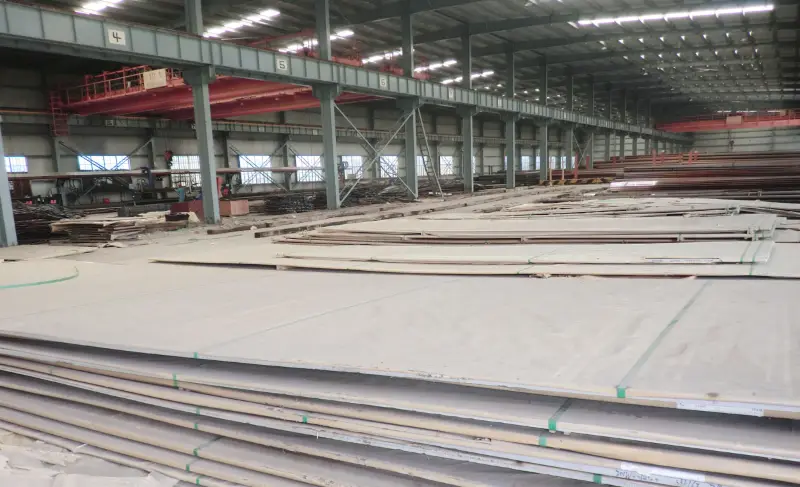
Hot rolling, cold rolling, solution annealing, pickling, descaling, cutting, leveling
- Phone : +8618037372205
- Email : [email protected]
- WhatsApp: Contact via Whtsapp
- WeChat: +8618037372205
Austenitic Stainless Steel 348 Introduction
UNS S34800 (Grade 348) is a niobium-stabilized austenitic stainless steel derived from 347 but with strict additional limits on cobalt (≤0.20%) and tantalum (≤0.10%). These restrictions minimize the formation of long-lived radioactive isotopes (Co-60, Ta-182) under neutron irradiation, making it the preferred material for nuclear reactor internals and fuel handling components. Like 347, the niobium addition provides excellent resistance to intergranular corrosion after welding or slow cooling. The alloy offers good high-temperature strength and oxidation resistance up to about 800°C. It is typically supplied as plate, sheet, or coil in the solution-annealed condition, combining high ductility with moderate strength. S34800 is non-magnetic in the annealed state and cannot be hardened by heat treatment.
Austenitic Stainless Steel 348 Chemical Composition
The composition of S34800 is identical to 347 except for the intentional limits on cobalt and tantalum. These trace elements are restricted to meet the stringent nuclear industry requirements for low neutron activation. Niobium (plus tantalum) stabilizes carbon and prevents chromium carbide precipitation at grain boundaries, ensuring resistance to sensitization.
| Element | Content (%) | Remarks |
|---|---|---|
| Carbon (C) | ≤ 0.08 | |
| Manganese (Mn) | ≤ 2.00 | |
| Phosphorus (P) | ≤ 0.045 | |
| Sulfur (S) | ≤ 0.030 | |
| Silicon (Si) | ≤ 1.00 | |
| Chromium (Cr) | 17.00 – 19.00 | |
| Nickel (Ni) | 9.00 – 13.00 | |
| Niobium (Nb) + Tantalum (Ta) | ≥ 10 × %C and ≤ 1.10 | Combined Nb+Ta |
| Cobalt (Co) | ≤ 0.20 | Nuclear restriction |
| Tantalum (Ta) | ≤ 0.10 | Separate limit |
Austenitic Stainless Steel 348 Thermal and Electrical Physical Properties
Physical properties are representative for 18Cr-10Ni austenitic stainless steels of similar composition. Slight variations may occur depending on exact chemistry and processing. Data are taken from published literature for stabilized grades and are suitable for engineering calculations.
| Property | Value | Unit | Condition / Temperature |
|---|---|---|---|
| Density (ρ) | 8.0 | g/cm³ | 20°C |
| Elastic Modulus (E) | 193 | GPa | 20°C |
| Shear Modulus (G) | 78 | GPa | 20°C |
| Poisson's Ratio (ν) | 0.28 | — | 20°C |
| Thermal Expansion Coefficient (α) | 16.6 | 10⁻⁶/K | 20–100°C |
| Thermal Expansion Coefficient (α) | 17.2 | 10⁻⁶/K | 20–200°C |
| Thermal Expansion Coefficient (α) | 17.8 | 10⁻⁶/K | 20–300°C |
| Thermal Conductivity (λ) | 14.8 | W/m·K | at 100°C |
| Thermal Conductivity (λ) | 16.2 | W/m·K | at 300°C |
| Thermal Conductivity (λ) | 20.0 | W/m·K | at 500°C |
| Specific Heat Capacity (cp) | 500 | J/kg·K | 20°C |
| Electrical Resistivity (ρe) | 720 | nΩ·m | 20°C |
Austenitic Stainless Steel 348 Mechanical Properties
Values per ASTM A240 for solution-annealed plate/coil at room temperature. Ductility requirements vary with product thickness. The material exhibits typical austenitic stainless steel behavior with high elongation and moderate yield strength. Hardness is not a standard requirement but typical values are provided.
| Property | Value | Unit | Test Condition |
|---|---|---|---|
| Tensile Strength (Rm) | ≥ 515 | MPa | Room temperature, annealed |
| Yield Strength (ReH, 0.2% offset) | ≥ 205 | MPa | Room temperature, annealed |
| Elongation A (50 mm gauge) | ≥ 40 | % | Thickness ≤ 19.0 mm (0.75 in) |
| Elongation A (50 mm gauge) | ≥ 30 | % | Thickness > 19.0 to 38.1 mm (0.75–1.5 in) |
| Typical Hardness | ≤ 92 HRB / ≤ 201 HBW | — | Annealed, for reference |
Austenitic Stainless Steel 348 Fully Equivalent Standards and Replacement Grades
Only specifications that include the mandatory cobalt and tantalum limits qualify as fully equivalent. No direct EN or JIS grades meet this criterion without supplementary requirements.
| Country/Region | Standard | Grade | Remarks |
|---|---|---|---|
| USA | ASTM A240/A240M | UNS S34800 | Plate, sheet, strip; nuclear-grade with Co and Ta limits |
| USA | ASME SA-240 | Grade 348 | Pressure vessel applications, identical chemistry |
| USA | UNS | S34800 | Unified numbering system designation |
Austenitic Stainless Steel 348 Application Introduction
S34800 is engineered for environments where both corrosion resistance and minimal neutron activation are required. Its specialized composition makes it the material of choice for nuclear service; it is also used in other high-integrity chemical plants where trace cobalt must be restricted to avoid contamination.
Product Applications: Reactor core support structures and vessel internals, Fuel element guide tubes and spacer grids, Heat exchanger tubing and tube sheets, Flanges, gaskets, and bolting for critical service, Retorts, muffles, and furnace parts
Processed into products: Bolts, nuts, studs, and washers for nuclear pressure boundaries, Valve bodies and trim, Pipe fittings and welded connections, Spent fuel storage racks and baskets, Instrument tubing and thermowells
Application industries: Nuclear power generation (PWR, BWR internals), Spent nuclear fuel storage and transportation, Radiochemical processing and reprocessing plants, Petrochemical and chemical plants with special clean-services requirements, Industrial heat treatment equipment
Austenitic Stainless Steel 348 Similar or Alternative Grades for Less Stringent Applications
These grades share niobium (or titanium) stabilization but lack the nuclear-specific Co/Ta restrictions. They are suitable for general corrosion- and heat-resistant applications where activation is not a concern.
| Country/Region | Standard | Grade | Remarks |
|---|---|---|---|
| USA | ASTM A240/A240M | 347 (S34700) | Nb-stabilized; no Co/Ta limits; general chemical and high-temp service |
| USA | ASTM A240/A240M | 321 (S32100) | Ti-stabilized; alternative for intergranular corrosion resistance but not preferred for nuclear |
| Europe | EN 10088-2/3 | 1.4550 (X6CrNiNb18-10) | Nb-stabilized equivalent to 347; Co/Ta not controlled |
| Japan | JIS G4304 | SUS347 | Corresponds to 347; same limitations as above |
| USA | ASTM A240/A240M | 304L (S30403) | Low carbon alternative but may sensitize after prolonged heating; not nuclear-grade |
Notes:
- Heat treatment: solution anneal at ≥1040°C followed by rapid cooling to preserve the fully austenitic structure.
- Welding: readily weldable by all common processes (GTAW, GMAW, SMAW, SAW) using matching or 347 filler metals; no post-weld heat treatment is generally required for corrosion resistance, but nuclear codes may mandate qualification.
- Trace elements: strictly control Co and Ta during melting; certified mill test reports must verify these limits.
- Availability: typically supplied as plate, sheet, coil, and also forged products under ASTM A182 (Grade F348) and fittings under ASTM A403 (WP348).
- Share



