
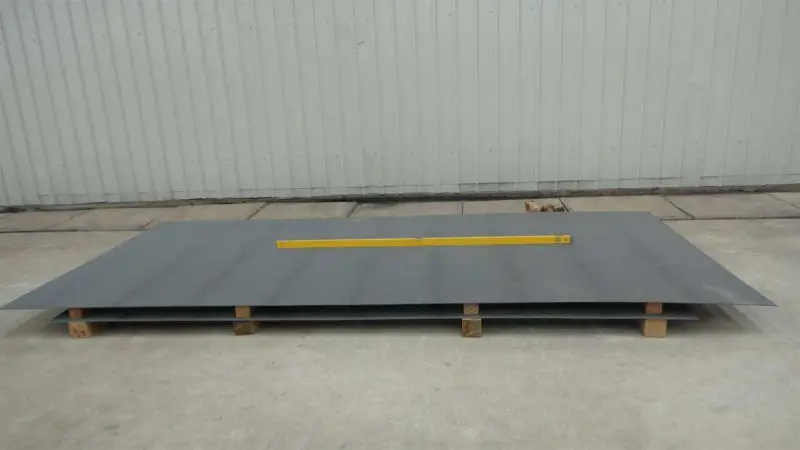
348H (S34809) Austenitic Stainless Steel
Austenitic 348H (S304809) Stainless Steel: High-Temperature Oxidation Resistant Plate & Coil
Explore the properties, chemical composition, mechanical and physical data of 348H (UNS S304809) austenitic stainless steel, specifically designed for high-temperature and nuclear applications. Typical delivery as plate and coil meeting ASTM A240/A240M.
Hot rolling, cold rolling, annealing, pickling, welding, forming, machining
- Phone : +8618037372205
- Email : [email protected]
- WhatsApp: Contact via Whtsapp
- WeChat: +8618037372205
348H Austenitic Stainless Steel Introduction
Austenitic 348H stainless steel, designated UNS S304809, is a niobium-tantalum stabilized version of 304H with controlled cobalt content (max 0.20%). It offers excellent resistance to intergranular corrosion, high creep strength, and oxidation resistance at elevated temperatures up to 800°C (1472°F). The niobium addition prevents chromium carbide precipitation, making it suitable for welding and stress relief without sensitization. Its low cobalt content makes it indispensable for nuclear reactor applications. Typical product forms include hot-rolled plate and coil in accordance with ASTM A240/A240M. The alloy combines good formability and weldability with a minimum tensile strength of 515 MPa and a yield strength of 205 MPa in annealed condition.
348H Austenitic Stainless Steel Chemical Composition
The chemical composition of 348H is tailored to ensure high creep strength and intergranular corrosion resistance. The niobium and tantalum addition stabilizes carbon, preventing chromium carbide formation. The strict cobalt limit (≤0.20%) qualifies the steel for nuclear applications where activation products must be minimized. All values are weight percent as per ASTM A240/A240M.
| Element | Composition (wt%) | Remarks |
|---|---|---|
| Carbon (C) | 0.04 - 0.10 | Key for high-temperature strength |
| Manganese (Mn) | ≤ 2.00 | |
| Silicon (Si) | ≤ 1.00 | |
| Phosphorus (P) | ≤ 0.045 | |
| Sulfur (S) | ≤ 0.030 | |
| Chromium (Cr) | 17.0 - 19.0 | Provides oxidation resistance |
| Nickel (Ni) | 9.0 - 13.0 | Austenite stabilizer |
| Niobium + Tantalum (Nb+Ta) | (10 × C) - 1.10 | Carbon stabilization; typical Nb 0.40-0.80 |
| Cobalt (Co) | ≤ 0.20 | Restricted for nuclear applications |
| Iron (Fe) | Balance | Remainder |
348H Austenitic Stainless Steel Thermal and Electrical Physical Properties
Physical properties are typical values for annealed 348H stainless steel. These properties are essential for thermal and structural design, especially in nuclear and high-temperature applications. The low thermal conductivity and relatively high thermal expansion must be accounted for in welding and operation. Data compiled from ASM Handbook and supplier datasheets for similar 347-type alloys.
| Property | Value | Unit | Test Condition / Temperature |
|---|---|---|---|
| Density (ρ) | 8.0 | g/cm³ | Room temperature |
| Modulus of Elasticity (E) | 193 | GPa | Room temperature |
| Shear Modulus (G) | 77 | GPa | Calculated, room temperature |
| Poisson's Ratio (ν) | 0.29 | — | Room temperature |
| Thermal Expansion Coefficient (α) | 16.5 | 10⁻⁶/K | 20–100 °C |
| Thermal Expansion Coefficient (α) | 17.5 | 10⁻⁶/K | 20–500 °C |
| Thermal Expansion Coefficient (α) | 18.5 | 10⁻⁶/K | 20–800 °C |
| Thermal Conductivity (λ) | 15.0 | W/(m·K) | 20 °C |
| Thermal Conductivity (λ) | 18.5 | W/(m·K) | 200 °C |
| Thermal Conductivity (λ) | 22.0 | W/(m·K) | 500 °C |
| Specific Heat Capacity | 500 | J/(kg·K) | 0–100 °C |
| Electrical Resistivity (ρ_e) | 0.70 | µΩ·m | 20 °C |
348H Austenitic Stainless Steel Mechanical Properties
Mechanical properties are determined on annealed material at room temperature. The values represent the minimum required per ASTM A240/A240M. Elevated temperature properties show that 348H retains strength well up to 650°C. The high elongation and formability allow deep drawing and bending operations. Hardness and bend test requirement are included for material acceptance.
| Property | Value | Unit | Test Condition |
|---|---|---|---|
| Tensile Strength (Rm) | ≥ 515 | MPa | Room temperature, transverse specimen |
| Yield Strength (Rp0.2) | ≥ 205 | MPa | Room temperature, 0.2% offset |
| Elongation (A) | ≥ 40 | % | Gauge length 2 in. (50 mm) for thickness ≤ 9.53 mm |
| Elongation (A) | ≥ 40 | % | Gauge length 2 in. (50 mm) for thickness 9.53–19.05 mm |
| Elongation (A) | ≥ 35 | % | Gauge length 2 in. (50 mm) for thickness 19.05–31.75 mm |
| Elongation (A) | ≥ 30 | % | Gauge length 2 in. (50 mm) for thickness > 31.75 mm |
| Brinell Hardness | ≤ 201 | HBW | As annealed, typical range 150-190 |
| Rockwell B Hardness | ≤ 92 | HRB | As annealed |
| Bend Test (180°) | No cracks | Mandrel diameter = 1 × specimen thickness |
348H Austenitic Stainless Steel Direct Equivalent Standards and Grades
| Country/Region | Standard | Grade | Remarks |
|---|---|---|---|
| United States | ASTM A240/A240M, ASME SA240 | 348H (UNS S304809) | Original grade with Co ≤ 0.20% |
| International | ISO 15510 | X6CrNiNb18-11 (approximate) | Not specifically high carbon or Co limited |
348H Austenitic Stainless Steel Application Introduction
348H stainless steel is specifically engineered for applications where high-temperature strength and resistance to intergranular corrosion are critical, with additional requirement of low cobalt for nuclear safety. It is widely used in nuclear reactor core internals, chemical process equipment, and power generation components. The alloy performs well in oxidizing and moderately corrosive environments up to 800°C. Typical applications and components include:
Product Applications: Reactor Pressure Vessel Internals (baffles, formers, core support structures), Heat Exchanger Tubes and Tube Sheets, Superheater and Reheater Tubing, High-Temperature Piping Systems, Furnace Belts, Retorts, and Muffles, Steam Turbine Casings and Components, Expansion Joints and Bellows
Processed into products: Bolting, Studs, and Nuts for High-Temperature Service, Welded Pressure Vessel Shells and Heads, Flanges, Fittings, and Couplings, Thermowell Protection Tubes, Baffle Plates and Flow Guides, Thermal Insulation Jackets, Cryogenic Pressure Vessel Components (when low Cobalt is needed)
Application industries: Nuclear Power Generation, Chemical and Petrochemical Processing, Oil Refining, Conventional Power Plants (superheaters, reheaters), Aerospace (high-temperature fasteners, jet engine parts), Heat Treatment and Furnace Manufacturing
348H Austenitic Stainless Steel Similar / Alternative Materials
| Country/Region | Standard | Grade | Remarks |
|---|---|---|---|
| United States | ASTM A240 | 347H (UNS S34709) | Nb+Ta stabilized, no Co limit; equivalent for non-nuclear use |
| United States | ASTM A240 | 321H (UNS S32109) | Ti stabilized, similar high-temp strength, no Co limit |
| Europe | EN 10028-7 | 1.4912 (X6CrNiNb18-12) | Nb stabilized, C 0.04-0.10, Ni 12-15; close match but Co not restricted |
| China | GB/T 4237 | 06Cr18Ni11Nb (S34778) | Nb stabilized, max C 0.08; lower carbon, may require downgrading for H applications |
| Japan | JIS G4304 | SUS 347 | Nb stabilized, not high carbon; requires H grade for creep strength |
Notes:
348H is often supplied in the solution-annealed condition (minimum 1100°C / 2000°F followed by water quench or rapid cool). For optimal intergranular corrosion resistance, pickling and passivation after fabrication is recommended. The controlled cobalt content requires special melt practices and certification; mill test reports typically include Co analysis. Welding consumables should be matched or over-alloyed with Nb+Ta, typically AWS E347-15 or ER347 with controlled Co. When in service above 540°C, the material is subject to sigma phase embrittlement after long-term exposure; design should consider this. Post-weld stress relief at 870–900°C improves dimensional stability and corrosion resistance.
- Share



