
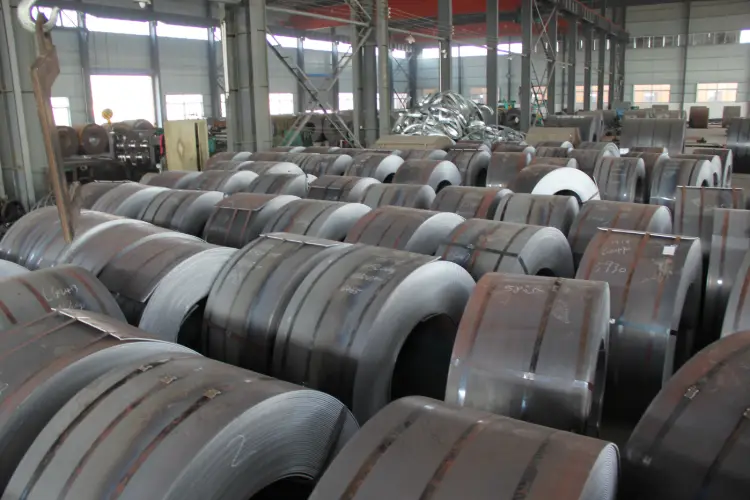
RINA F550 Shipbuilding Steel Coil
RINA F550 Shipbuilding Steel Coil: High-Strength Marine Grade for Extreme Environments
Comprehensive technical data for RINA F550 (FH550) high-strength shipbuilding steel coil, including chemical composition, mechanical properties, thermal properties, and international equivalents. Ideal for marine and offshore structural applications.
Thermomechanical controlled rolling (TMCP), quenching and tempering (Q&T), normalizing (less common); suitable for welding, cutting, forming, bending
- Phone : +8618037372205
- Email : [email protected]
- WhatsApp: Contact via Whtsapp
- WeChat: +8618037372205
RINA F550 Shipbuilding Steel Coil Introduction
RINA F550 (officially designated as FH550) is a high-strength, low-alloy structural steel specifically developed for shipbuilding and offshore applications, certified by the Registro Italiano Navale (RINA). It offers a minimum yield strength of 550 MPa and excellent low-temperature toughness down to -60°C. This grade is produced in coil and plate form using advanced thermomechanical controlled processing (TMCP) or quenching and tempering (Q&T), ensuring a fine-grained microstructure and superior weldability. Key features include:
- High strength-to-weight ratio, enabling lighter ship designs without compromising safety.
- Outstanding impact resistance in cold climates, meeting F-grade impact requirements (27 J at -60°C).
- Good formability and weldability with appropriate consumables and practices.
It conforms to RINA Rules Part D and international IACS UR W11 standards.
RINA F550 Shipbuilding Steel Coil Chemical Composition
The chemical composition conforms to IACS UR W11 for high strength steels with yield strength 550 MPa. The steel is microalloyed with Nb, V, Ti, and Al for grain refinement and precipitation strengthening. Residual elements are strictly controlled to ensure good weldability and toughness.
- Carbon equivalent (CEV) is usually limited to enhance weldability.
- Fine grain practice requires sufficient acid-soluble aluminum or combined microalloying.
| Element | Specification Value (max or range) | Remarks |
|---|---|---|
| C (Carbon) | ≤ 0.18% | Higher carbon increases strength but reduces weldability |
| Mn (Manganese) | 0.90 – 1.60% | Contributes to strength and hardenability |
| Si (Silicon) | ≤ 0.50% | Deoxidizer; improves strength |
| P (Phosphorus) | ≤ 0.025% | Low content to avoid cold brittleness |
| S (Sulfur) | ≤ 0.025% | Forms MnS; low limit for toughness |
| Al (Aluminium, acid soluble) | ≥ 0.020% when used alone | Grain refinement; alternative to Nb/V/Ti |
| Nb (Niobium) | May be added; total Nb+V+Ti ≤ 0.12% | |
| V (Vanadium) | Total Nb+V+Ti ≤ 0.12% | |
| Ti (Titanium) | Total Nb+V+Ti ≤ 0.12% | |
| Mo (Molybdenum) | ≤ 0.08% | Improves strength; limited for weldability |
| Cu (Copper) | ≤ 0.35% | Residual element |
| Cr (Chromium) | ≤ 0.20% | Residual element |
| Ni (Nickel) | ≤ 0.40% | Residual element; enhances toughness |
| N (Nitrogen) | ≤ 0.012% (unless bound by Al/Ti) | Must be combined for ductility |
RINA F550 Shipbuilding Steel Coil Thermal and Electrical Physical Properties
Physical properties are representative for low-alloy structural steel at room temperature unless otherwise indicated. These values are not part of obligatory classification tests but are useful for design and thermal analysis.
- Thermal conductivity and expansion vary with temperature; tabulated values are for ~20°C and ~100°C where noted.
| Property | Typical Value | Unit | Test Condition / Remarks |
|---|---|---|---|
| Density (ρ) | 7850 | kg/m³ | At 20°C |
| Modulus of elasticity (E) | 205 – 210 | GPa | At 20°C |
| Shear modulus (G) | ≈ 80 | GPa | At 20°C |
| Poisson's ratio (ν) | 0.28 – 0.30 | – | Elastic range |
| Thermal expansion coefficient (α) | 12 | ×10⁻⁶/K | Mean value 20–100°C |
| Thermal conductivity (λ) | 50 | W/(m·K) | At 20°C; decreases with temperature |
| Specific heat capacity | 460 | J/(kg·K) | At 20°C |
| Electrical resistivity (ρ_e) | 0.18 – 0.22 | µΩ·m | At 20°C |
RINA F550 Shipbuilding Steel Coil Mechanical Properties
Mechanical properties are determined on TMCP or Q&T plates/coil samples per RINA/IACS requirements. Values shown are the minimum guaranteed for the FH550 grade in longitudinal direction (transverse values may be lower). Impact energy requirements correspond to F-grade (-60°C).
- Bend test: 180° over a specified former, no cracks.
- Specimens for tensile testing are prepared according to ISO 6892-1 or equivalent.
| Property | Required Value (min or range) | Unit | Test Condition / Remarks |
|---|---|---|---|
| Yield strength (ReH) | ≥ 550 | MPa | Thickness ≤ 50 mm; plate/coil longitudinal |
| Tensile strength (Rm) | 670 – 830 | MPa | For all thickness ranges |
| Elongation after fracture (A5) | ≥ 16 | % | Gauge length 5.65√So; longitudinal; thickness ≤ 50 mm |
| Bending test (bend angle 180°) | d = 3a (t ≤ 25 mm); d = 4a (t > 25 mm) | – | d: mandrel diameter; a: specimen thickness; no cracks |
| Impact energy (KV2) at -60°C | ≥ 27 (average), ≥ 20 (individual) | J | Charpy V-notch, longitudinal; F-grade requirement |
| Impact energy (KV2) at -60°C, transverse | ≥ 20 (average), ≥ 14 (individual) | J | When transverse testing is specified |
| Reduction of area (Z) | ≥ 40 (informative) | % | Typical for this grade; not a mandatory acceptance criteria |
RINA F550 Shipbuilding Steel Coil Equivalent Material Standards and Replaceable Grades
| Country/Region | Standard / Classification Society | Grade | Remarks |
|---|---|---|---|
| International (Italy) | RINA Rules Part D | FH550 (F550) | Original specification |
| United Kingdom | Lloyd's Register (LR) | FH550 | Equivalent F-grade 550 MPa ship steel |
| Norway/Germany | DNV GL Rules | VL F550 | DNV class notation for 550 MPa -60°C grade |
| France | Bureau Veritas (BV) | FH550 | Identical designation and properties |
| USA | American Bureau of Shipping (ABS) | FH550 | ABS grade with -60°C impact requirement |
| China | China Classification Society (CCS) | FH550 | CCS high-strength hull structural steel |
| Japan | Nippon Kaiji Kyokai (ClassNK) | KF550 | K-grade for -60°C, yield 550 MPa |
| International | IACS UR W11 | F550 | Unified requirement for 550 MPa F-grade steel |
RINA F550 Shipbuilding Steel Coil Application Introduction
RINA F550 is designed for critical structural components exposed to high stress and low temperatures. Its high strength allows thinner sections and weight savings, while the F-grade toughness ensures safety in Arctic or harsh marine environments. It is fully weldable with low-hydrogen processes and preheating according to the thickness.
Product Applications: Ship hulls (deck, shell, bottom plating, longitudinal stiffeners), Offshore platform decks, helidecks, and crane pedestals, Wind turbine monopile foundations and transition pieces, Heavy-duty structural frameworks, Subsea templates and manifolds
Processed into products: Plates and coils for cutting and forming, Welded T-beams and H-beams, Bulkhead panels and web frames, Flange plates and gusset plates, Cold-formed stiffeners and corrugated bulkheads, Circular tube sections for bracing
Application industries: Shipbuilding (naval vessels, cargo ships, tankers, bulk carriers, cruise ships), Offshore oil & gas (jack-up rigs, semisubmersibles, floating production units), Marine engineering (harbour cranes, lock gates, breakwaters), Renewable energy (offshore wind turbine foundations, transition pieces), Pressure vessels and storage tanks (when accepted by relevant standards)
RINA F550 Shipbuilding Steel Coil Similar / Approximate Substitute Materials
| Country/Region | Standard | Grade | Remarks |
|---|---|---|---|
| Europe | EN 10225:2009 (Weldable structural steels for offshore structures) | S550G2+Q (S550QL) | 550 MPa yield, quenched & tempered; often used for offshore; not identical notch toughness without F-grade |
| USA | ASTM A514 / A514M | Grade B or Q | Quenched & tempered plates with minimum yield 690 MPa; higher strength but different toughness class |
| Europe | EN 10149-2:2013 | S550MC | Thermomechanically rolled, minimum yield 550 MPa; for cold forming; not a certified shipbuilding grade |
| International | API RP 2A / API 2H | Grade 50 (2H) or 2W | High-strength steel for offshore structures; yield ~345-414 MPa; lower strength than F550 |
| USA | ASTM A572/A572M | Grade 65 | 345-450 MPa yield; lower strength; general structural applications |
Notes:
- Welding must follow RINA-approved procedures, typically using low-hydrogen consumables and preheat/interpass temperature control based on CEV and thickness.
- For thicknesses above 50 mm, mechanical property values may be slightly reduced; consult the certification body for specific tensile and impact requirements.
- Ultrasonic testing (UT) and strict surface quality are normally required for shipbuilding plates.
- The material is usually supplied with RINA 3.1 or 3.2 certificates.
- Share



