
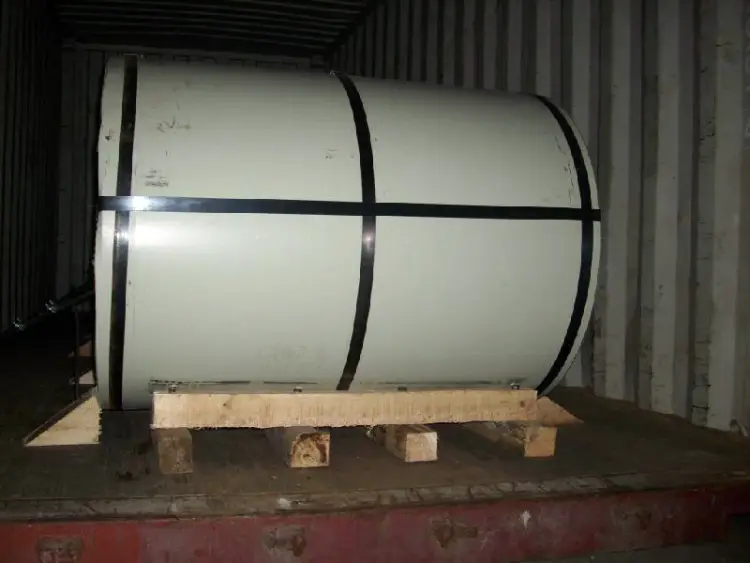
RINA E550 Shipbuilding Steel Coil
RINA E550 Shipbuilding Steel Coil - High Strength Hull Structural Steel
Detailed material data for RINA E550 shipbuilding steel: chemical composition, mechanical properties, physical properties, international equivalents and application guide.
Welding, hot/cold forming, cutting, bending, edge preparation, shot blasting
- Phone : +8618037372205
- Email : [email protected]
- WhatsApp: Contact via Whtsapp
- WeChat: +8618037372205
RINA E550 Shipbuilding Steel Coil Introduction
RINA E550 is a high-strength shipbuilding structural steel certified by the Italian Naval Register (RINA). It belongs to the grade with a minimum yield strength of 550 MPa and is classified as a fine-grain, low-alloy steel suitable for cold-climate service due to its "E" designation (impact tested at -40°C). This steel is typically supplied in normalized, controlled-rolled or thermo-mechanically controlled processed (TMCP) condition. It offers excellent weldability, high toughness, and good formability for heavy ship components. RINA E550 is widely used in the construction of ship hulls, decks, bulkheads and offshore structures.
RINA E550 Shipbuilding Steel Coil Chemical Composition
Chemical composition limits according to RINA Rules, Part D, Ch. 3, Sec. 1 for grade E550. The steel is fully killed and fine-grain treated with aluminium and/or other grain-refining elements. Maximum carbon equivalent (CEV) may also be specified, typically CEV ≤ 0.42% for thickness up to 50 mm.
| Chemical Element | Standard Value | Unit | Remarks |
|---|---|---|---|
| C (Carbon) | ≤ 0.20 | % | Ladle analysis |
| Si (Silicon) | 0.10 – 0.50 | % | Ladle analysis |
| Mn (Manganese) | 0.90 – 1.60 | % | Ladle analysis |
| P (Phosphorus) | ≤ 0.025 | % | Ladle analysis |
| S (Sulfur) | ≤ 0.025 | % | Ladle analysis |
| Al (Aluminium) total | ≥ 0.015 | % | Minimum for grain refinement; or sufficient Nb, V, Ti combination |
| Nb (Niobium) | ≤ 0.05 | % | Optional grain refiner, if added |
| V (Vanadium) | ≤ 0.10 | % | Optional grain refiner, if added |
| Ti (Titanium) | ≤ 0.02 | % | Optional grain refiner, if added |
| Cu (Copper) | ≤ 0.35 | % | Residual element |
| Cr (Chromium) | ≤ 0.20 | % | Residual element |
| Ni (Nickel) | ≤ 0.40 | % | Residual element |
| Mo (Molybdenum) | ≤ 0.08 | % | Residual element |
| CEV (Carbon Equivalent) | ≤ 0.42 | % | Typical requirement for thickness ≤50 mm, CEV = C + Mn/6 + (Cr+Mo+V)/5 + (Ni+Cu)/15 |
RINA E550 Shipbuilding Steel Coil Thermal and Electrical Physical Properties
Typical physical properties for similar high-strength shipbuilding steel at room temperature. These values are not mandatory but are useful for design calculations. Variation may occur depending on exact composition and processing.
| Property | Typical Value | Unit | Test Condition |
|---|---|---|---|
| Density (ρ) | ~7850 | kg/m³ | At 20°C |
| Elastic Modulus (E) | ~206 | GPa | At 20°C, static |
| Shear Modulus (G) | ~80 | GPa | At 20°C |
| Poisson's Ratio (ν) | ~0.3 | — | At 20°C, elastic range |
| Thermal Expansion (α, 20–100°C) | ~12.0 × 10⁻⁶ | K-1 | From 20°C to 100°C |
| Thermal Expansion (α, 20–200°C) | ~12.5 × 10⁻⁶ | K-1 | From 20°C to 200°C |
| Thermal Expansion (α, 20–300°C) | ~13.0 × 10⁻⁶ | K-1 | From 20°C to 300°C |
| Thermal Conductivity (λ) | ~50 | W/m·K | At 20°C |
| Specific Heat Capacity (cp) | ~480 | J/kg·K | At 20°C |
| Electric Resistivity (ρe) | ~0.22 × 10⁻⁶ | Ω·m | At 20°C |
RINA E550 Shipbuilding Steel Coil Mechanical Properties
Mechanical properties as specified in RINA Rules for plates and wide flats of grade E550. The yield strength (ReH), tensile strength (Rm), elongation (A) and impact energy (KV) are mandatory. Bending test is required. Impact tests are performed at -40°C (E-grade). Values depend on product thickness; multiple rows are shown for thickness ranges ≤50 mm and >50–100 mm.
| Property | Required Value | Unit | Test Condition |
|---|---|---|---|
| Yield Strength (ReH) | ≥ 550 | MPa | Thickness ≤ 50 mm, transverse |
| Yield Strength (ReH) | ≥ 530 | MPa | Thickness > 50–100 mm, transverse |
| Tensile Strength (Rm) | 670 – 830 | MPa | Thickness ≤ 50 mm |
| Tensile Strength (Rm) | 670 – 830 | MPa | Thickness > 50–100 mm |
| Elongation (A) | ≥ 16 | % | Gauge length 5.65√So; thickness ≤ 50 mm |
| Elongation (A) | ≥ 16 | % | Thickness > 50–100 mm |
| Bend Test (180°) | No cracks | — | Mandrel diameter 3a, thickness ≤ 50 mm; a = specimen thickness |
| Bend Test (180°) | No cracks | — | Mandrel diameter 4a, thickness > 50–100 mm |
| Charpy Impact (KV2, longitudinal) | ≥ 50 | J | At -40°C, thickness ≤ 50 mm |
| Charpy Impact (KV2, longitudinal) | ≥ 44 | J | At -40°C, thickness > 50–70 mm |
| Charpy Impact (KV2, longitudinal) | ≥ 38 | J | At -40°C, thickness > 70–100 mm |
| Charpy Impact (KV2, transverse) | ≥ 34 | J | At -40°C, thickness ≤ 50 mm |
| Charpy Impact (KV2, transverse) | ≥ 28 | J | At -40°C, thickness > 50–70 mm |
| Charpy Impact (KV2, transverse) | ≥ 24 | J | At -40°C, thickness > 70–100 mm |
RINA E550 Shipbuilding Steel Coil Fully Equivalent Material Standards and Substitutable Grades
| Country/Region | Standard / Classification Society | Grade | Remarks |
|---|---|---|---|
| Italy (Original) | RINA Rules | E550 | Base standard |
| China | CCS Rules for Ships | EH550 | Direct equivalent |
| Norway / International | DNV Rules | E550 | Direct equivalent |
| United Kingdom | LR Rules | EH550 | Direct equivalent |
| USA | ABS Rules | EH550 | Direct equivalent |
| France | BV Rules | EH550 | Direct equivalent |
| Japan | NK Rules | KE550 | Equivalent grade |
| South Korea | KR Rules | REH550 | Equivalent grade |
| Germany (historical) | GL (now DNV) | E550 | DNV-GL unification equivalent |
RINA E550 Shipbuilding Steel Coil Application Introduction
RINA E550 steel is designed for critical structural components in modern shipbuilding and offshore engineering where high strength and excellent low-temperature toughness are required. Its fine-grain structure ensures good weldability and resistance to brittle fracture, making it suitable for hulls exposed to cold sea environments.
Main features:
- High strength reduces plate thickness and vessel weight, improving payload and fuel efficiency.
- Excellent Charpy impact properties at -40°C guarantee safety in Arctic and sub-Arctic operations.
- Good formability and weldability with standard procedures (preheating may be needed for thick sections).
- Available in various thicknesses and as coil, plate, or profile.
Product Applications: Hull plating (side shells, bottom shells, decks), Transverse and longitudinal bulkheads, Stiffeners and frames, Deckhouses, Jack-up rig legs and spudcans, Offshore structure nodes and bracings, Ice-strengthened structures
Processed into products: Rolled ship plates (flat and tapered), Flame-cut shaped parts (brackets, gusset plates), Welded stiffened panels, Built-up beams and girders, Angle, bulb-flat and T-bar profiles, Formed cold-bent sections (stringers), Welded tubular sections for offshore jackets
Application industries: Shipbuilding, Offshore engineering, Marine construction, Heavy lifting equipment (marine cranes, A-frames), Polar/ice-class vessel structures
RINA E550 Shipbuilding Steel Coil Similar / Comparable Steel Grades
| Country/Region | Standard / Classification Society | Grade | Remarks |
|---|---|---|---|
| International | RINA Rules | E500 / EH500 | Lower yield strength (min 500 MPa), similar toughness class |
| International | RINA Rules | E620 / EH620 | Higher yield strength (min 620 MPa), similar weldability and toughness |
| International | EN 10025-6 | S690Q / S690QL | Quenched & tempered structural steel, similar strength but not specifically ship class unless certified |
| International | API 2W | Grade 60 | Offshore structural plate, TMCP, comparable to EH550 in strength and toughness |
Notes:
This steel is certified according to the RINA Register and must be ordered with RINA inspection and stamping. The CEV (carbon equivalent) is normally limited to 0.42% for thickness up to 50 mm, but can be relaxed if the manufacturer demonstrates adequate weldability. For heavy sections, TMCP or QT conditions are often used to guarantee uniform properties. Surface quality and dimensional tolerances comply with RINA or EN 10029. All data are derived from official RINA Rules and are for general reference; for actual construction, the latest edition of the rules and the specific mill test certificate should be consulted.
- Share



