
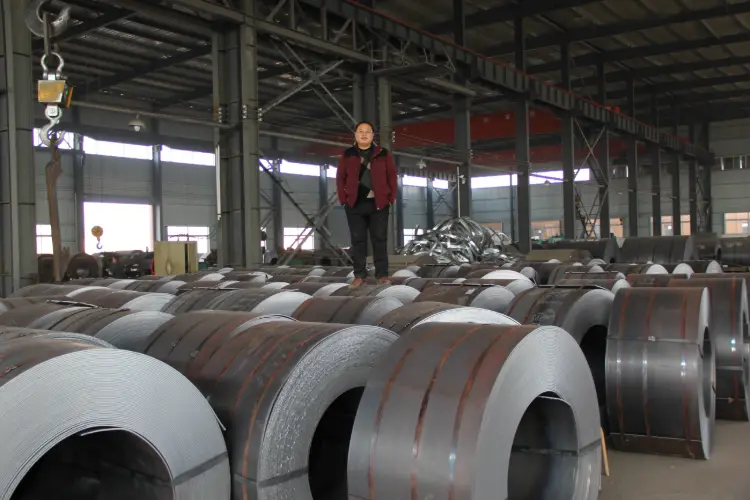
RINA D550 Shipbuilding Steel Coil
RINA D550 Shipbuilding Steel Coil: High-Strength, D-Grade Toughness for Marine Structures
In-depth profile of RINA D550 high-strength shipbuilding steel including chemical composition, mechanical and thermal properties, equivalent grades, and typical applications. Ideal for marine engineering and offshore structures requiring excellent low-temperature toughness.
Cutting, welding, bending, cold forming, machining
- Phone : +8618037372205
- Email : [email protected]
- WhatsApp: Contact via Whtsapp
- WeChat: +8618037372205
RINA D550 Shipbuilding Steel Coil Introduction
RINA D550 is a high-strength shipbuilding structural steel grade certified by Registro Italiano Navale (RINA). It combines a minimum yield strength of 550 MPa with D-grade impact toughness at -20 °C, making it suitable for critical hull components and offshore structures exposed to low temperatures. The steel is typically supplied in thermomechanically rolled (TMCP) or quenched and tempered (QT) condition, offering an outstanding balance of strength, weldability, and resistance to brittle fracture. Its fine-grained microstructure, controlled by microalloying elements such as niobium, vanadium, and titanium, ensures consistent mechanical performance across a wide thickness range.
- Minimum yield strength 550 MPa (ReH)
- Excellent notch toughness down to -20 °C
- Good weldability with proper procedure
- Used in ship hulls, decks, bulkheads, and offshore platforms
RINA D550 Shipbuilding Steel Coil Chemical Composition
The chemical composition of RINA D550 is designed to achieve high strength and excellent toughness at low temperatures. Tight control of carbon equivalent (Ceq) ensures good weldability. Microalloying elements like Nb, V, and Ti provide grain refinement and precipitation strengthening. Maximum limits are specified for residual elements to avoid detrimental effects on mechanical properties.
- Carbon Equivalent typically ≤ 0.45% for thickness ≤ 50 mm
- The sum of Nb+V+Ti is usually limited to 0.12% max
| Chemical Element | Specified Value (wt%) | Remarks |
|---|---|---|
| Carbon (C) | ≤ 0.20 | Max |
| Manganese (Mn) | 0.90 – 1.60 | Range for strength and toughness |
| Silicon (Si) | 0.10 – 0.50 | Deoxidation and strength |
| Phosphorus (P) | ≤ 0.025 | Max |
| Sulfur (S) | ≤ 0.025 | Max |
| Aluminium (Altot) | ≥ 0.015 | Grain refinement, fully killed |
| Chromium (Cr) | ≤ 0.25 | Residual |
| Nickel (Ni) | ≤ 0.40 | Residual; may be higher for improved toughness |
| Molybdenum (Mo) | ≤ 0.08 | Residual |
| Copper (Cu) | ≤ 0.35 | Residual |
| Niobium (Nb) | ≤ 0.05 | Microalloy, grain refiner |
| Vanadium (V) | ≤ 0.10 | Precipitation strengthening |
| Titanium (Ti) | ≤ 0.02 | Grain refinement, nitride former |
| Nitrogen (N) | ≤ 0.012 | Max, bound by Al and Ti |
RINA D550 Shipbuilding Steel Coil Thermal and Electrical Physical Properties
The following physical properties are typical for fine‑grained structural steels similar to RINA D550 and are not part of the classification standard. They are provided for design and engineering calculations. Actual values may vary slightly depending on exact chemical composition and heat treatment.
- Density is assumed constant for structural steel at 20 °C.
- Thermal expansion and conductivity values are mean values for the range indicated.
| Property | Standard Value (Typical) | Unit | Test Condition |
|---|---|---|---|
| Density (ρ) | 7850 | kg/m³ | at 20 °C |
| Modulus of Elasticity (E) | 205 | GPa | at 20 °C |
| Shear Modulus (G) | 79 | GPa | at 20 °C |
| Poisson's Ratio (ν) | 0.3 | - | at 20 °C |
| Thermal Expansion Coefficient (α) | 1.2 × 10⁻⁵ | 1/K | 20 – 100 °C |
| Thermal Conductivity (λ) | 50 | W/(m·K) | at 20 °C |
| Specific Heat Capacity | 460 | J/(kg·K) | at 20 °C |
| Electrical Resistivity (ρₑ) | 0.14 | μΩ·m | at 20 °C |
RINA D550 Shipbuilding Steel Coil Mechanical Properties
Mechanical properties are determined from test pieces taken in the transverse direction, unless otherwise agreed. The values below represent the minimum requirements according to RINA Rules for thicknesses up to 100 mm for yield/tensile strength and up to 50 mm for elongation and Charpy impact. Charpy V-notch specimens (10×10 mm) are used for D-grade toughness verification at -20 °C.
- Thinner product forms may exhibit slightly higher elongation.
- Bend tests are performed with a 180° bend angle.
| Property | Minimum / Typical Value | Unit | Test Condition |
|---|---|---|---|
| Yield Strength (ReH) | ≥ 550 | MPa | t ≤ 100 mm, transverse |
| Tensile Strength (Rm) | 670 – 830 | MPa | t ≤ 100 mm, transverse |
| Elongation (A5) | ≥ 16 | % | Gauge length 5.65√S₀, longitudinal; t ≤ 50 mm |
| Bend Test (bending angle 180°) | d = 3a | - | Bend diameter for thickness a ≤ 50 mm |
| Charpy V-Notch Impact (KV₂) | ≥ 27 (longitudinal) | J | at -20 °C, specimen 10×10 mm |
| Charpy V-Notch Impact (KV₂) | ≥ 20 (transverse) | J | at -20 °C, specimen 10×10 mm |
RINA D550 Shipbuilding Steel Coil Fully Equivalent Material Standards and Alternative Designations
| Country / Region | Standard / Specification | Grade | Remarks |
|---|---|---|---|
| International (IACS) | IACS UR W11 | D550 | IACS Unified Requirement – high strength hull structural steel |
| Italy | RINA Rules Pt.D | D550 | Original classification society grade |
| Europe | EN 10025-6 | S550QL | Quenched and tempered, -20 °C impact, equivalent strength |
| Europe | EN 10025-6 | S550QL1 | Same as S550QL but with improved through‑thickness properties |
| Norway / Germany (DNV GL) | DNVGL‑OS‑B101 | VL D550 | Previously NV D550; equivalent shipbuilding grade |
| United Kingdom | LR Rules | DH550 | Lloyd's Register D‑grade 550 MPa |
| United States | ABS Rules | ABS D550 | American Bureau of Shipping equivalent |
| France | BV Rules | D550 | Bureau Veritas equivalent |
| China | CCS Rules | D550 | China Classification Society |
| Japan | NK Rules | KD550 | Nippon Kaiji Kyokai |
| Korea | KR Rules | RD550 | Korean Register |
RINA D550 Shipbuilding Steel Coil Application Introduction
RINA D550 is designed for welded structures that demand a high strength‑to‑weight ratio combined with reliable low‑temperature toughness. Proper welding procedures are essential: preheating (typically 75–150 °C depending on thickness) and controlled interpass temperatures help prevent hydrogen‑induced cracking. TMCP processing minimizes the need for post‑weld heat treatment, but stress relieving may be applied when codes require.
- Can be used in heavy‑section welded fabrications without preheat for moderate thicknesses.
- Excellent formability allows cold bending and fabrication of complex geometries.
- Commonly paired with matching strength consumables (e.g., AWS E11018‑M or equivalent).
Product Applications: Hull plates and stiffened panels for tankers, bulk carriers, and container ships, Offshore platform legs, braces, and jacket structures, Ship frames, longitudinal bulkheads, and main deck stringers, Heavy‑lift crane booms and mobile harbor cranes, Submarine pressure hulls and naval surface vessels
Processed into products: Main deck plates and sheer strakes, Transverse bulkheads and wash bulkheads, Bottom shell plates and bilge keels, Chain plates and anchor handling equipment, Tower can sections for offshore wind turbines, Bracing members and spudcans of jack‑up rigs
Application industries: Shipbuilding and marine engineering, Offshore oil and gas platforms, Heavy machinery and crane manufacturing, Bridge construction (including movable bridges), Renewable energy (offshore wind turbine towers and foundations)
RINA D550 Shipbuilding Steel Coil Similar / Comparable Material Recommendations
| Country / Region | Standard / Specification | Grade | Remarks |
|---|---|---|---|
| Italy / Int. | RINA | EH550 | Higher toughness (‑40 °C); identical minimum strength, suitable for lower service temperatures |
| Italy / Int. | RINA | FH550 | Ultra‑high toughness (‑60 °C); same strength, used in arctic conditions |
| Europe | EN 10025-6 | S550Q | ‑20 °C impact, but may differ in commercial delivery conditions (Q&T) |
| Europe | EN 10025-6 | S500QL | Slightly lower yield strength (500 MPa), similar toughness |
| United States | ASTM A709 | HPS 70W | Weathering bridge steel, yield ≈ 485 MPa; different corrosion resistance |
| Norway / Germany | DNVGL‑OS‑B101 | VL E550 | DNV grade with ‑40 °C toughness, otherwise equivalent |
Notes:
Welding guidelines: Use low‑hydrogen processes and consumables matching the steel grade. Preheat temperatures typically range from 75 °C to 150 °C depending on plate thickness and joint restraint. Interpass temperature should not exceed 200 °C. Post‑weld heat treatment (PWHT) is not normally required for TMCP products, but if stress relief is specified (e.g., for pressure vessel applications), it should be carried out at 530–580 °C. Surface protection: As a carbon‑manganese structural steel, D550 requires coating or cathodic protection in immersed conditions. The material can be supplied with shop‑primer for temporary corrosion protection during construction. Availability: Plate widths up to 4.5 m and thicknesses from 6 mm to 150 mm are commonly available; coils are produced in thicknesses up to 25 mm.
- Share



