
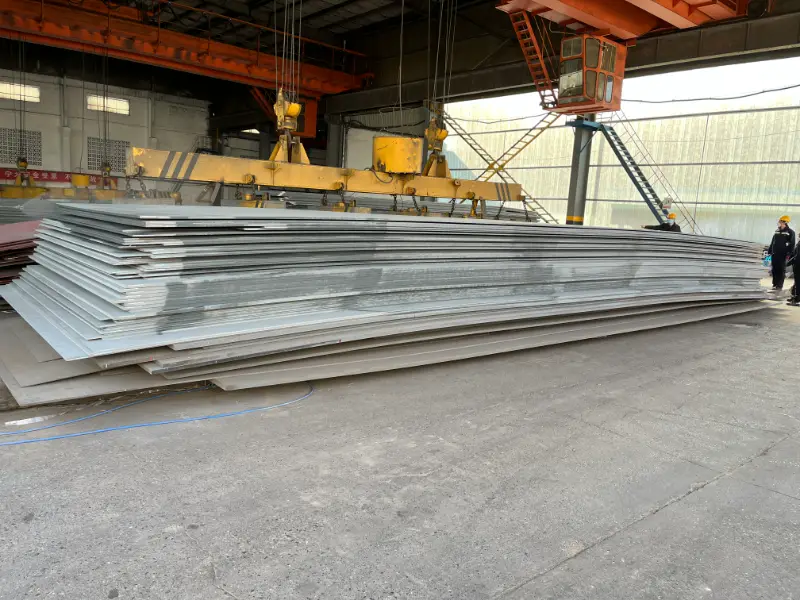
Austenitic Stainless Steel 334 (S33400)
Austenitic Stainless Steel 334 (S33400) - High-Temperature Oxidation Resistance Alloy
Comprehensive material data for Austenitic 334 (S33400) stainless steel plate/coil, including chemical composition, mechanical, thermal, and electrical properties, equivalent grades, similar materials, and application guidance.
Welding, Hot Forming, Cold Working, Machining, Heat Treatment
- Phone : +8618037372205
- Email : [email protected]
- WhatsApp: Contact via Whtsapp
- WeChat: +8618037372205
Austenitic Stainless Steel 334 Introduction
Austenitic 334 (UNS S33400) is a high-nickel, high-chromium stainless steel designed for exceptional oxidation resistance at elevated temperatures. It features a fully austenitic microstructure stabilized by balanced alloying elements. The material provides outstanding scaling resistance up to approximately 1000 °C, making it suitable for cyclic and continuous high-temperature service. Key attributes include:
- Oxidation Resistance: Superior to standard austenitic grades like 304 and 316 at high temperatures.
- Carburization Resistance: Enhanced protection against carbon absorption in carburizing atmospheres.
- Weldability: Fabrication by common fusion and resistance methods.
Austenitic Stainless Steel 334 Chemical Composition
The chemical composition meets the requirements of ASTM A240 for UNS S33400 grade. The values represent ladle analysis and standard product analysis tolerances may apply. Elements are carefully balanced to achieve an austenitic structure with superior high-temperature corrosion resistance.
- Key Alloying: High Nickel (Ni) and Chromium (Cr) provide oxidation resistance.
- Silicon (Si): Minor addition for scaling resistance.
- Low Carbon: Minimizes carbide precipitation during service.
| Element | Composition (%) | Remarks |
|---|---|---|
| Carbon (C) | ≤ 0.08 | Standard requirement |
| Manganese (Mn) | ≤ 1.00 | Standard requirement |
| Phosphorus (P) | ≤ 0.030 | Standard requirement |
| Sulfur (S) | ≤ 0.015 | Standard requirement |
| Silicon (Si) | ≤ 1.00 | Typical range 0.30–0.60 for oxidation resistance |
| Chromium (Cr) | 18.00–20.00 | Primary element for oxidation resistance |
| Nickel (Ni) | 20.50–23.50 | Austenite stabilizer and high-temperature strength |
| Nitrogen (N) | ≤ 0.10 | Residual element, normally not intentionally added |
| Iron (Fe) | Balance (~56%) | Base element, nominal remainder |
Austenitic Stainless Steel 334 Thermal and Electrical Physical Properties
Physical property data represents typical values for the annealed condition. These properties are influenced by composition and processing and are provided for engineering design guidance.
- Thermal Conductivity: Relatively low, typical of austenitic stainless steels.
- Thermal Expansion: Higher than ferritic grades, important for design with thermal cycling.
| Property | Typical Value | Unit | Test Condition/Temperature |
|---|---|---|---|
| Density (ρ) | 7.98 | g/cm³ | At 20 °C |
| Elastic Modulus (E) | 193 | GPa | At 20 °C |
| Shear Modulus (G) | 76 | GPa | At 20 °C, calculated from E and ν |
| Poisson's Ratio (ν) | 0.27–0.30 | At 20 °C, typical for austenitic steel | |
| Thermal Expansion Coefficient (α) | 16.2 | ×10⁻⁶/K | 20–100 °C |
| Thermal Expansion Coefficient (α) | 17.0 | ×10⁻⁶/K | 20–500 °C |
| Thermal Expansion Coefficient (α) | 18.0 | ×10⁻⁶/K | 20–1000 °C |
| Thermal Conductivity (λ) | 12.7 | W/m·K | At 100 °C |
| Thermal Conductivity (λ) | 16.3 | W/m·K | At 500 °C |
| Specific Heat Capacity (cp) | 500 | J/kg·K | At 20 °C |
| Electrical Resistivity (ρe) | 0.90 | μΩ·m | At 20 °C |
| Melting Range | 1370–1400 | °C | Approximate solidus/liquidus |
Austenitic Stainless Steel 334 Mechanical Properties
The following mechanical properties are typical for solution-annealed plate/coil per ASTM A240 requirements. Actual values depend on section thickness and processing. The alloy offers good ductility combined with moderate strength at room temperature, retaining useful strength at elevated temperatures.
- Tensile Testing: Conducted according to ASTM A370.
- Bend Test: No requirement in base standard for annealed product, but excellent ductility allows tight bends.
| Property | Standard Requirement Value | Unit | Test Condition |
|---|---|---|---|
| Yield Strength (Rp0.2, min) | ≥ 205 | MPa | Room Temperature, ASTM A370 |
| Tensile Strength (Rm, min) | ≥ 515 | MPa | Room Temperature, ASTM A370 |
| Elongation (A, 50 mm, min) | ≥ 40 | % | Room Temperature, ASTM A370 |
| Hardness (max) | ≤ 95 HRB / ≤ 201 HBW | Room Temperature (typical conversion) |
Austenitic Stainless Steel 334 Fully Equivalent Material Standards and Substitute Grade Recommendations
The following national and international standards list grades that are considered identical or directly interchangeable with UNS S33400. These materials share the same chemical composition and property requirements.
| Country/Region | Standard | Grade | Remarks |
|---|---|---|---|
| USA | ASTM A240/A240M | 334 (S33400) | Fully equivalent plate, sheet, strip |
| USA | ASME SA-240 | 334 | Equivalent for pressure vessel applications |
| USA | AMS 5524 | 334 | Aerospace Material Specification, sheet and strip |
| USA | AMS 5570 | 334 | Seamless tubing |
| Europe (EN) | Not directly listed | ~1.4860 (GX40CrNiSi25-20) | Cast alloy with similar oxidation resistance, not identical wrought grade |
| Global (UNS) | UNS | S33400 | Universal designation |
Austenitic Stainless Steel 334 Application Introduction
Austenitic 334 (S33400) is engineered for high-temperature environments where resistance to oxidation and carburization is critical. It finds extensive use in industrial heating equipment and process industries. Fabrication methods include welding, forming, and machining.
- Welding: Use ER331 or matching filler, with proper shielding to avoid oxidation.
- Forming: Excellent ductility allows severe cold forming; intermediate annealing may be needed.
Product Applications: Annealing Covers and Boxes, Radiant Tubes and Heating Elements Sheathing, Furnace Muffles and Retorts, Heat Exchanger Components, Thermal Oxidizers, Combustion Chambers, High-Temperature Clamps and Fasteners
Processed into products: Bent and welded furnace tubes, Laser-cut burner plates, Deep-drawn furnace retort cans, Welded belt links and conveyor components, Fabricated radiant tube assemblies, Expanded metal grids for furnace floors
Application industries: Thermal Processing (Industrial Furnaces), Petrochemical and Chemical Processing, Power Generation (Gas Turbine Components), Heat Treatment Equipment, Automotive (Exhaust Systems, limited high-end applications), Aerospace (Auxiliary power units and ducting)
Austenitic Stainless Steel 334 Similar/Alternative Materials with Comparable Properties
The following grades are frequently considered as alternatives where secondary features like oxidation resistance are comparable, but composition or primary application differs. They are not direct equivalents but can serve as substitutes in certain environments.
| Country/Region | Standard | Grade | Remarks |
|---|---|---|---|
| USA | ASTM A240 | 310S (S31008) | Similar high-temp scaling resistance to ~980 °C; lower nickel (19–22%), slightly higher chromium (24–26%). More economical. |
| USA | ASTM A240 | 330 (N08330) | Higher nickel (34–37%) for carburization resistance; lower oxidation resistance above 980 °C compared to 334. Higher cost. |
| Europe (EN) | EN 10095 | 1.4845 (X8CrNi25-21) | Similar to 310S; lower nickel and higher chromium than 334. Suitable for furnace parts. |
| USA (Alloy) | UNS N06600 | Alloy 600 | Nickel-base alloy with 72Ni-15Cr. Superior carburization resistance, but much higher cost and lower strength at intermediate temperatures. |
Notes:
Processing Note: After forming or welding, re-solution annealing may be required to restore full corrosion resistance. Descaling in pickling acids (HNO₃+HF) is typical after heat treatment. Not recommended for use in strongly reducing sulfur-containing atmospheres at high temperatures. The maximum service temperature in air is approximately 1050 °C for intermittent service and 980 °C for continuous service. For section thicknesses above 12.7 mm, tensile properties may slightly decrease.
- Share



