
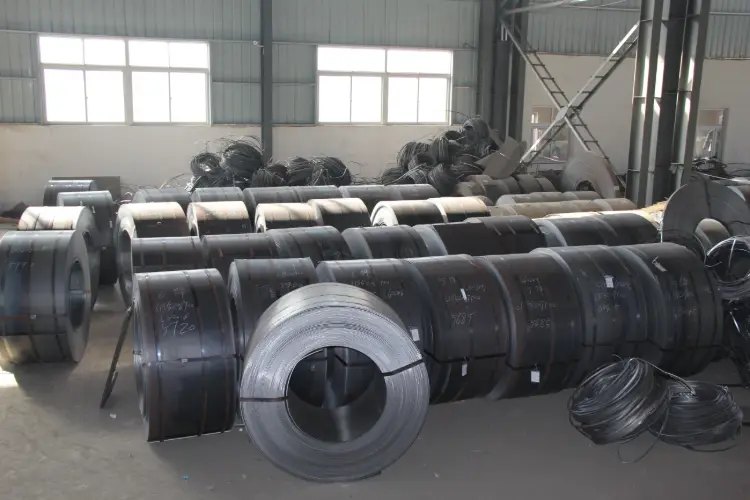
RINA A620 Shipbuilding Steel Coil
RINA A620 Shipbuilding Steel Coil - High-Strength Quenched & Tempered Plate for Hull Structures
Detailed material data for RINA A620 high-strength quenched and tempered shipbuilding steel, including chemistry, mechanical and physical properties, international equivalents, and application guidance for marine and offshore structures.
Cutting, welding (with preheat and controlled heat input), cold forming (limited), machining
- Phone : +8618037372205
- Email : [email protected]
- WhatsApp: Contact via Whtsapp
- WeChat: +8618037372205
RINA A620 Shipbuilding Steel Coil Introduction
RINA A620 is a high-strength quenched and tempered steel grade certified by the Italian Classification Society (RINA) for shipbuilding and offshore applications. It belongs to the yield strength class of 620 MPa with minimum impact toughness guaranteed at 0 °C (Grade A toughness level). The steel is designed for welded structures requiring high load-bearing capacity combined with good low-temperature toughness. Typical delivery condition is the quenched and tempered (QT) state. Its high strength allows for weight reduction in heavy structures while maintaining excellent weldability and formability when proper fabrication procedures are followed. The material is primarily supplied as plates and coils, and is used in critical hull components, deck structures, and heavy offshore installations. Strict compliance with RINA Rules Part D, Chapter 3 ensures consistent quality for classification society approval.
RINA A620 Shipbuilding Steel Coil Chemical Composition
The chemical composition complies with RINA Rules Part D, Table for high strength quenched and tempered steels. Fine grain practice is mandatory through aluminium, niobium, vanadium and/or titanium additions. The sum of Nb+V+Ti is typically ≤0.12%. Boron may be added to improve hardenability within specified limits. Impurity elements like phosphorus and sulphur are kept very low to ensure good toughness and weldability.
| Chemical Element | Specified Value (max unless range) | Remarks |
|---|---|---|
| Carbon (C) | ≤0.20 | Ladle analysis; CEV ≤0.80 typical |
| Silicon (Si) | ≤0.55 | Deoxidation element |
| Manganese (Mn) | 0.70 – 1.70 | Contributes to strength and hardenability |
| Phosphorus (P) | ≤0.020 | Controlled for toughness |
| Sulphur (S) | ≤0.015 | Controlled for cleanliness |
| Chromium (Cr) | ≤1.50 | Optional alloy for strength |
| Nickel (Ni) | ≤2.00 | Improves low-temperature toughness |
| Molybdenum (Mo) | ≤0.60 | Increases hardenability and creep resistance |
| Copper (Cu) | ≤0.50 | May be present from scrap |
| Vanadium (V) | ≤0.10 | Microalloying, grain refinement |
| Niobium (Nb) | ≤0.06 | Microalloying, grain refinement |
| Titanium (Ti) | ≤0.05 | Grain refinement, deoxidation |
| Total Aluminium (Al_t) | ≥0.020 | Required for fine grain practice |
| Nitrogen (N) | ≤0.015 | Bound by Al, Ti |
| Boron (B) | ≤0.005 | Optional for increased hardenability |
RINA A620 Shipbuilding Steel Coil Thermal and Electrical Physical Properties
Physical properties are typical for low-alloy quenched and tempered steel. Exact values depend on the final heat treatment and composition. The data below represent a general guideline for structural design and thermal analysis. Thermal conductivity decreases and thermal expansion increases slightly with temperature.
| Property | Typical Value | Unit | Test Condition |
|---|---|---|---|
| Density (ρ) | 7850 | kg/m³ | At 20 °C |
| Modulus of Elasticity (E) | 205 | GPa | At 20 °C |
| Shear Modulus (G) | 80 | GPa | At 20 °C, calculated from E and ν |
| Poisson's Ratio (ν) | 0.3 | - | At 20 °C, typical for steel |
| Coefficient of Thermal Expansion (α) | 11.5 | 10⁻⁶/K | 20 – 100 °C |
| Coefficient of Thermal Expansion (α) | 12.2 | 10⁻⁶/K | 20 – 200 °C |
| Coefficient of Thermal Expansion (α) | 12.8 | 10⁻⁶/K | 20 – 300 °C |
| Thermal Conductivity (λ) | 42 | W/(m·K) | At 20 °C |
| Thermal Conductivity (λ) | 38 | W/(m·K) | At 200 °C |
| Thermal Conductivity (λ) | 35 | W/(m·K) | At 300 °C |
| Specific Heat Capacity | 460 | J/(kg·K) | At 20 °C |
| Electrical Resistivity (ρ_e) | 0.22 | μΩ·m | At 20 °C |
RINA A620 Shipbuilding Steel Coil Mechanical Properties
The mechanical properties are specified according to RINA Rules for Grade A620. The test pieces are taken in the transverse direction unless otherwise agreed. Impact requirements are for standard Charpy V-notch specimens. Yield and tensile strength apply to the quenched and tempered condition. Bending tests are performed with the axis of the bend transverse to the final rolling direction.
| Property | Required Value | Unit | Test Condition / Remarks |
|---|---|---|---|
| Yield Strength (ReH) | ≥620 | MPa | Thickness ≤50 mm |
| Yield Strength (ReH) | ≥580 | MPa | Thickness >50 mm to 100 mm |
| Tensile Strength (Rm) | 720 – 890 | MPa | Thickness ≤50 mm |
| Tensile Strength (Rm) | 720 – 890 | MPa | Thickness >50 mm to 100 mm |
| Elongation (A5) | ≥15 | % | Longitudinal, gauge length 5.65√So, t ≤50 mm |
| Elongation (A5) | ≥14 | % | Longitudinal, gauge length 5.65√So, t >50 mm |
| Bend Test (180°) | d = 3a | - | Mandrel diameter, t ≤50 mm, no cracks |
| Bend Test (180°) | d = 4a | - | Mandrel diameter, t >50 mm, no cracks |
| Impact Energy (KV, longitudinal) | ≥27 (average) / ≥20 (single) | J | At 0 °C, Charpy V-notch |
| Impact Energy (KV, transverse) | ≥20 (average) / ≥14 (single) | J | At 0 °C, Charpy V-notch |
RINA A620 Shipbuilding Steel Coil Fully Equivalent Material Standards and Replaceable Grades
| Country / Region | Standard / Specification | Grade | Remarks |
|---|---|---|---|
| Italy / International | RINA Rules Part D, Ch.3 | A620 (also D620, E620, F620 for lower temp.) | Original specification; A-grade impact at 0 °C |
| European Union | EN 10025-6:2019 | S620Q (1.8914) + J0 option | Yield 620 MPa; impact test at 0 °C requires +J0 ordering option |
| International (ISO) | ISO 4950-2:1995 | E620J0 | Yield ≥620 MPa; impact guaranteed at 0 °C (J0); chemical composition comparable |
| USA | ASTM A514/A514M | Grade S | Yield ≥620 MPa (≤65 mm); tensile 689–862 MPa; elongation 16–18% in 200 mm; some differences in toughness requirements |
RINA A620 Shipbuilding Steel Coil Application Introduction
RINA A620 is primarily used in welded structural applications where high strength and good weldability are essential. The quenched and tempered condition provides an excellent combination of yield strength (≥620 MPa) and adequate toughness at 0 °C. Typical industries and products include:
Product Applications: Ship hull plates and stiffeners (especially in high-stress areas like sheer strakes and bilge keels), Deck and tank top panels on large vessels, Legs and rack components of jack-up rigs, Boom sections and jib components of heavy-duty cranes, Offshore wind turbine transition pieces and monopile reinforcing plates, Heavy machinery frames and high-load structural parts
Processed into products: Web frames, brackets, and floors in ship construction, Crane telescopic boom segments and lattice boom chords, Offshore module skid beams and lift points, Loader and excavator arms and booms, Support rings and flanges for tubular structures, High-strength fastener plates and anchor plates
Application industries: Shipbuilding and marine engineering, Offshore oil & gas (platforms, FPSO modules), Heavy lifting and transport (cranes, mobile harbour cranes), Bridge construction (complex high-load sections), Pressure vessel and storage tank fabrication (limited to low-temperature toughness requirements), Mining and earth-moving equipment
RINA A620 Shipbuilding Steel Coil Similar / Nearby Alternative Material Recommendations
| Country / Region | Standard / Specification | Grade | Remarks |
|---|---|---|---|
| Italy / International | RINA Rules Part D | A690 (D690, E690, F690) | Higher yield strength class (≥690 MPa); used when higher load capacity or further weight saving is needed; requires careful welding |
| European Union | EN 10025-6 | S690Q (1.8931) | Yield ≥690 MPa; similar chemistry with higher alloy content; direct upgrade for 620 MPa applications |
| International (ISO) | ISO 4950-2 | E690J0 (690QL) | Yield ≥690 MPa; ensures good toughness at 0 °C; can substitute A620 with redesign |
| Japan | JIS G 3128 | SHY 685N | Yield ≥685 MPa; available in plate forms for welded structures; comparable hardenability, but slightly higher strength |
Notes:
Welding considerations: Preheat and interpass temperature control are required depending on thickness and combined plate thickness. Typically preheat ≥75–125 °C. Low hydrogen welding processes are strongly recommended. Post-weld heat treatment (PWHT) is normally not required but may be applied for stress relief; the effect on strength must be evaluated.
Forming: Cold forming is possible with appropriate bend radii (≥3t). Hot forming should be followed by re-quenching and tempering.
Corrosion protection: Standard marine paint systems and cathodic protection can be applied.
Certification: Material is supplied with RINA (or other IACS members) inspection certificates type 3.1 or 3.2 according to EN 10204.
- Share



