
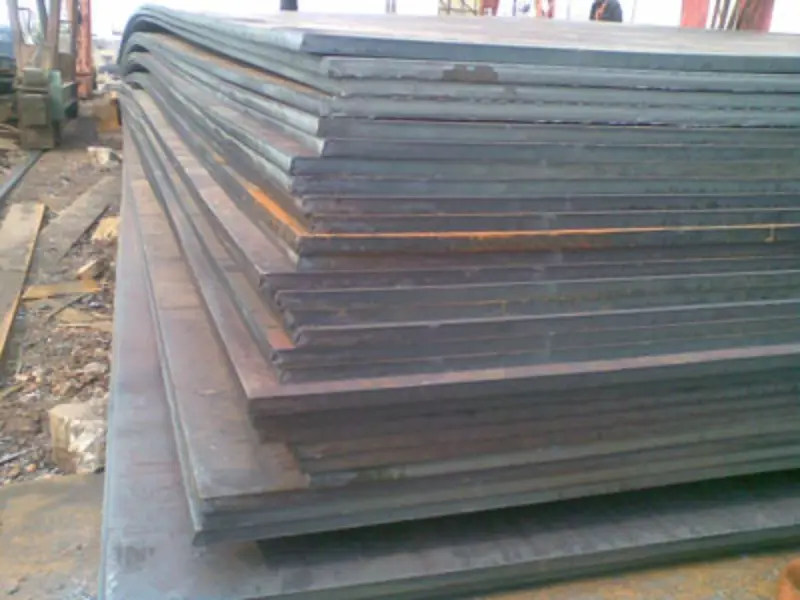
RINA F500 Shipbuilding Steel
RINA F500 Shipbuilding Steel: Premium High-Strength Structural Steel for Marine and Offshore Engineering
RINA F500 is a high-strength hull structural steel complying with Registro Italiano Navale rules, ensuring 500 MPa minimum yield, excellent low-temperature toughness and weldability for demanding marine environments.
Hot rolling, Thermomechanical Controlled Processing (TMCP), normalizing rolling, cold forming, machining, welding (under controlled heat input and preheat if required), plasma/laser cutting
- Phone : +8618037372205
- Email : [email protected]
- WhatsApp: Contact via Whtsapp
- WeChat: +8618037372205
RINA F500 Shipbuilding Steel Introduction
RINA F500 is a high-strength, fine-grain structural steel grade specifically designed for shipbuilding and offshore structures, governed by the Registro Italiano Navale (RINA) classification society rules. Produced via thermomechanical controlled processing (TMCP) or normalizing rolling, it delivers a minimum yield strength of 500 MPa, outstanding impact toughness at temperatures as low as -60 °C, and reliable weldability with proper procedures. This steel enables weight reduction in vessel construction while maintaining robustness against harsh marine conditions, fatigue, and brittle fracture. It is typically supplied in plate, coil, and section forms for critical structural members of large container vessels, bulk carriers, tankers, and offshore platforms. Its balanced chemistry, including microalloying elements like niobium, vanadium, and titanium, ensures uniform mechanical properties across a wide range of thicknesses.
RINA F500 Shipbuilding Steel Chemical Composition
The chemical composition of RINA F500 is controlled to ensure high strength, excellent weldability, and low-temperature toughness. Typical limits as per RINA Rules are listed below. Microalloying elements such as
- Nb, V, Ti are added for grain refinement and precipitation strengthening.
- Cu, Cr, Ni are kept low to maintain weldability, but may be present as residuals.
- Nitrogen is intentionally limited to avoid strain aging and ensure notch toughness.
Actual values must comply with the applicable inspection document and may be further restricted by the purchaser.
| Element | Standard Value (≤) | Remarks |
|---|---|---|
| Carbon (C) | 0.18 | Higher C increases strength but reduces weldability |
| Silicon (Si) | 0.55 | Deoxidizer, contributes to strength |
| Manganese (Mn) | 0.90 – 1.70 | Enhances strength and hardenability; upper limit often 1.60 for FH-grade |
| Phosphorus (P) | 0.025 | Lower for improved toughness and weldability |
| Sulfur (S) | 0.025 | Controlled for formability and toughness |
| Aluminum total (Al) | ≥ 0.015 | Grain refining element |
| Niobium (Nb) | 0.05 | Promotes fine grain structure |
| Vanadium (V) | 0.10 | Precipitation strengthening |
| Titanium (Ti) | 0.05 | Grain refinement; binds nitrogen |
| Copper (Cu) | 0.35 | Residual element |
| Chromium (Cr) | 0.25 | Residual element |
| Nickel (Ni) | 0.40 | Residual element; enhances toughness |
| Molybdenum (Mo) | 0.08 | Residual element |
| Nitrogen (N) | 0.009 | Maximized to ensure toughness; higher N may require Ti addition |
RINA F500 Shipbuilding Steel Thermal, Electrical and Physical Properties
These physical properties are representative of RINA F500 steel and are not mandatory specification items. They are useful for design calculations involving heat transfer, structural analysis, and electrical applications.
- Density and modulus values are consistent with low-alloy steels.
- Thermal expansion coefficient is average for the range 20–100 °C.
- Electrical resistivity and thermal conductivity are typical for ferritic steels.
| Physical Property | Typical Value | Unit | Conditions |
|---|---|---|---|
| Density (ρ) | 7850 | kg/m³ | 20 °C |
| Elastic Modulus (E) | 210 | GPa | 20 °C |
| Shear Modulus (G) | 81 | GPa | 20 °C |
| Poisson's Ratio (ν) | 0.3 | – | In elastic range |
| Thermal Expansion Coefficient (α) | 12.1 × 10⁻⁶ | K⁻¹ | 20–100 °C |
| Thermal Conductivity (λ) | 45 | W/(m·K) | 100 °C |
| Specific Heat Capacity (cp) | 460 | J/(kg·K) | 20–100 °C |
| Electrical Resistivity (ρe) | 0.25 × 10⁻⁶ | Ω·m | 20 °C |
RINA F500 Shipbuilding Steel Mechanical Properties
Mechanical properties are determined on test pieces in the as-delivered condition. Values depend on product thickness. RINA F500 is a high-strength grade with a minimum yield strength of 500 MPa. Impact toughness is verified at -60 °C (F-grade) with Charpy V-notch longitudinal specimens. Multiple thickness ranges are shown where properties differ. Bending test requirements ensure formability without cracking.
| Property | Standard Requirement | Unit | Test Conditions / Thickness Range |
|---|---|---|---|
| Yield Strength (ReH) | ≥ 500 | MPa | t ≤ 50 mm |
| Yield Strength (ReH) | ≥ 460 | MPa | 50 < t ≤ 100 mm |
| Tensile Strength (Rm) | 610 – 770 | MPa | t ≤ 100 mm |
| Elongation (A5) | ≥ 17 | % | t ≤ 50 mm (gauge length 5.65√S) |
| Elongation (A5) | ≥ 15 | % | 50 < t ≤ 100 mm |
| Charpy Impact (KV2, longitudinal) | ≥ 41 | J | At -60 °C (F-grade) |
| Bend Test (D = mandrel dia, a = thickness) | D = 3a, 180° | – | For tensile test confirmation; no cracks |
RINA F500 Shipbuilding Steel Complete Equivalents: International Grades Matching RINA F500
| Country / Region | Standard | Grade | Remarks |
|---|---|---|---|
| International | ABS (American Bureau of Shipping) | FH50 | Equivalent F-grade, 500 MPa yield, -60 °C impact |
| Norway / Germany | DNV (Det Norske Veritas) | F500 | Identical mechanical and chemical requirements |
| France | BV (Bureau Veritas) | FH500 | Class notation FH500, recognized worldwide |
| UK | LR (Lloyd's Register) | FH50 | Equivalent for high-strength hulls |
| Japan | NK (Nippon Kaiji Kyokai) | KF500 | Equivalent strength and toughness level |
| China | CCS (China Classification Society) | F500 | Direct equivalent under CCS rules |
| South Korea | KR (Korean Register) | F500 | Equivalent notation for high-strength plates |
| Russia | RS (Russian Maritime Register) | F500 | Corresponds to RS F500 grade |
RINA F500 Shipbuilding Steel Application Introduction
RINA F500 is engineered for weight-critical marine structures that require exceptional yield strength and reliability at sub-zero temperatures. Its high strength-to-weight ratio allows designers to reduce plate thickness, cutting material and fuel costs. To maintain weld quality and toughness, mild preheat and low-hydrogen procedures are recommended, especially for thick sections.
Product Applications: Container ships, bulk carriers, oil tankers, LNG carriers, Jack-up rig legs, semi-submersible columns, jacket braces, Heavy-lift ship cranes and deck structures, Ferry and RoRo vessels, cruise ship reinforcements, Permanent and mobile offshore units
Processed into products: Longitudinal and transverse hull plates (deck, bottom, side shell), Longitudinal bulkheads, stringers, and sheer strakes, Bottom transverses, floors, and deep girders, Hatch coaming tops, crane pedestal reinforcements, Transition joints, pad eyes, and lifting lugs
Application industries: Shipbuilding (merchant vessels, naval ships, mega yachts), Offshore oil & gas (platforms, floating production units), Marine renewable energy (offshore wind turbine foundations, tidal structures), Port and terminal equipment (crane booms, ship unloaders), Ice-going vessels and icebreakers (where low-temperature toughness is critical)
RINA F500 Shipbuilding Steel Similar / Alternative Materials with Approximated Performance
| Country / Region | Standard | Grade | Remarks |
|---|---|---|---|
| International | RINA | EH36 / FH36 | Lower yield strength (355 MPa), but similar welding and toughness characteristics; suitable for less stressed parts. |
| International | RINA | AH50 / DH50 / EH50 | Same 500 MPa yield strength but with higher impact test temperatures (0 °C, -20 °C, -40 °C respectively). F500 retains the best low-temperature performance. |
| International | EN 10025 | S500Q / S500QL / S500QL1 | Comparable strength structural steel with guaranteed toughness at -20 °C / -40 °C / -60 °C; not specifically a shipbuilding grade but used in offshore structures. |
| International | API | 2W Grade 50 | High-strength steel for offshore platforms with similar yield but different certification regime. |
Notes:
RINA F500 is a notch-tough steel grade typically supplied with inspection certificates (3.1 or 3.2 per EN 10204). For welding, low-hydrogen electrodes or wires matching the steel's strength level (e.g., AWS A5.28 E110C-G or equivalent) are suggested; preheat temperature may be required based on thickness and carbon equivalent (CEV). CEV is generally limited to ≤0.43% to assure cold cracking resistance. Ultrasonic testing, per RINA Part D, is often mandatory for plates above a certain thickness used in critical structural members. Contact the mill or classification society for the most current specification.
- Share



