
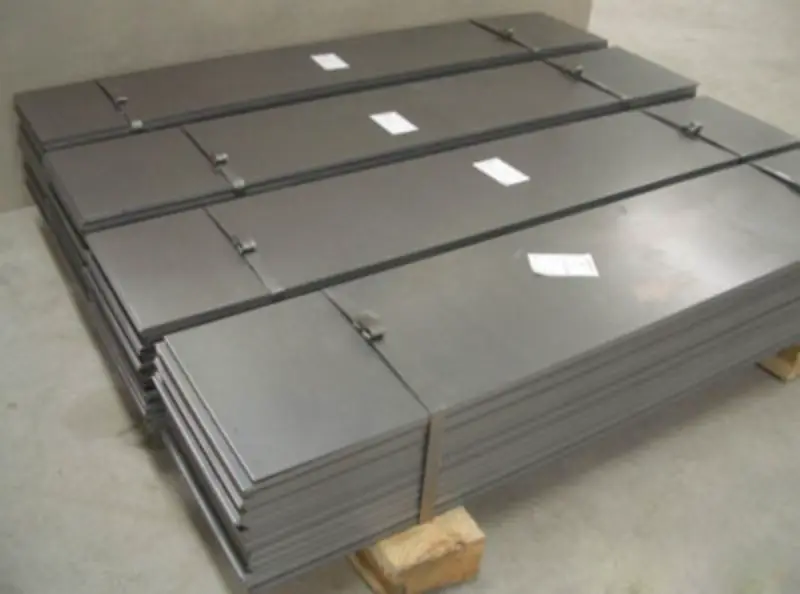
Austenitic 321H (S32109) Stainless Steel Plate/Coil
Austenitic 321H (S32109) Stainless Steel Plate/Coil - High-Temperature Strength & Corrosion Resistance
Detailed technical data for 321H (UNS S32109) austenitic stainless steel plate and coil. Chemical composition, mechanical and thermal properties per ASTM A240, plus international equivalents and application guidance.
Hot rolling, cold rolling, solution annealing (typically 1050°C water quench), pickling, cutting, forming, welding
- Phone : +8618037372205
- Email : [email protected]
- WhatsApp: Contact via Whtsapp
- WeChat: +8618037372205
Austenitic 321H Stainless Steel Plate/Coil Introduction
Austenitic 321H stainless steel (UNS S32109) is the high-carbon version of Type 321, distinguished by its elevated carbon content (0.04–0.10%) which provides improved high-temperature strength and creep resistance. As a titanium-stabilized alloy, it effectively resists intergranular corrosion after exposure to temperatures in the chromium carbide precipitation range (427–816°C). This makes 321H ideal for applications where post-weld annealing is impractical and where elevated temperature performance is required. The material is typically supplied as plate, sheet, coil or strip in the solution-annealed condition. It exhibits excellent oxidation resistance up to approximately 816°C and possesses good toughness even at cryogenic temperatures. Key features:
- Titanium stabilization prevents sensitization and intergranular attack
- Higher carbon content delivers superior creep and stress rupture properties
- Weldable by common fusion and resistance methods
- Resistant to a wide range of organic and inorganic chemicals
Austenitic 321H Stainless Steel Plate/Coil Chemical Composition
Typical chemical composition limits for 321H stainless steel per ASTM A240. The titanium addition is carefully controlled to be at least five times the total carbon plus nitrogen content, ensuring effective stabilization against chromium carbide precipitation during service in the sensitization range. All values are in weight percent.
| Element | Specification (wt%) | Notes |
|---|---|---|
| Carbon (C) | 0.04 – 0.10 | Higher carbon provides improved high-temperature strength |
| Manganese (Mn) | ≤ 2.00 | |
| Phosphorus (P) | ≤ 0.045 | |
| Sulfur (S) | ≤ 0.030 | |
| Silicon (Si) | ≤ 0.75 | |
| Chromium (Cr) | 17.0 – 19.0 | Key element for corrosion and oxidation resistance |
| Nickel (Ni) | 9.0 – 12.0 | Austenite former |
| Titanium (Ti) | 5 × (C + N) min, 0.70 max | Stabilizes carbon and nitrogen to prevent sensitization |
| Nitrogen (N) | ≤ 0.10 |
Austenitic 321H Stainless Steel Plate/Coil Thermal and Electrical Physical Properties
Typical physical properties for 321H stainless steel in the annealed condition. These values are averaged over a range of measured data and are suitable for engineering calculations. Thermal conductivity increases with temperature, while the coefficient of thermal expansion exhibits a steady rise up to the maximum service limit. Electrical resistivity is relatively high, typical of austenitic stainless steels.
| Property | Typical Value | Unit | Test Condition |
|---|---|---|---|
| Density (ρ) | 7.9 – 8.0 | g/cm³ | 20°C |
| Elastic Modulus (E) | 193 | GPa | 20°C |
| Shear Modulus (G) | 77 | GPa | 20°C |
| Poisson's Ratio (ν) | 0.30 | — | 20°C |
| Thermal Expansion Coeff. (α) | 16.5 | µm/m·°C | 20–100°C |
| Thermal Expansion Coeff. (α) | 17.5 | µm/m·°C | 20–300°C |
| Thermal Expansion Coeff. (α) | 18.0 | µm/m·°C | 20–500°C |
| Thermal Expansion Coeff. (α) | 19.0 | µm/m·°C | 20–700°C |
| Thermal Conductivity (λ) | 14.9 | W/m·K | 20°C |
| Thermal Conductivity (λ) | 15.1 | W/m·K | 100°C |
| Thermal Conductivity (λ) | 18.7 | W/m·K | 500°C |
| Specific Heat Capacity | 500 | J/kg·K | 0–100°C |
| Electrical Resistivity (ρe) | 0.72 | µΩ·m | 20°C |
Austenitic 321H Stainless Steel Plate/Coil Mechanical Properties
Room-temperature tensile properties and hardness requirements per ASTM A240 for 321H plate/coil in the solution-annealed condition. The alloy exhibits a fully austenitic structure with excellent ductility. Mechanical properties at elevated temperatures are significantly influenced by the carbon content and heat treatment. Bend testing is performed to verify formability.
| Property | Specification | Unit | Test Condition |
|---|---|---|---|
| Tensile Strength (Rm) | ≥ 515 | MPa | Room temperature, ASTM A370 |
| Yield Strength (Rp0.2) | ≥ 205 | MPa | Room temperature, 0.2% offset |
| Elongation (A) | ≥ 40 | % | Thickness ≤ 19.0 mm, gauge length 50 mm |
| Elongation (A) | ≥ 35 | % | Thickness > 19.0 mm, gauge length 50 mm |
| Hardness, Brinell | ≤ 217 | HB | Room temperature |
| Hardness, Rockwell B | ≤ 95 | HRB | Room temperature |
| Bend Test | Bend angle 180°, no cracks | — | Thickness ≤ 19.0 mm, bend diameter = 2 × thickness |
Austenitic 321H Stainless Steel Plate/Coil Equivalent Material Standards and Substitute Grades
| Country/Region | Standard | Grade | Remarks |
|---|---|---|---|
| USA | ASTM A240/A240M | 321H (UNS S32109) | Original specification, high carbon heat resistant |
| European Union | EN 10088-2 / EN 10028-7 | 1.4941 (X6CrNiTi18-10) | Fully equivalent titanium stabilized grade for high temperature |
| Japan | JIS G4304 / G4305 | SUS321H | Direct equivalent |
| China | GB/T 4237 / GB/T 4238 | 12Cr18Ni11Ti | High carbon variant, matched composition |
Austenitic 321H Stainless Steel Plate/Coil Application Introduction
321H stainless steel is engineered for sustained service at elevated temperatures where both strength and corrosion resistance are needed. Its titanium stabilization prevents harmful carbide precipitation, making it the preferred choice for welded structures that cannot be annealed after fabrication. Typical sectors:
Product Applications: Heat exchangers and superheater tubing, Expansion bellows and joints, Pressure vessels and high-temperature ducting, Thermal oxidizer components, Afterburner and exhaust system parts for aircraft, Furnace muffles, retorts, and annealing boxes, Weldments in petrochemical plants (catalyst tubes, reformer tubes)
Processed into products: Boiler and superheater tubesheets, High-temperature gaskets and seals, Tailpipes and collector boxes, Industrial oven linings, Refinery heater tubes, Welded structural parts operating in the sensitization range (427–816°C), Fasteners (bolts, nuts) for high-temperature service
Application industries: Petrochemical and oil refining, Chemical processing, Power generation (fossil and nuclear), Aerospace and aircraft exhaust systems, Thermal processing equipment, Automotive thermal management, Furnace and heat treatment manufacturing
Austenitic 321H Stainless Steel Plate/Coil Similar / Alternative Materials
| Country/Region | Standard | Grade | Remarks |
|---|---|---|---|
| USA | ASTM A240 | 321 (S32100) | Lower carbon (max 0.08%); reduced high-temperature strength but similar corrosion resistance |
| USA | ASTM A240 | 304H (S30409) | High carbon 18-8 stainless without titanium; may be susceptible to sensitization after welding |
| USA | ASTM A240 | 316H (S31609) | High carbon Mo-bearing grade; better pitting resistance but less stabilization |
| USA | ASTM A240 | 347H (S34709) | Niobium-stabilized high carbon grade; comparable strength but uses Nb instead of Ti |
| European Union | EN 10088-2 | 1.4541 (321) | Standard titanium-stabilized grade with lower carbon; suitable where high-temperature strength is not critical |
Notes:
Welding recommendations: 321H can be welded by all common processes. When matching filler metal is required, use AWS A5.9 ER321 or E321-XX electrodes. Because of its titanium stabilization, preheat and post-weld heat treatment are generally not necessary to prevent intergranular attack. However, in highly corrosive environments, a solution anneal after welding may improve corrosion resistance. The maximum service temperature in air is around 816°C (1500°F), but scaling resistance decreases in sulfur-containing atmospheres. For cryogenic applications, the alloy retains excellent toughness and can be used down to -196°C. Caution: Any deviation from the specified carbon range can significantly affect high-temperature mechanical properties; always verify that material certifications match ASTM A240 requirements for 321H.
- Share



