
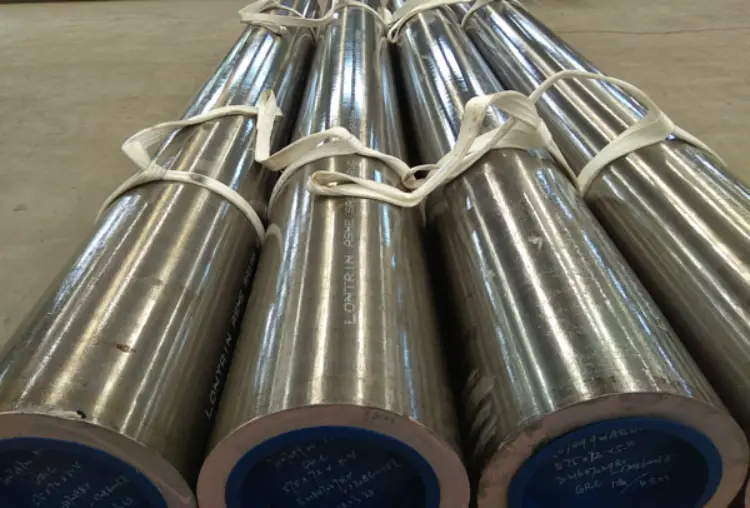
DIN 17400 1.4016 Stainless Steel Pipe
DIN 17400 1.4016 Stainless Steel Pipe: Ferritic Corrosion-Resistant Alloy for Industrial Applications
Explore the technical data of 1.4016 stainless steel pipe under DIN 17400, a ferritic chromium steel with good corrosion resistance and formability for automotive, catering, and architectural uses.
Cold drawing, cold rolling, bending, deep drawing, stamping, welding (with preheating and post-weld annealing recommended)
- Phone : +8618037372205
- Email : [email protected]
- WhatsApp: Contact via Whtsapp
- WeChat: +8618037372205
DIN 17400 1.4016 Stainless Steel Pipe Introduction
1.4016 (X6Cr17) is a ferritic stainless steel specified in the historical German standard DIN 17400, now superseded by EN 10088-1 and EN 10028-7. It contains approximately 16-18% chromium and a maximum of 0.08% carbon, offering good resistance to corrosion in mildly aggressive environments such as fresh water, steam, and atmospheric conditions. The steel is non-hardenable by heat treatment and exhibits moderate strength and ductility. It is magnetic and readily formed, welded with care, and widely used in applications where cost-effective stainless performance is required without the need for high-temperature strength or severe chemical resistance. The pipe form is commonly delivered in annealed and pickled condition.
DIN 17400 1.4016 Stainless Steel Pipe Chemical Composition
The chemical composition of 1.4016 stainless steel pipe according to DIN 17400 and its successor EN 10088-1. Sulfur and phosphorus are controlled to ensure good weldability and formability. Chromium provides the fundamental corrosion resistance. The carbon content is limited to avoid excessive hardening and maintain ferritic structure.
| Chemical Element | Standard Value (wt.%) | Remarks |
|---|---|---|
| Carbon (C) | ≤ 0.08 | Max. limit per melt analysis |
| Silicon (Si) | ≤ 1.00 | Typical range 0.3-1.0% |
| Manganese (Mn) | ≤ 1.00 | Typical range 0.3-1.0% |
| Phosphorus (P) | ≤ 0.040 | Max. limit |
| Sulfur (S) | ≤ 0.015 | For improved weldability; controlled to 0.015 max. |
| Chromium (Cr) | 16.00 - 18.00 | Key element for corrosion resistance |
| Nickel (Ni) | ≤ 0.75 | Residual; may be present in small amounts |
| Iron (Fe) | Balance | Approx. 81.1 - 83.9% |
DIN 17400 1.4016 Stainless Steel Pipe Thermal and Electrical Physical Properties
Physical properties of 1.4016 stainless steel at room temperature and elevated temperatures, useful for design in thermal applications. The coefficient of thermal expansion is lower than that of austenitic grades, which reduces thermal stresses. The material is magnetic at all temperatures.
| Property | Standard Requirement Value | Unit | Test Condition |
|---|---|---|---|
| Density (ρ) | 7.70 | kg/dm³ | At 20°C |
| Modulus of Elasticity (E) | 220 | GPa | At 20°C (longitudinal) |
| Shear Modulus (G) | 85 | GPa | At 20°C (calculated) |
| Poisson's Ratio (ν) | 0.28 - 0.30 | - | At 20°C |
| Mean Coefficient of Thermal Expansion (α) | 10.0 | 10⁻⁶/K | 20-100°C |
| Mean Coefficient of Thermal Expansion (α) | 10.5 | 10⁻⁶/K | 20-200°C |
| Mean Coefficient of Thermal Expansion (α) | 11.0 | 10⁻⁶/K | 20-400°C |
| Thermal Conductivity (λ) | 25.0 | W/(m·K) | At 20°C |
| Thermal Conductivity (λ) | 26.1 | W/(m·K) | At 100°C |
| Specific Heat Capacity (c) | 460 | J/(kg·K) | At 20°C |
| Electrical Resistivity (ρ_e) | 0.60 | Ω·mm²/m | At 20°C |
DIN 17400 1.4016 Stainless Steel Pipe Mechanical Properties
Mechanical properties at room temperature for 1.4016 pipe in the soft-annealed condition (+A) according to DIN 17400 and aligned with EN 10088-3 for long products (tube properties may vary). Values are for wall thickness ≤ 75 mm. Higher strength can be achieved by cold working, but at the expense of ductility. The material is not intended for impact-critical applications at low temperatures due to its ferritic structure.
| Property | Standard Requirement Value | Unit | Test Condition |
|---|---|---|---|
| Yield Strength (ReH) - transverse | ≥ 240 | MPa | Room temperature, as delivered +A |
| Tensile Strength (Rm) - transverse | 450 - 600 | MPa | Room temperature |
| Elongation (A) - longitudinal | ≥ 20 | % | Gauge length L0 = 5.65√S0 |
| Bend Test (bend angle / mandrel diameter) | 180° / Ø ≥ 1 × t | ° / mm | For sheets and strips; tube bending may require larger radius |
| Hardness (HB) | ≤ 183 | HB | Annealed condition (typical 170-183) |
| Hardness (HV) | ≤ 190 | HV | Annealed condition |
| Impact Energy (KV) at 20°C | ≥ 55 (longitudinal) | J | Only required if specified; ferritic grades may show transition temperature |
DIN 17400 1.4016 Stainless Steel Pipe Fully Equivalent Material Standards and Replaceable Grade Recommendations
| Country/Region | Standard | Grade | Remarks |
|---|---|---|---|
| European Union | EN 10088-1 | X6Cr17 (1.4016) | Current European standard; identical material |
| Germany | DIN 17440 (historical) | X6Cr17 (1.4016) | Original designation, now replaced |
| USA | ASTM A240 / A276 | AISI 430 (UNS S43000) | Chemical and mechanical equivalence for flat and long products |
| Japan | JIS G4304 / JIS G4303 | SUS430 | Close equivalent; minor compositional variations |
| China | GB/T 3280 / GB/T 1220 | 10Cr17 (old 1Cr17) | Equivalent ferritic stainless steel |
| International | ISO 15510 | X6Cr17 | International designation |
DIN 17400 1.4016 Stainless Steel Pipe Application Introduction
1.4016 stainless steel pipe is used in moderate corrosion environments and where cost and magnetic properties are advantageous. Its formability and oxidation resistance up to about 800°C make it suitable for many industrial and consumer products.
Product Applications: Automotive exhaust components and decorative trim, Architectural panels and curtain wall supports, Kitchen sinks, backsplashes, and food preparation tables, Chemical storage tanks (for mild acids like nitric acid at low concentration), Domestic appliances: oven linings, washing machine tubs, Metal furniture: chairs, tables, shelving systems, Heat exchanger tubes for low-chloride water services
Processed into products: Welded structural brackets and supports, Deep-drawn sinks and basins, Rolled rings and flanges for light chemical service, Machined valve bodies for water treatment, Bent tube handrails and grab bars, Stamped clips, brackets, and fasteners
Application industries: Automotive (exhaust systems, trim, manifolds), Architecture and construction (handrails, cladding, decorative tubing), Food processing and catering (sinks, worktops, utensils), Chemical and petrochemical (mild acid storage tanks, piping for non-severe media), Furniture manufacturing (frames, supports), Appliance industry (washing machine drums, dishwasher interiors), Heat exchanger manufacturing (non-chloride water systems)
DIN 17400 1.4016 Stainless Steel Pipe Similar and Substitute Materials Recommendations
| Country/Region | Standard | Grade | Remarks |
|---|---|---|---|
| European Union | EN 10088-1 | X3CrTi17 (1.4510) | Titanium-stabilized ferritic grade; improved weldability and intergranular corrosion resistance |
| European Union | EN 10088-1 | X2CrMoTi18-2 (1.4521) | Molybdenum-added ferritic; higher pitting corrosion resistance |
| USA | ASTM A240 | Type 439 (UNS S43035) | Titanium-stabilized 17% Cr alloy; better weld properties, often replaces 430 for tube applications |
| Japan | JIS G4304 | SUS430LX | Ti/Nb-stabilized 17Cr ferritic; improved formability after welding |
| Global | - | AISI 434 (UNS S43400) | Mo-modified ferritic; enhanced corrosion resistance compared to 430, suitable for some pipe applications |
Notes:
Welding: Preheating to 200-300°C and post-weld annealing at 750-800°C followed by rapid cooling are recommended to restore ductility and corrosion resistance. Corrosion: Susceptible to intergranular corrosion if sensitised; not recommended for welding thick sections without stabilisation. Magnetic: Always magnetic, unlike austenitic grades. Surface finish: Available in pickled, bright annealed, or polished finishes to meet aesthetic requirements. Pipe dimensions: Typically produced in the range of OD 6 mm to 406.4 mm and wall thickness 1.0 to 15.24 mm, as per EN 10216-5 and EN 10217-7.
- Share



